Lambaris in public reservoirs (nationwide)
01/11 to 28/02
Closed season for tambiú (yellowtail lambari) and redtail lambari in public reservoirs nationwide.
Source: IN IBAMA nº 51/2004
Astyanax lacustris · Characidae · forage fish
The bamboo-pole fish. Many people's first fish, universal live bait and fried riverbank snack.
Also called: lambari, lambari-do-rabo-amarelo, tambiú, piaba


Choose the place and the species. The index, from 0 to 100, combines weather, sun, moon and tide with each fish's habits. Up to 28 days, with each day's confidence.
Reading the weather across 3 global models and 31 simulations…
Each card shows the day's index (0 to 100) and, below it, a strip with the index for each hour, from 0h to 23h. from poor to excellent.
Choose how many fishing days. We compare each stretch by its average index, discount days with a warning or closed season, and show the 3 best.
Line: the middle value of 31 simulations of the American GEFS model. Band: where 8 out of 10 fall. Narrow, firm trend; wide, high uncertainty.
Small schooling characin, found in rivers, streams, lagoons and reservoirs of the Center-South. Eats just about anything: insects, seeds, algae and scraps. It is the first fish for many anglers, caught with a bamboo rod, quill float and dough. For sport anglers it is the live bait most used for trahira, peacock bass, golden dorado and black bass. It breeds several times a year and grows fast, so it holds up well to fishing pressure. Caught in quantity, it becomes the classic fried lambari. Follow local rules on catching and transporting live bait.
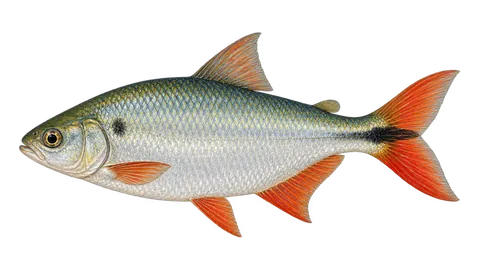
Small silver body with a greenish back. Long dark spot behind the head (umeral) and a dark spot at the base of the tail. Caudal fin yellow to orange. Other lambaris (red-tail, bocarra) have red tails or a bigger mouth. Piraputanga juveniles have red fins.
Upper Paraná, Pantanal and São Francisco: rivers, streams, lagoons, reservoirs and small farm ponds.
Habitat: Vegetated banks, slack water, small beaches, streams and reservoirs; schools near the surface.
native to the basins
states
São Paulo, Minas Gerais, Goiás, Paraná, Mato Grosso do Sul, Mato Grosso, Bahia
Spring and summer. In winter the schools go deeper and slower.
Daytime. Active all day; most aggressive in the morning and late afternoon.
Cold days scatter the school.
Little effect.
No significant effect.
Light rain doesn't matter.
Small effect; look for slack water.
Tolerant; the chum holds the school.
Wind makes it hard to see the float.
Surface, 1 m.
lures
natural baits
accessories
Chum with fine cracked corn and cast the float into the middle of the school. Set the hook on the first dip, with a short wrist flick.
For anyone who's never fished and wants a simple kit for a pay lake, lake, reservoir or calm river, with natural bait.
guideFor anyone who has never fished: license, where to go, a cheap kit that works, how to rig a bobber line, how to bait the hook and what to do when the fish bites.
guideHow to take a child fishing without scares: life jacket and supervision, hook and spine safety, gear that won't tangle, how to keep the fun going, and what the law says about licenses for minors.
Summary of the regulations we found, with the source for each. Rules change; before keeping or transporting fish, check with the state environmental agency.
Conservation: Formerly called Astyanax altiparanae.
Closed season for tambiú (yellowtail lambari) and redtail lambari in public reservoirs nationwide.
Source: IN IBAMA nº 51/2004
Allowed: Recreational fishing only for non-native species and hybrids (peacock bass, tilapia, black bass, carp, croaker, etc.; piauçu remains prohibited), with handline, simple pole, or rod with spinning or baitcasting reel, up to 10 kg + 1 fish. In rivers, from shore only; in reservoirs, from a boat or from shore. Prohibited: floodplain lakes, aquatic-animal bait, within 1,500 m of dams and waterfalls, and within 500 m of confluences. Tournaments only in reservoirs and only with non-native species.
Source: IN IBAMA nº 25/2009
Allowed: Only exotic or hybrid species, 3 kg + 1 fish per day, with handline, rod, simple pole, or spinning or baitcasting reel. Nets prohibited. Keep the minimum distances from dams and reservoirs.
Source: Portarias IEF nº 154/2011 (São Francisco), 155/2011 (East) and 156/2011 (Grande/Paranaíba)
Allowed: Sport and guided fishing only in reservoirs, catch and release with barbless hooks (no keeping, transporting or eating). Subsistence: up to 5 kg per day, for household consumption only.
Allowed: Subsistence fishing by riverside residents and authorized scientific fishing. Decree 15.166/2019 (art. 11, §5) allows catch and release only in February and only in the channels of the Paraguay and Paraná rivers. For the rest of the period, not even catch and release is allowed. Check the Imasul portaria for each season.
Source: Decreto estadual MS nº 15.166/2019, art. 11; IN IBAMA nº 201/2008
Allowed: All fishing modalities are prohibited in rivers, including catch and release (Law 9.096/2009, art. 19-A). Exceptions: subsistence fishing from shore (3 kg or 1 fish, no transport or sale) and scientific fishing. Law 13.159/2025 now allows licensed sport fishing in UHE/PCH hydropower reservoirs, natural lakes and border rivers, subject to a scientific study and a license from the environmental agency. We have not confirmed whether these licenses are already being issued.
Allowed: Recreational fishing from a boat or from shore with handline, rod, spinning or baitcasting reel, up to 5 kg + 1 fish. Prohibited within 1,000 m of dams, waterfalls and rapids, and within 500 m of confluences. Floodplain lakes have a longer closed season (see next item).
Source: Portaria IBAMA nº 50/2007
Allowed: No fishing in the floodplain lakes during the period.
Source: Portaria IBAMA nº 50/2007
Fragile fish: wet your hand before picking it up and release it quickly.
A whole fried lambari, crispy, is a classic riverbank snack.
Length-weight relationship W = a·Lb (a = 0.01862, b = 3.07; FishBase). It's an average: a fat or lean fish can vary by 10% to 20%.
estimated weight
—
The season weights (months), the time of day and the sensitivities (cold, pressure, moon, wind, rain, tide, strong light, murky water and noise) are the app's editorial estimates, based on the literature below and on the field experience of anglers and guides. They are not official data nor a measurement made for this species, and they may vary by region and year. Closed seasons and legal rules appear in the rules section, with the norm and a link.
The weather comes from three independent global models, cross-checked hour by hour: when they agree, confidence goes up; when they diverge, the band between them shows on the chart. Beyond 16 days, we use the GEFS ensemble of 31 simulations: if 20 of the 31 predict rain, the chance of rain is 65%. Sun and moon are calculated astronomically, with no uncertainty.
The index adds up, weighted for each species: time of day (species curve anchored to real sunrise and sunset), moon (transits, rise and set, phase), pressure (3 h trend and 24 h swing), water temperature (in rivers, estimated from air temperature; at sea, estimated by an ocean model), wind, rain, clouds, tide and the month in the species' cycle.
Accuracy measured in the reference project (4 regions, 93 days, forecast vs. observed): maximum temperature is off by 0.6 °C on average the next day and 1.7 °C at 7 days; rain of 5 mm or more is detected 76% of the time the next day and 57% at 7 days. Detection isn't everything: the false alarm rate isn't published here yet, and 93 days in 4 regions is still a small sample. We now also measure every day, at the app's destinations:
Your location is saved only on this device and feeds the forecast, the map and the "today" on the home page.