

- common size
- 60–90 cm
- maximum
- 125 cm
- common weight
- 2.5–9.5 kg
- record/max.
- 30.0 kg
- depth
- 80–540 m
- ideal water
- 9–14 °C

the right time
to be on the water
Choose the place and the species. The index, from 0 to 100, combines weather, sun, moon and tide with each fish's habits. Up to 28 days, with each day's confidence.
Loading the forecast…
—
Looking for alerts within 30 km…
Looking for what anglers have logged near here…
what you need to fish herelicense, certification and boat documents
fish likely at this spot
Tap a fish to see its forecast.
hour by hour
slide your finger or mouse over the chart to see each hoursee hour-by-hour table
why this index at —?
choose the day
the fishing month at a glance
what's the best window for the crew?
Choose how many fishing days. We compare each stretch by its average index, discount days with a warning or closed season, and show the 3 best.
trend for the coming weeks
Line: the middle value of 31 simulations of the American GEFS model. Band: where 8 out of 10 fall. Narrow, firm trend; wide, high uncertainty.
everything about the great northern tilefish
how to recognize it
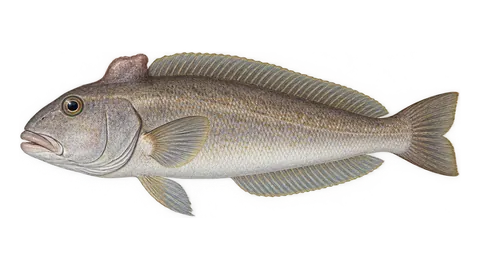
Elongated, sturdy body with a large fleshy crest on the nape, which separates it from other tilefishes (Caulolatilus). Iridescent blue-green back with yellow and golden spots, white belly and pinkish head, with blue under the eyes. In Brazil, the relative with the same crest is the peixe-batata (Lopholatilus villarii), from another geographic range: where the species occurs, location alone helps identification.
Also called: peixe-batata-do-norte, tilefish, golden tilefish, great northern tilefish
don't confuse with:
where found
open on the large mapWhere to look: Mud or sand bottoms, sometimes hard bottoms, on the shelf edge and slope, from 80 to 540 m and most common near 200 m. It occupies burrows dug into the sediment, especially in submarine canyons, in cold water.
Western Atlantic, from Nova Scotia (Canada) along the US coast and in the Gulf of Mexico (from Florida to Texas and along the Mexican coast from Tabasco to Yucatán), and in South America from the Gulf of Cariaco (Venezuela) to Suriname, according to FishBase. There are no records in Brazil: the equivalent species here is the peixe-batata (Lopholatilus villarii).
when to fish
best season
It lives in cold, deep water, so it hardly follows surface seasons; what decides when to go out is calm sea for drifting with a vertical line. In the Gulf of Mexico spawning runs from January to June (NOAA), when fish are more active.
best time of day
Daytime. Forages by day on the bottom (NOAA); fishing does best in daylight hours, with the drift well set.
what affects the great northern tilefish
cold and cold fronts
What matters is the bottom water (9 to 14 °C). A cold front at the surface hardly changes it; the 1882 die-off was linked to abnormally cold water on the bottom.
atmospheric pressure
Small effect at 200 m; the problem with the front is the sea it stirs up.
moon
Little influence at this depth; what matters is the bottom current.
rain
Rain does not bother the fish; it hurts comfort and visibility for drifting.
water level
Does not apply at sea. The equivalent is the current: with a fast drift, the sinker does not hold bottom.
noise
A burrow fish at 200 m, little affected by boat noise.
wind
Strong wind makes the boat drift fast and pulls the line off plumb, and the sinker stops touching bottom. Prefer calm seas.
tide
The bottom current sets the drift and the bait's position; a tide change can clean out the burrow and get the fishing going.
depth
Concentrated near 200 m, on mud and sand bottoms.
how to fish
lures
- bottom jig of 200 to 400 g (deep jigging)
- LED light or reflective tape above the dropper
natural baits
- squid strips
- sardine or mackerel in pieces
- shrimp
tip from an angler
Let the sinker touch the mud, reel up a few meters and keep the line taut in the drift: the species takes the bait close to the bottom.
- rod
- 5'6" to 6'6", heavy action with a firm tip, suited to deep fishing, 50 to 80 lb
- spinning / baitcasting reel
- electric reel or large deep-sea baitcasting reel, with 400 to 600 m of line
- line
- braided line 50 to 80 lb
- leader
- monofilament or fluorocarbon 80 to 130 lb, 2 to 3 m, with a hook dropper in line
- hook
- circle hook 8/0 to 12/0, on a dropper of two to four hooks
accessories
- heavy sinker (500 g to 1 kg, depending on the current)
- descending device to release what you will not keep
- gloves and pliers
catch and release
Pulled up from hundreds of meters, the fish suffers barotrauma and rarely recovers well once it reaches the surface. If you release it, use a descending device to return it to the bottom without delay. Since the species is classified as Endangered by the IUCN, keep only what you will eat.
rules for the great northern tilefish
Rules change; before keeping or transporting fish, check with the state environmental agency.
Mexico: up to 5 per species and 10 saltwater fish per day
5 specimens of the species per angler per day, within the limit of 10 saltwater fish details
In recreational sport fishing in Mexican federal waters, each angler may keep up to 10 marine fish per day, no more than 5 of the same species. The peixe-batata-do-norte (conejo amarillo) is not among the species reserved for sport fishing (marlin, sailfish, swordfish, dorado, roosterfish and tarpon) and has no quota of its own. Fish above the limit must be returned alive to the water, and sport-caught fish is for personal consumption, not for sale. Anglers fishing from a boat need a Conapesca permit.
Mexico (Gulf and Caribbean): up to 3 kg per day for domestic-consumption fishing
3 kg per angler per day, combining groupers and associated species details
In federal waters of the Gulf of Mexico and the Mexican Caribbean, the grouper rule lists the species (blanquillo camello or conejo amarillo) among the "associated species." For domestic-consumption fishing, each angler may take up to 3 kg per day of any grouper or associated species, only for personal and family consumption, not for sale, with equipment one person can operate alone. The Feb 1 to Mar 31 closure of that rule applies to groupers, not to associated species.
Source: NOM-065-SAG/PESC-2014 (DOF Jul 3, 2015), items 4.1 and 4.13 (Sagarpa/Conapesca)
Conservation: It does not occur in Brazil, so it is not on the national list (Portaria GM/MMA nº 1.667/2026). The IUCN global assessment, from 2013, classifies it as Endangered (A2bd). In the US, NOAA reports that the Gulf (2011 assessment) and South Atlantic (2025) stocks are not overfished, but the Mid-Atlantic stock is (2024). For the angler, caution is advised: keep little and release well. IUCN global: EN · endangered.
how much it weighs without taking it out of the water
estimated weight
—
how we calculate
Length-weight relationship W = a·Lb (a = 0.00776, b = 3.11; FishBase (relação peso-comprimento bayesiana, estimativa da própria espécie)). It's an average: a fat or lean fish can vary by 10% to 20%.
more about the great northern tilefish
The peixe-batata-do-norte (great northern tilefish; golden tilefish in the US) is one of the largest members of the family Malacanthidae and a close relative of the Brazilian peixe-batata. It lives in the western Atlantic, from Nova Scotia to the Gulf of Mexico, with Mexican records from Tabasco to Yucatán, and in South America from the Gulf of Cariaco, Venezuela, to Suriname. It occupies mud and sand bottoms near 200 m, in cold water at 9 to 14 °C, where it digs burrows. It eats shrimp and crabs, but also fish, squid, bivalves and sea cucumbers. It reaches 125 cm and 30 kg and can live up to 35 years. It is sensitive to cold: in 1882 a mass die-off left it rare for decades. In sport fishing, it is targeted on deep bottom trips with an electric reel.
Family: Latilidae · predator
fun facts
- In 1882, a mass die-off, linked to abnormally cold water, left the species rare for decades, according to FishBase.
- The genus Lopholatilus has only two species: this one, from the north, and the peixe-batata (L. villarii), from the south.
- It digs vertical burrows in the mud of submarine canyons, according to NOAA, and spends much of its life in them.
in the kitchen
White, firm flesh with a mild flavor, comparable to lobster or crab; sold fresh or frozen, it is good steamed, fried, grilled or baked. Note: the FDA (USA) lists Gulf of Mexico tilefish among the fish to avoid for pregnant women, nursing mothers and children, because of mercury.
similar species


sources and references (7)
The season weights (months), the time of day and the sensitivities (cold, pressure, moon, wind, rain, tide, strong light, murky water and noise) are the app's editorial estimates, based on the literature below and on the field experience of anglers and guides. They are not official data nor a measurement made for this species, and they may vary by region and year. Closed seasons and legal rules appear in the rules section, with the norm and a link.
- scientific FishBase: Lopholatilus chamaeleonticeps (ficha da espécie)Size, length-weight, depth, habitat, distribution, biology, and IUCN status. Page checked on Oct 13, 2026.
- scientific FishBase: nomes populares de Lopholatilus chamaeleonticepsNames by country and language.
- official NOAA Fisheries: Golden Tilefish (Lopholatilus chamaeleonticeps)Habitat in burrows, 250 to 1,500 feet (about 76 to 457 m), bottom temperature of 49 to 58 °F, diet, spawning, appearance and stock status in the US. Page checked on October 13, 2026.
- official FDA e EPA: Advice about Eating FishGulf of Mexico tilefish appears as a "choice to avoid" (higher mercury content) for pregnant women, nursing mothers and children aged 1 to 11. Page checked on October 13, 2026.
- scientific IUCN Red List: Lopholatilus chamaeleonticeps (avaliação global: Em perigo, A2bd, 2013)Search of the Red List by scientific name; classification per FishBase (version 2025-2).
- official NOM-017-PESC-1994 e sua modificação: pesca deportivo-recreativa em águas de jurisdição federal do MéxicoItem 4.9.1: up to 10 marine fish per angler per day, no more than 5 per species. The original text (DOF May 9, 1995) was also read at https://platiica.economia.gob.mx/normalizacion/wp-content/uploads/sites/2/PDF_Normas_Publicas/017-pesc.pdf.
- official NOM-065-SAG/PESC-2014: aproveitamento de meros e espécies associadas no Golfo do México e Mar Caribe (DOF 03/07/2015)Item 4.1 (list of associated species) and item 4.13 (domestic-consumption fishing: 3 kg per angler per day). We did not check whether there were changes after the 2015 text.
how we calculatewhere each number comes from
The weather comes from three independent global models, cross-checked hour by hour: when they agree, confidence goes up; when they diverge, the band between them shows on the chart. Beyond 16 days, we use the GEFS ensemble of 31 simulations: if 20 of the 31 predict rain, the chance of rain is 65%. Sun and moon are calculated astronomically, with no uncertainty.
The index adds up, weighted for each species: time of day (species curve anchored to real sunrise and sunset), moon (transits, rise and set, phase), pressure (3 h trend and 24 h swing), water temperature (in rivers, estimated from air temperature; at sea, estimated by an ocean model), wind, rain, clouds, tide and the month in the species' cycle.
sources for this lookup
how accurate the forecast is
Accuracy measured in the reference project (4 regions, 93 days, forecast vs. observed): maximum temperature is off by 0.6 °C on average the next day and 1.7 °C at 7 days; rain of 5 mm or more is detected 76% of the time the next day and 57% at 7 days. Detection isn't everything: the false alarm rate isn't published here yet, and 93 days in 4 regions is still a small sample. We now also measure every day, at the app's destinations: