

- common size
- 25–32 cm
- maximum
- 56 cm
- common weight
- 0.3–0.6 kg
- record/max.
- 0.7 kg
- depth
- 1–75 m
- ideal water
- 24–29 °C

the right time
to be on the water
Choose the place and the species. The index, from 0 to 100, combines weather, sun, moon and tide with each fish's habits. Up to 28 days, with each day's confidence.
Loading the forecast…
—
Looking for alerts within 30 km…
Looking for what anglers have logged near here…
what you need to fish herelicense, certification and boat documents
fish likely at this spot
Tap a fish to see its forecast.
hour by hour
slide your finger or mouse over the chart to see each hoursee hour-by-hour table
why this index at —?
choose the day
the fishing month at a glance
what's the best window for the crew?
Choose how many fishing days. We compare each stretch by its average index, discount days with a warning or closed season, and show the 3 best.
trend for the coming weeks
Line: the middle value of 31 simulations of the American GEFS model. Band: where 8 out of 10 fall. Narrow, firm trend; wide, high uncertainty.
everything about the saucereye porgy
how to recognize it
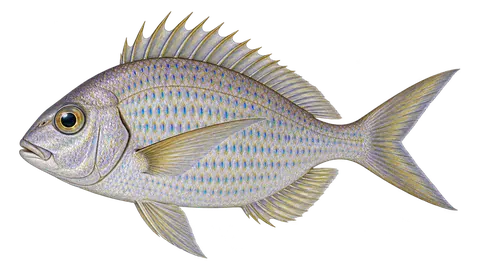
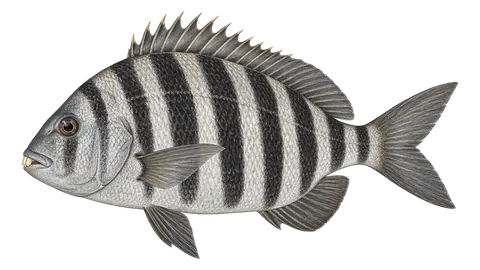
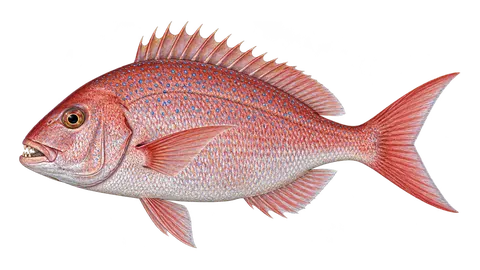
Tall, compressed body. The cheek is usually blue with yellow spots, and the blue scale markings are more linear than in other peixe-pena. There is no horizontal blue band above the gill cover opening, but a dark bluish spot is common just behind the top of that opening. It is confused with the peixe-pena (C. pennatula, vertical blue spots on the scales) and with the peixe-pena-bajonado (blue line under the eye and orange corner of the mouth).
Also called: peixe-pena-cálamo, peixe-pena, saucereye porgy, porgy
don't confuse with:
where found
open on the large mapWhere to look: Coral reefs (adults) and sand bottoms with seagrass (juveniles), from 1 to 75 m.
According to FishBase, it ranges from North Carolina and Bermuda to Brazil. In Brazil, the species' latitude range (37°N to 33°S) would cover all four coasts, but the exact southern limit was not confirmed. In Latin America, FishBase lists Mexico, the Caribbean coast of Central America, Colombia, Venezuela, the Guianas and the Caribbean islands.
coast
when to fish
best season
Resident fish, caught all year round. We found no seasonal calendar; the app's weights are estimates.
best time of day
Daytime. Feeds by day, on reefs and sand bottoms. At night porgies tend to shelter; we found no specific study. Editorial estimate.
what affects the saucereye porgy
cold and cold fronts
Warm-water fish (subtropical to tropical): cold water and a cold front slow fishing.
atmospheric pressure
A cold front with a choppy sea stops fishing for a day or two.
moon
Small effect; the moon matters more through the current.
rain
Heavy rain muddies coastal water and gets in the way.
water level
Does not apply at sea. The equivalent is the water clarity over the reefs.
noise
FishBase says the fish lets you come close; even so, avoid bumping the hull.
wind
Strong wind makes it hard to keep bait on the bottom and gives the boat drift.
tide
Tidal current brings food to reef edges; fish while the water is moving.
depth
From 1 to 75 m; adults on coral, juveniles in seagrass.
how to fish
natural baits
- shrimp
- crab pieces
- marisco
- minhoca-do-mar
- squid strips
tip from an angler
Small, well-secured bait, kept still near the coral or seagrass: the fish nibbles and steals soft bait. Set the hook on the second tug.
- rod
- 5'6" to 6'6", 8 to 20 lb
- spinning / baitcasting reel
- spinning reel 2500 to 4000
- line
- braided line 15 to 30 lb
- leader
- fluorocarbon 25 to 40 lb
- hook
- single hook 1 to 3/0, well sharpened
accessories
- alicate
- ruler
catch and release
Shallow-bottom fish: remove the hook with pliers and release it promptly. Its teeth and dorsal spines call for care when holding it.
rules for the saucereye porgy
Rules change; before keeping or transporting fish, check with the state environmental agency.
Mexico: up to 5 per species and 10 saltwater fish per day
5 specimens of the species per angler per day, within the limit of 10 saltwater fish details
In recreational sport fishing in Mexican federal waters, each angler may keep up to 10 marine fish per day, no more than 5 of the same species. The peixe-pena-cálamo is not among the species reserved for sport fishing (marlin, sailfish, swordfish, tarpon, roosterfish and dorado, up to 50 nautical miles from shore, item 0.3 of the rule) nor among those with their own limit (billfish, sharks, pescada, tarpon, dorado, roosterfish and baya), and it has no quota of its own. Fish above the limit must be returned alive to the water, and sport-caught fish may not be sold.
Colombia: AUNAP license and catch-and-release in sport fishing
Individual AUNAP license; catch-and-release guidanceconfirm with the agency details
AUNAP Resolution 0549 of 2022 sets the guidelines for recreational sport fishing in Colombia. Anglers need a permit: for an individual, Colombian or foreign, it is a personal, non-transferable card. The rule makes "catch and release" the guidance and admits keeping only part of the catch for personal consumption, respecting the minimum sizes it sets. We did not confirm the daily limit or the minimum sizes by species: check with AUNAP before keeping fish.
Conservation: Not on the Brazilian national list (Portaria GM/MMA nº 1.667/2026). ICMBio published a national assessment profile in 2025; the category was not checked for this profile. We found no specific federal rule for the species.
how much it weighs without taking it out of the water
estimated weight
—
how we calculate
Length-weight relationship W = a·Lb (a = 0.02239, b = 2.93; FishBase (relação peso-comprimento bayesiana, estimativa da própria espécie)). It's an average: a fat or lean fish can vary by 10% to 20%.
more about the saucereye porgy
The peixe-pena-cálamo (Calamus calamus), the "saucereye porgy" of English-speaking anglers, lives from 1 to 75 m, from North Carolina and Bermuda to Brazil. Adults often stay in coral areas; juveniles prefer sand bottoms with seagrass (Thalassia). It eats mollusks, worms, brittle stars, hermit crabs, crabs and sea urchins. FishBase says it lets anglers come close, and that it is sold fresh and frozen. It reaches 56 cm total length and is common at 30 cm. It is a reef-bottom fishing species of small commercial value, and there are reports of ciguatera with the species.
Family: Sparidae · predator
fun facts
- The genus name comes from the Greek kalamos, "reed" or "cane," according to FishBase.
- FishBase notes that the species lets divers come close, which makes it easy to see while diving.
- Juveniles prefer seagrass and adults prefer corals: the fish changes habitat as it grows.
in the kitchen
Sold fresh and frozen, according to FishBase. There are reports of ciguatera with the species: in reef areas, follow local health advice.
similar species

sources and references (9)
The season weights (months), the time of day and the sensitivities (cold, pressure, moon, wind, rain, tide, strong light, murky water and noise) are the app's editorial estimates, based on the literature below and on the field experience of anglers and guides. They are not official data nor a measurement made for this species, and they may vary by region and year. Closed seasons and legal rules appear in the rules section, with the norm and a link.
- scientific FishBase: Calamus calamus (ficha da espécie)Size, length-weight, depth, habitat, distribution, biology and IUCN status. Page checked on October 13, 2026. The published maximum weight (680 g) is much lower than the one predicted by the length-weight relationship for 56 cm (about 3 kg); we kept FishBase's values.
- scientific FishBase: nomes populares de Calamus calamusNames by country and language. FishBase gives no Portuguese name for the species; the name of this entry follows «peixe-pena», used in Brazil for the genus.
- official Portaria GM/MMA nº 1.667, de 27 de abril de 2026: Lista Nacional Oficial de Espécies da Fauna Ameaçadas de Extinção (peixes e invertebrados aquáticos)The species is not on the list. Checked in the DOU of April 28, 2026.
- scientific IUCN Red List: Calamus calamus (avaliação global: Pouco Preocupante, LC, 30/03/2011)Global assessment. Link given on the FishBase profile (Red List, version 2025-2).
- official ICMBio/SALVE: Ficha de Calamus calamus (avaliação nacional do risco de extinção)National assessment by ICMBio, published in 2025. DOI checked in Crossref on Oct 13, 2026; the assigned category was not checked for this profile.
- scientific Carpenter, K. E. (org.) (2002). The living marine resources of the Western Central Atlantic. Vol. 3: Bony fishes part 2 (Opistognathidae to Molidae). FAO Species Identification Guide for Fishery Purposes. Roma: FAO.Reference identification guide for the species' families in the western Atlantic. Index checked Oct 13, 2026.
- official DOF: Modificação da NOM-017-PESC-1994, para regular a pesca deportivo-recreativa em águas de jurisdição federal do MéxicoText signed Oct 14, 2013. Species reservation for sport fishing (item 0.3), daily quotas at sea (4.9.1), catch and release of the surplus (4.9.5) and a ban on selling the fish (4.11). Text checked Oct 13, 2026; the DOF publication date does not appear in the text consulted. The daily limit was confirmed only for Mexico; for other countries we did not confirm species-specific rules.
- official AUNAP (Colômbia): Resolução 0549 de 2022, lineamientos de ordenación pesquera para la pesca deportiva con fines recreativosWe checked, in a partial transcription of the text, what the rule says about the personal license (art. 6) and about "catch and release" as the premise, with retention for personal consumption only within minimum sizes (art. 8). We could not read the articles on the daily quota and minimum sizes, so those figures are left out.
- official 50 CFR § 622.444: Bag and possession limits (Plano de Manejo do EEZ de Porto Rico, subparte S)Checked on October 13, 2026 in the Cornell LII copy (87 FR 56217, of Sep 13, 2022, amended by 90 FR 26940, of Jun 25, 2025). The limit of 5 per person per day applies to the listed groups (groupers, parrotfish and snappers; angelfish, grunts, jacks, surgeonfish, hogfish and wrasses) and does not mention porgies, so we did not record a federal limit for the species in Puerto Rico. In St. Thomas and St. John (US Virgin Islands), § 622.519 includes porgies in the group with a 5-per-person-per-day limit; the Virgin Islands are not among the countries of this entry.
how we calculatewhere each number comes from
The weather comes from three independent global models, cross-checked hour by hour: when they agree, confidence goes up; when they diverge, the band between them shows on the chart. Beyond 16 days, we use the GEFS ensemble of 31 simulations: if 20 of the 31 predict rain, the chance of rain is 65%. Sun and moon are calculated astronomically, with no uncertainty.
The index adds up, weighted for each species: time of day (species curve anchored to real sunrise and sunset), moon (transits, rise and set, phase), pressure (3 h trend and 24 h swing), water temperature (in rivers, estimated from air temperature; at sea, estimated by an ocean model), wind, rain, clouds, tide and the month in the species' cycle.
sources for this lookup
how accurate the forecast is
Accuracy measured in the reference project (4 regions, 93 days, forecast vs. observed): maximum temperature is off by 0.6 °C on average the next day and 1.7 °C at 7 days; rain of 5 mm or more is detected 76% of the time the next day and 57% at 7 days. Detection isn't everything: the false alarm rate isn't published here yet, and 93 days in 4 regions is still a small sample. We now also measure every day, at the app's destinations: