PR: catch and release only
possession, keeping and transport bannedPR
In PR the piracanjuba is among the species with possession, keeping and transport banned in inland waters. Release immediately at the same spot.
Brycon orbignyanus · Bryconidae · omnivore
Once a prized trophy of the Paraná and Uruguay rivers, now Critically Endangered. In the river, release only; legal fishing with harvest is limited to pay lakes with farmed fish.
Also called: piracanjuba, piracanjuva, bracanjuva


Choose the place and the species. The index, from 0 to 100, combines weather, sun, moon and tide with each fish's habits. Up to 28 days, with each day's confidence.
Reading the weather across 3 global models and 31 simulations…
Each card shows the day's index (0 to 100) and, below it, a strip with the index for each hour, from 0h to 23h. from poor to excellent.
Choose how many fishing days. We compare each stretch by its average index, discount days with a warning or closed season, and show the 3 best.
Line: the middle value of 31 simulations of the American GEFS model. Band: where 8 out of 10 fall. Narrow, firm trend; wide, high uncertainty.
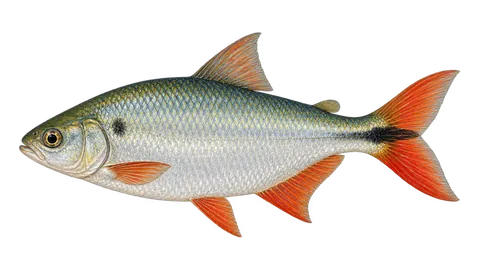
A large, silver characin with red fins that was once common in the Paraná, Grande, Tietê and Uruguay rivers. It eats fruit, seeds, insects and small fish, and depends on rivers with riparian forest and free-flowing rapids. Dams, forest loss and fishing have wiped out populations: today it survives in a few stretches, such as the free-flowing Paraná between Porto Primavera and Itaipu, the Ivinhema and the middle Uruguay. It is on the national list as Critically Endangered, and PR bans possession and keeping. It is farmed in fish farms, and pay lakes are where it can be fished for harvest. If you hook one in the river, release it without lifting it out of the water.
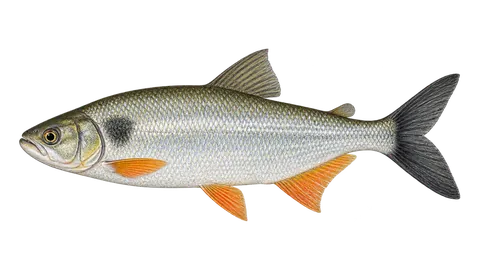
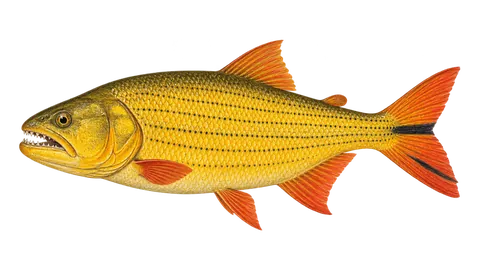
Elongated, silver body, blue-grey or greenish back. Orange to reddish fins, tail with a dark band on the peduncle that runs along the central rays. Small mouth with multicuspid teeth. The piraputanga is quite similar, but it is from the Pantanal and smaller. The golden dorado has a gold body and a large mouth. The matrinxã is Amazonian.
Today restricted to free-flowing stretches of the upper Paraná (between Porto Primavera and Itaipu, Ivinhema River) and the Uruguay River. Farmed fish in pay lakes in SP, PR, MG and GO.
Habitat: Large rivers with rapids, islands and riparian forest; backwaters under fruit trees.
native to the basins
states
Paraná, Mato Grosso do Sul, São Paulo, Rio Grande do Sul, Santa Catarina
famous destinations
Most active in warm months. In a pay lake it produces October to April.
Daytime, with peaks at dawn and dusk. Active by day, with peaks early and late in the afternoon.
Cold water keeps fish still on the bottom.
Little known effect.
Little effect.
Light rain knocks down fruit and insects and activates the surface.
In the river, it follows the supply of fruit from the flooded forest.
Wary; approach quietly.
Little effect.
Surface and mid-water, down to 3 m.
lures
natural baits
accessories
At the pay lake, float with feed or fruit in the shade of the trees. In the river, don't target this species.
Summary of the regulations we found, with the source for each. Rules change; before keeping or transporting fish, check with the state environmental agency.
Conservation: Threatened species already listed before 2026: catch, transport and trade banned (Portaria GM/MMA no. 1.666/2026, art. 3). Caught it by accident? Release it immediately.
In PR the piracanjuba is among the species with possession, keeping and transport banned in inland waters. Release immediately at the same spot.
EN species on the national list have full protection, with catch banned. On the current list (Portaria GM/MMA 1.667/2026), the piracanjuba is listed as Critically Endangered. Farmed fish with an invoice are not covered by the ban.
Source: Portaria MMA nº 445/2014 (annexes updated by Portaria MMA nº 148/2022)
Brycon orbignyanus is CR on the national list (Portaria MMA 148/2022 and Portaria GM/MMA 1.667/2026). Catching, transport and sale are prohibited nationwide, with no use plan. If you hook one, release it alive immediately. In PR and RS it is also listed as threatened in state rules.
Source: Portaria GM/MMA nº 1.666/2026 (art. 3º) and nº 1.667/2026
Possession, killing and transport of these species are prohibited in Paraná's inland waters (Paraná and Atlantic Southeast basins, except the Iguaçu River and the coast). Catch and release only, with immediate release at the same spot.
IN Semad 17/2026 excludes threatened species on the national list from catching; the list updates automatically with each new MMA list. In Goiás, pintado, piracanjuba, matrinchã B. gouldingi and, after about Oct 25, 2026, new species on the list may not be killed.
State Decree 51.797/2014 declares as threatened in RS: dorado (EN in the Patos Lagoon basin, VU in the Uruguay basin), pintado (EN) and piracanjuba (CR). The decree itself does not set catching rules: confirm with Sema-RS whether there is a retention restriction. Good practice is to release.
Allowed: Recreational fishing only for non-native species and hybrids (peacock bass, tilapia, black bass, carp, croaker, etc.; piauçu remains prohibited), with handline, simple pole, or rod with spinning or baitcasting reel, up to 10 kg + 1 fish. In rivers, from shore only; in reservoirs, from a boat or from shore. Prohibited: floodplain lakes, aquatic-animal bait, within 1,500 m of dams and waterfalls, and within 500 m of confluences. Tournaments only in reservoirs and only with non-native species.
Source: IN IBAMA nº 25/2009
Allowed: Only exotic or hybrid species, 3 kg + 1 fish per day, with handline, rod, simple pole, or spinning or baitcasting reel. Nets prohibited. Keep the minimum distances from dams and reservoirs.
Source: Portarias IEF nº 154/2011 (São Francisco), 155/2011 (East) and 156/2011 (Grande/Paranaíba)
Allowed: Sport and guided fishing only in reservoirs, catch and release with barbless hooks (no keeping, transporting or eating). Subsistence: up to 5 kg per day, for household consumption only.
Allowed: Recreational fishing from shore, or from a boat without motor. Only handline or rod, line and hook, one gear per angler, up to 5 kg. Prohibited in floodplain lakes, within 1,500 m of dams, within 500 m of confluences, and in stretches listed in the rule (e.g., Turvo River).
Source: IN IBAMA nº 193/2008
If you hook one in the river, release it without lifting it out of the water: cut the line close to the hook if it is deep.
Highly prized flesh. Eat only fish from fish farms or pay lakes, with an invoice.
Length-weight relationship W = a·Lb (a = 0.01413, b = 3.05; FishBase (estimativa bayesiana pelo gênero)). It's an average: a fat or lean fish can vary by 10% to 20%.
estimated weight
—
The season weights (months), the time of day and the sensitivities (cold, pressure, moon, wind, rain, tide, strong light, murky water and noise) are the app's editorial estimates, based on the literature below and on the field experience of anglers and guides. They are not official data nor a measurement made for this species, and they may vary by region and year. Closed seasons and legal rules appear in the rules section, with the norm and a link.
The weather comes from three independent global models, cross-checked hour by hour: when they agree, confidence goes up; when they diverge, the band between them shows on the chart. Beyond 16 days, we use the GEFS ensemble of 31 simulations: if 20 of the 31 predict rain, the chance of rain is 65%. Sun and moon are calculated astronomically, with no uncertainty.
The index adds up, weighted for each species: time of day (species curve anchored to real sunrise and sunset), moon (transits, rise and set, phase), pressure (3 h trend and 24 h swing), water temperature (in rivers, estimated from air temperature; at sea, estimated by an ocean model), wind, rain, clouds, tide and the month in the species' cycle.
Accuracy measured in the reference project (4 regions, 93 days, forecast vs. observed): maximum temperature is off by 0.6 °C on average the next day and 1.7 °C at 7 days; rain of 5 mm or more is detected 76% of the time the next day and 57% at 7 days. Detection isn't everything: the false alarm rate isn't published here yet, and 93 days in 4 regions is still a small sample. We now also measure every day, at the app's destinations:
Your location is saved only on this device and feeds the forecast, the map and the "today" on the home page.