


the right time
to be on the water
Choose the place and the species. The index, from 0 to 100, combines weather, sun, moon and tide with each fish's habits. Up to 28 days, with each day's confidence.
Loading the forecast…
—
hour by hour
slide your finger or mouse over the chart to see each hoursee hour-by-hour table
why this index at —?
choose the day
the fishing month at a glance
what's the best window for the crew?
Choose how many fishing days. We compare each stretch by its average index, discount days with a warning or closed season, and show the 3 best.
trend for the coming weeks
Line: the middle value of 31 simulations of the American GEFS model. Band: where 8 out of 10 fall. Narrow, firm trend; wide, high uncertainty.
everything about the red-bellied piranha
how to recognize it
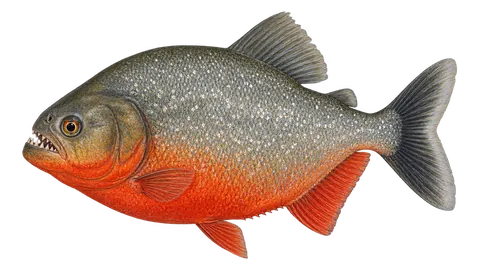
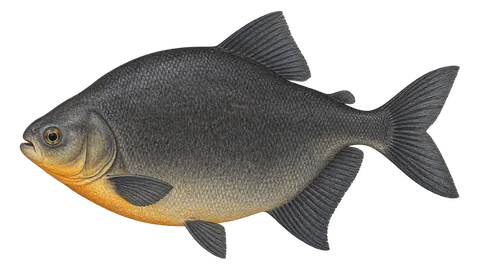
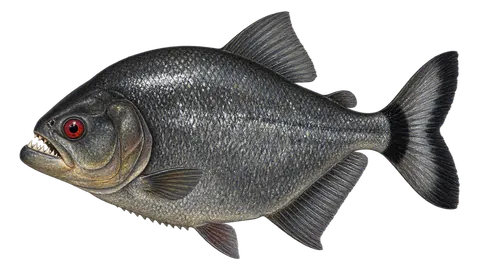
Tall, compressed body, silver-grey with a sparkle of tiny silver dots. Belly, throat and lower body red or orange. Projecting lower jaw, triangular razor-like teeth. Pacu has a small mouth with molar-like teeth and a dark body without strong red. The black piranha is Amazonian, dark, and red-eyed.
Also called: piranha-vermelha, piranha-caju, piranha-do-pantanal, piranha
don't confuse with:
where found
open on the large mapWhere to look: Bays, corixos, slack water, vegetated banks and camalote; still or slow-moving water.
All of the Pantanal (bays, corixos, the Paraguay, Cuiabá, Miranda, Aquidauana and Taquari rivers) and the Amazon basin.
native to the basins
states
Mato Grosso do Sul, Mato Grosso, Amazonas, Pará
when to fish
best season
In the dry season (July to October) the bays shrink and the piranhas are concentrated and hungry.
best time of day
Daytime, with peaks at dawn and dusk. Active by day, with peaks early and late in the afternoon.
what affects the red-bellied piranha
cold and cold fronts
The friagem (cold snap) reduces their appetite.
atmospheric pressure
Little effect.
moon
Little effect.
rain
Little effect.
water level
Falling water concentrates the schools in the bays.
noise
Noise on the water can even attract them: slapping the bait on the surface works.
wind
Little effect.
depth
Shallow and mid-water, down to 3 m.
how to fish
lures
- colherinha
- small jig
natural baits
- piece of fish
- beef heart
- carne
- lambari
tip from an angler
Use a wire leader and a long-shank hook. Strike on the first bite: the piranha strips the hook in seconds.
- rod
- 5'6" to 6', 10 to 20 lb, or bamboo rod
- spinning / baitcasting reel
- spinning reel 2000 to 3000
- line
- monofilament 0.30 to 0.35 mm
- leader
- fine steel cable 20 to 30 lb, 15 to 20 cm (wire leader)
- hook
- 1/0 to 2/0 long-shank hooks
accessories
- long-nose pliers
- small boga
catch and release
Never put your hand near the mouth. Hold it firmly behind the head with a cloth or boga, and remove the hook with pliers.
kits and guides
rules for the red-bellied piranha
Rules change; before keeping or transporting fish, check with the state environmental agency.
MS: piranha limit of 5
5 fishMS details
In MS an angler may catch and carry 5 piranhas (Pygocentrus nattereri and/or Serrasalmus marginatus), in addition to the native fish.
Source: Decreto estadual MS nº 15.375/2020, art. 4º, II (amends Decreto nº 15.166/2019) - Semadesc/Imasul
piracema and closed seasons
Each bar is the period when fishing is prohibited or restricted. The green line is today. Tap the name to see what is still allowed.
Spawning closure (piracema) in the Pantanal of Mato Grosso do Sul
Allowed: Subsistence fishing by riverside residents and authorized scientific fishing. Decree 15.166/2019 (art. 11, §5) allows catch and release only in February and only in the channels of the Paraguay and Paraná rivers. For the rest of the period, not even catch and release is allowed. Check the Imasul portaria for each season.
Source: Decreto estadual MS nº 15.166/2019, art. 11; IN IBAMA nº 201/2008
Spawning closure (piracema) in Mato Grosso (all basins)
Allowed: All fishing modalities are prohibited in rivers, including catch and release (Law 9.096/2009, art. 19-A). Exceptions: subsistence fishing from shore (3 kg or 1 fish, no transport or sale) and scientific fishing. Law 13.159/2025 now allows licensed sport fishing in UHE/PCH hydropower reservoirs, natural lakes and border rivers, subject to a scientific study and a license from the environmental agency. We have not confirmed whether these licenses are already being issued.
Closed season in the rivers of Marajó Island (PA)
Allowed: The same recreational-angler exceptions as in Portaria 48/2007 apply (handline or rod, 5 kg + 1 fish), unless a stricter state rule applies.
Source: Portaria IBAMA nº 48/2007
Closed season in the Amazon basin in Amapá
Allowed: Recreational anglers with handline or rod, line and hook are outside the Annex II prohibitions, with a bag limit of 5 kg + 1 fish, unless a stricter state rule applies.
Source: Portaria IBAMA nº 48/2007
Closed season in Roraima
Border rivers MT/RO and MT/PA
Allowed: See the exceptions in Portaria 48/2007 and the state rules for each bank.
Source: Portaria IBAMA nº 48/2007
how much it weighs without taking it out of the water
estimated weight
—
how we calculate
Length-weight relationship W = a·Lb (a = 0.02138, b = 3.16; FishBase). It's an average: a fat or lean fish can vary by 10% to 20%.
more about the red-bellied piranha
The most common piranha in the Pantanal, with a red belly and throat. Lives in schools in bays, corixos and slack water, and eats fish, chunks of meat and scraps. Attacks on people are rare and almost always tied to extreme drought, blood, or fish scraps in the water. For anglers it is a fun fish: it bites fast, steals bait and cuts thin line. In MS the bag limit is 5 piranhas, separate from the native fish. Piranha broth is a Pantanal specialty. Always handle with pliers.
Family: Serrasalmidae · predator
fun facts
- Teeth are replaced in blocks throughout life.
- In the Pantanal, piranha broth has a reputation as an aphrodisiac.
in the kitchen
Piranha broth is a typical Pantanal dish. White, tasty meat, with bones.
similar species
sources and references (6)
The season weights (months), the time of day and the sensitivities (cold, pressure, moon, wind, rain, tide, strong light, murky water and noise) are the app's editorial estimates, based on the literature below and on the field experience of anglers and guides. They are not official data nor a measurement made for this species, and they may vary by region and year. Closed seasons and legal rules appear in the rules section, with the norm and a link.
- scientific FishBase — Pygocentrus nattereri (ficha da espécie)Names, distribution, biology, length-weight relationship and references. Page checked on October 13, 2026.
- official Portaria GM/MMA nº 1.667, de 27 de abril de 2026 — Lista Nacional Oficial de Espécies da Fauna Ameaçadas de Extinção (peixes e invertebrados aquáticos)Most recent national list. The species is not on it (search by scientific name in the text published in the DOU, checked on October 13, 2026).
- official ICMBio/SALVE — Ficha de Pygocentrus nattereri (avaliação nacional do risco de extinção)National assessment by ICMBio, published in 2024. DOI verified on Crossref.
- scientific IUCN Red List — Pygocentrus nattereri (avaliação global: Pouco Preocupante, LC, 21/12/2020)Global assessment. Link given on the FishBase entry (Red List, version 2025-2).
- scientific Fink, W. L. (1993). Revision of the piranha genus Pygocentrus (Teleostei, Characiformes). Copeia 1993(3): 665–687.
- scientific Britski, H. A.; Silimon, K. Z. S.; Lopes, B. S. (2007). Peixes do Pantanal: manual de identificação. 2ª ed. Brasília: Embrapa Informação Tecnológica. 227 p.Printed work; the URL is the bibliographic record on FishBase, which cites this work for the species.
how we calculatewhere each number comes from
The weather comes from three independent global models, cross-checked hour by hour: when they agree, confidence goes up; when they diverge, the band between them shows on the chart. Beyond 16 days, we use the GEFS ensemble of 31 simulations: if 20 of the 31 predict rain, the chance of rain is 65%. Sun and moon are calculated astronomically, with no uncertainty.
The index adds up, weighted for each species: time of day (species curve anchored to real sunrise and sunset), moon (transits, rise and set, phase), pressure (3 h trend and 24 h swing), water temperature (in rivers, estimated from air temperature; at sea, estimated by an ocean model), wind, rain, clouds, tide and the month in the species' cycle.
sources for this lookup
how accurate the forecast is
Accuracy measured in the reference project (4 regions, 93 days, forecast vs. observed): maximum temperature is off by 0.6 °C on average the next day and 1.7 °C at 7 days; rain of 5 mm or more is detected 76% of the time the next day and 57% at 7 days. Detection isn't everything: the false alarm rate isn't published here yet, and 93 days in 4 regions is still a small sample. We now also measure every day, at the app's destinations: