


the right time
to be on the water
Choose the place and the species. The index, from 0 to 100, combines weather, sun, moon and tide with each fish's habits. Up to 28 days, with each day's confidence.
Loading the forecast…
—
hour by hour
slide your finger or mouse over the chart to see each hoursee hour-by-hour table
why this index at —?
choose the day
the fishing month at a glance
what's the best window for the crew?
Choose how many fishing days. We compare each stretch by its average index, discount days with a warning or closed season, and show the 3 best.
trend for the coming weeks
Line: the middle value of 31 simulations of the American GEFS model. Band: where 8 out of 10 fall. Narrow, firm trend; wide, high uncertainty.
everything about the patagonian blennie
how to recognize it
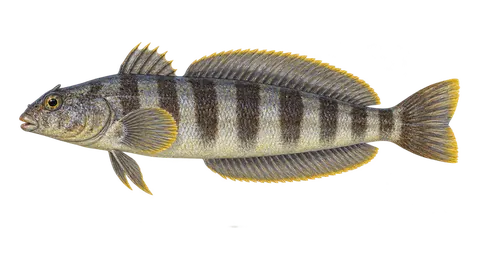
Elongated, almost cylindrical body, terminal and protractile mouth. Two dorsal fins, the first short and the second long; pelvic fins in front of the pectorals. Blue-gray to brown back, with dark vertical bands that fade toward the yellowish silver belly; fins with yellowish tips. It does not look like the Brazilian snooks (Centropomus), which have a black lateral line and a large mouth.
Also called: róbalo-patagônico, róbalo, babosa-da-patagônia, Patagonian blennie
where found
open on the large mapWhere to look: Beaches, rocky shores, estuaries, channels and tidal rivers; goes up freshwater stretches and prefers sand, gravel and algae bottoms.
Not found in Brazil. Pacific coast of Chile, from Valparaíso to Cape Horn, and Atlantic coast of Uruguay (Río de la Plata) and Argentina to Tierra del Fuego, including the Falklands.
when to fish
best season
Fishable all year, with the best period from spring to austral autumn, October to April, when the water warms and the fish enter the estuaries more.
best time of day
Daytime, with peaks at dawn and dusk. Feeds by day and at dusk, following the tide; in estuaries it enters with the rising tide.
what affects the patagonian blennie
cold and cold fronts
In winter it becomes slower and deeper.
atmospheric pressure
Fronts with strong wind hinder shore fishing.
moon
Full-moon and new-moon tides bring more water into the estuaries.
rain
Full and muddy river scatters the fish; clearing water afterward is good.
water level
In tidal rivers, the level follows the tide; on the rising tide the robalo goes up the river.
noise
Moderately sensitive in shallow water.
wind
Patagonia's strong wind is the biggest limit on casting.
tide
The rising tide at river mouths and estuaries is the best phase.
depth
From 0.5 to 5 m in estuaries and beaches.
how to fish
lures
- spoon 7 to 15 g
- spinner No. 2 to 4
- streamers and nymphs on the fly
natural baits
- sea worm (polychaete)
- shrimp and small crabs
- mussel
tip from an angler
Wait for the tide to start rising at the river mouth and fish near the bottom: the robalo enters with the salt water.
- rod
- 7' to 9', medium action, 6 to 15 lb
- spinning / baitcasting reel
- spinning reel 2500 to 3000
- line
- monofilament 8 to 14 lb or braided line 10 to 20 lb
- leader
- fluorocarbon 12 to 20 lb
- hook
- No. 1 to 2/0
accessories
- light sinker
- alicate
- waders in the estuary
catch and release
Hardy fish: remove the hook with pliers, wet your hands and release quickly. Respect the mandatory release in Argentina's national parks.
rules for the patagonian blennie
Rules change; before keeping or transporting fish, check with the state environmental agency.
Argentina (continental Patagonia): release in national parks
mandatory release in national parks; general rules in provincial waters details
The Patagonian continental fishing regulation lists the robalo as a native species of sport value in provincial waters. In national parks, every native fish, including the robalo, must be released. In rivers and streams the general rule to release all fish applies, and in lakes the kill is limited to 1 fish per day, from Dec 1 to Mar 31 (2025/2026 season). Fishing for robalo at sea and in estuaries follows each province's rules, which we did not check.
Source: Resolución APN nº 417/2025 (Boletín Oficial, Dec 9, 2025), Annex I, items 9º, 10º, 17º and 18º
Conservation: Old Chilean classifications (1998) listed it as vulnerable from Valparaíso to Biobío. Under Chile's Law 20.256, native species that are vulnerable or more threatened may not be fished recreationally.
how much it weighs without taking it out of the water
estimated weight
—
how we calculate
Length-weight relationship W = a·Lb (a = 0.00977, b = 3.06; FishBase (estimativa bayesiana para a família e o formato do corpo); peso máximo calculado por esta relação para 85 cm, porque não há peso máximo publicado). It's an average: a fat or lean fish can vary by 10% to 20%.
more about the patagonian blennie
Despite the name, it is not related to the snooks of Brazil: it belongs to a family with a single species, related to Antarctic fishes. It lives along the Chilean coast, from Valparaíso to Cape Horn, and on the Atlantic coast, from the Río de la Plata to Tierra del Fuego and the Falklands. It lives in shallow waters, beaches, estuaries and tidal rivers, goes up freshwater stretches and may go more than 200 m. Juveniles eat small crustaceans; large ones also eat algae, as well as fish and invertebrates. It is a hermaphrodite: born male, and many turn female between 30 and 40 cm. It reaches about 85 to 90 cm and lives over 10 years. It is one of the most fished species from the shore in the estuaries of southern Chile and the Patagonian coast.
Family: Eleginopidae · omnivore
fun facts
- It is a protandrous hermaphrodite: born male, and many individuals turn female after 30 cm.
- It is the only species in its family and a close relative of the Antarctic notothenioids, such as the icefishes.
in the kitchen
White, tasty flesh, valued in southern Chile and Patagonia, fried or roasted.
sources and references (6)
The season weights (months), the time of day and the sensitivities (cold, pressure, moon, wind, rain, tide, strong light, murky water and noise) are the app's editorial estimates, based on the literature below and on the field experience of anglers and guides. They are not official data nor a measurement made for this species, and they may vary by region and year. Closed seasons and legal rules appear in the rules section, with the norm and a link.
- scientific FishBase — Eleginops maclovinus (ficha da espécie)Names, distribution, biology, length-weight relationship, list of countries and references. Page checked 13/10/2026. The country list includes Argentina, Chile, Uruguay and the Falklands. No maximum weight is published.
- official Ministério do Meio Ambiente do Chile — Ficha de classificação de Eleginops maclovinus (10º processo do Reglamento de Clasificación de Especies)Proposal for Least Concern (LC) from the Classification Committee (minutes of 09/10/2013); distribution, maximum size of 850 mm and diet.
- scientific Licandeo, R.; Barrientos, C.; González, M. T. (2006). Age, growth rates, sex change and feeding habits of notothenioid fish Eleginops maclovinus from the central-southern Chilean coast. Environmental Biology of Fishes 77: 51-61.DOI checked in Crossref.
- scientific Flores, A.; Wiff, R.; Brown, D. (2025). Size at sex change in the protandric hermaphrodite Patagonian blenny Eleginops maclovinus. Journal of Fish Biology 108: 118-127.DOI checked in Crossref.
- scientific Ceballos, S. G. et al. (2016). Genetic relationships between Atlantic and Pacific populations of the notothenioid fish Eleginops maclovinus: the footprints of Quaternary glaciations in Patagonia. Heredity 116: 372-377.DOI checked in Crossref.
- official Argentina — Resolución APN nº 417/2025 (Administración de Parques Nacionales): aprova o Reglamento General de Pesca Deportiva Continental Patagónico, temporada 2025/2026Published in the Official Gazette on Dec 9, 2025. Annex I (general regulation) checked: items 8 to 11 (species), 13 (baits) and 17 and 18 (release and daily limit).
how we calculatewhere each number comes from
The weather comes from three independent global models, cross-checked hour by hour: when they agree, confidence goes up; when they diverge, the band between them shows on the chart. Beyond 16 days, we use the GEFS ensemble of 31 simulations: if 20 of the 31 predict rain, the chance of rain is 65%. Sun and moon are calculated astronomically, with no uncertainty.
The index adds up, weighted for each species: time of day (species curve anchored to real sunrise and sunset), moon (transits, rise and set, phase), pressure (3 h trend and 24 h swing), water temperature (in rivers, estimated from air temperature; at sea, estimated by an ocean model), wind, rain, clouds, tide and the month in the species' cycle.
sources for this lookup
how accurate the forecast is
Accuracy measured in the reference project (4 regions, 93 days, forecast vs. observed): maximum temperature is off by 0.6 °C on average the next day and 1.7 °C at 7 days; rain of 5 mm or more is detected 76% of the time the next day and 57% at 7 days. Detection isn't everything: the false alarm rate isn't published here yet, and 93 days in 4 regions is still a small sample. We now also measure every day, at the app's destinations: