

- common size
- 35–60 cm
- maximum
- 104 cm
- common weight
- 0.5–3 kg
- record/max.
- 10.0 kg
- depth
- 0.3–15 m
- ideal water
- 24–30 °C

the right time
to be on the water
Choose the place and the species. The index, from 0 to 100, combines weather, sun, moon and tide with each fish's habits. Up to 28 days, with each day's confidence.
Loading the forecast…
—
Looking for alerts within 30 km…
Looking for what anglers have logged near here…
what you need to fish herelicense, certification and boat documents
fish likely at this spot
Tap a fish to see its forecast.
hour by hour
slide your finger or mouse over the chart to see each hoursee hour-by-hour table
why this index at —?
choose the day
the fishing month at a glance
what's the best window for the crew?
Choose how many fishing days. We compare each stretch by its average index, discount days with a warning or closed season, and show the 3 best.
trend for the coming weeks
Line: the middle value of 31 simulations of the American GEFS model. Band: where 8 out of 10 fall. Narrow, firm trend; wide, high uncertainty.
everything about the bonefish
how to recognize it
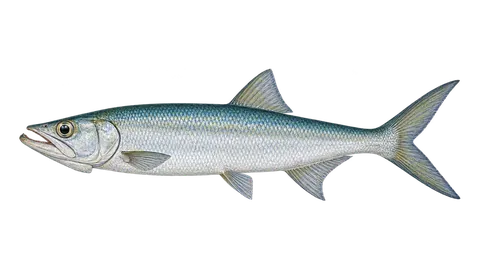
Elongated, rounded body, silver with bluish reflections on the back, conical snout that extends past the mouth, which is small and turned downward. A single dorsal fin in the middle of the body and a deeply forked tail; base of the pectoral fins yellowish. Differs from the ubarana (Elops) by its small mouth under the snout, and from the thread ubarana (Albula nemoptera) by not having the last dorsal and anal rays elongated into a filament.
Also called: ubarana-focinho-de-rato, ubarana-rato, ubarana-boca-de-rato, peixe-rato, bonefish
don't confuse with:
where found
open on the large mapWhere to look: Sand and mud flats, sand bars, tidal channels, bays and shallow estuaries; also near reefs.
Recorded in the North and Northeast, on flats, bays and estuaries. Records farther south are rare.
coast
states
Amapá, Pará, Maranhão, Piauí, Ceará, Rio Grande do Norte, Paraíba, Pernambuco, Alagoas, Sergipe, Bahia
when to fish
best season
In the North and Northeast it appears all year; the tide matters more than the month.
best time of day
Daytime. Feeds on the flats during the day, especially with the flood tide.
what affects the bonefish
cold and cold fronts
Very sensitive to cold water.
atmospheric pressure
A cold front pulls the fish off the flats.
moon
Spring tides cover more flat and spread the fish out.
rain
Heavy rain and murky water end sight fishing.
water level
Enters the flats on the flood and leaves on the ebb.
noise
Extremely wary: shadows, hull noise and a poor cast spook it.
wind
Strong wind ruffles the water and makes the fish hard to see.
tide
The flood and the start of the ebb over the flats are the time.
depth
Very shallow: from 0.3 to 1.5 m on the flats.
how to fish
lures
- shrimp and crab flies with lead eyes
- small 3 to 7 g jigs
natural baits
- shrimp
- small crab
tip from an angler
Cast in front of the fish, let the fly fall to the bottom, and move it in short twitches as it approaches.
- rod
- fly #7 to #9, 9'0"; or light spinning 7'0", 6 to 12 lb
- spinning / baitcasting reel
- fly reel with good drag or spinning reel 2500 to 3000
- line
- floating fly line; braided line 10 to 15 lb
- leader
- fluorocarbon 12 to 16 lb, 2.5 to 3 m (fly)
- hook
- hook 2 to 6 on flies; light jig head
accessories
- polarized glasses
- cap
- walking shoes for the flats
catch and release
It is the symbol fish of catch and release: don't lift it out of the water, release it quickly and far from sharks and barracudas.
rules for the bonefish
Rules change; before keeping or transporting fish, check with the state environmental agency.
We found no species-specific rule beyond the region's general rules.
Conservation: Not on the national list (Portaria GM/MMA 1.667/2026). Global assessment: Near Threatened (IUCN). We found no specific federal rule for this species. IUCN global: NT · near threatened.
how much it weighs without taking it out of the water
estimated weight
—
how we calculate
Length-weight relationship W = a·Lb (a = 0.0123, b = 3.02; FishBase (estimativa bayesiana, comprimento total)). It's an average: a fat or lean fish can vary by 10% to 20%.
more about the bonefish
The bonefish (ubarana-focinho-de-rato) is the flats fish of fly anglers, one of the most famous sport fish in the world. It lives in shallow coastal waters, bays and estuaries over sand and mud bottoms, where it roots the bottom for worms, crustaceans and mollusks. It can breathe air with its swim bladder in water poor in oxygen. Small fish travel in schools; large ones go alone. It is very wary and, when hooked, makes long runs. In Brazil it is rarely targeted and shows up more in nets and lines in the North and Northeast. The taxonomy of the genus is under review: there is more than one Albula species in the western Atlantic.
Family: Albulidae · predator
fun facts
- It can breathe air with its swim bladder in water poor in oxygen.
- When rooting the bottom in shallow water, its tail tip shows above the water.
in the kitchen
Meat full of bones and little valued; the bonefish is almost always released. There are ciguatera records in other regions.
similar species
sources and references (7)
The season weights (months), the time of day and the sensitivities (cold, pressure, moon, wind, rain, tide, strong light, murky water and noise) are the app's editorial estimates, based on the literature below and on the field experience of anglers and guides. They are not official data nor a measurement made for this species, and they may vary by region and year. Closed seasons and legal rules appear in the rules section, with the norm and a link.
- scientific FishBase — Albula vulpes (ficha da espécie)Names, distribution, biology, length-weight relationship and references. Page checked on October 13, 2026.
- official Portaria GM/MMA nº 1.667, de 27 de abril de 2026 — Lista Nacional Oficial de Espécies da Fauna Ameaçadas de Extinção (peixes e invertebrados aquáticos)Most recent national list. The species is not on it (search by scientific name in the text published in the DOU, checked on October 13, 2026).
- official ICMBio/SALVE — Ficha de Albula vulpes (avaliação nacional do risco de extinção)ICMBio national assessment, published in 2025. DOI checked on Crossref.
- scientific IUCN Red List — Albula vulpes (avaliação global: Quase Ameaçada, NT, 29/03/2011)Global assessment. Link given on the FishBase entry (Red List, version 2025-2).
- scientific Carpenter, K. E. (org.) (2002). The living marine resources of the Western Central Atlantic. Vol. 2: Bony fishes part 1 (Acipenseridae to Grammatidae). FAO Species Identification Guide for Fishery Purposes. Roma: FAO.Albulidae chapter (Smith, D. G.; Crabtree, R. E.), cited by FishBase for the species.
- scientific Carvalho-Filho, A. (1999). Peixes: costa brasileira. 3ª ed. São Paulo: Melro. 320 p.Printed work; the URL is the bibliographic record on FishBase, which cites this work for the species.
- scientific Menezes, N. A.; Buckup, P. A.; Figueiredo, J. L.; Moura, R. L. (orgs.) (2003). Catálogo das espécies de peixes marinhos do Brasil. São Paulo: Museu de Zoologia da USP. 160 p.List of marine species recorded in Brazil. Printed work; the URL is the bibliographic record in FishBase, which cites this work for the species.
how we calculatewhere each number comes from
The weather comes from three independent global models, cross-checked hour by hour: when they agree, confidence goes up; when they diverge, the band between them shows on the chart. Beyond 16 days, we use the GEFS ensemble of 31 simulations: if 20 of the 31 predict rain, the chance of rain is 65%. Sun and moon are calculated astronomically, with no uncertainty.
The index adds up, weighted for each species: time of day (species curve anchored to real sunrise and sunset), moon (transits, rise and set, phase), pressure (3 h trend and 24 h swing), water temperature (in rivers, estimated from air temperature; at sea, estimated by an ocean model), wind, rain, clouds, tide and the month in the species' cycle.
sources for this lookup
how accurate the forecast is
Accuracy measured in the reference project (4 regions, 93 days, forecast vs. observed): maximum temperature is off by 0.6 °C on average the next day and 1.7 °C at 7 days; rain of 5 mm or more is detected 76% of the time the next day and 57% at 7 days. Detection isn't everything: the false alarm rate isn't published here yet, and 93 days in 4 regions is still a small sample. We now also measure every day, at the app's destinations: