

- common size
- 45–80 cm
- maximum
- 111 cm
- common weight
- 0.1–0.8 kg
- record/max.
- 2.3 kg
- depth
- 0–3 m
- ideal water
- 22–30 °C

the right time
to be on the water
Choose the place and the species. The index, from 0 to 100, combines weather, sun, moon and tide with each fish's habits. Up to 28 days, with each day's confidence.
Loading the forecast…
—
Looking for alerts within 30 km…
Looking for what anglers have logged near here…
what you need to fish herelicense, certification and boat documents
fish likely at this spot
Tap a fish to see its forecast.
hour by hour
slide your finger or mouse over the chart to see each hoursee hour-by-hour table
why this index at —?
choose the day
the fishing month at a glance
what's the best window for the crew?
Choose how many fishing days. We compare each stretch by its average index, discount days with a warning or closed season, and show the 3 best.
trend for the coming weeks
Line: the middle value of 31 simulations of the American GEFS model. Band: where 8 out of 10 fall. Narrow, firm trend; wide, high uncertainty.
everything about the atlantic needlefish
how to recognize it
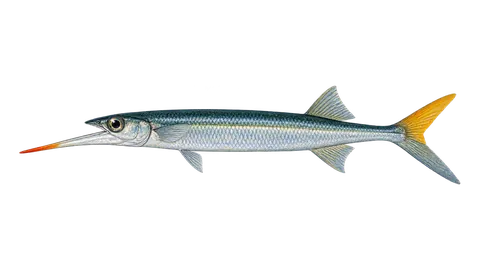
A very elongated, rounded body with a long beak of small, sharp teeth, a greenish-blue back and silvery flanks. The mark is the dark spot behind the eye, which does not extend below the middle of the eye. Dorsal fin with 14 to 17 rays and anal fin with 16 to 20, both set far back. It is smaller than the zambaia-roliço and the agulhão-lambaio (Tylosurus), which exceed 1.5 m and have a deeply forked tail and a black keel on the caudal peduncle.
Also called: zambaia-azul, agulha-torta, zambaia, atlantic needlefish
don't confuse with:
where found
open on the large mapWhere to look: Lagoons, mangrove channels, estuaries, sheltered beaches and the surroundings of piers, almost always near the surface; enters fresh water.
In Brazil, FishBase's latitude range (up to 9°S) covers the North and Northeast, and the species is known to fishers in Ceará. In Latin America, FishBase's list includes Mexico, Central America, Colombia, Venezuela, the Guianas and Trinidad and Tobago; FishBase says it is absent from the Bahamas and the Antilles, but the country list includes Cuba, the Dominican Republic and Jamaica.
coast
when to fish
best season
Present all year in tropical waters; more active and closer to shore with the warm water of spring and summer.
best time of day
Daytime. Hunts by day near the surface, most active in early morning and late afternoon.
what affects the atlantic needlefish
cold and cold fronts
Loses activity and moves away from the edges when the water cools.
atmospheric pressure
Small effect.
moon
Small effect.
rain
Heavy rain muddies the estuary water and scatters the schools; light drizzle doesn't hurt.
water level
Doesn't apply at sea. In estuaries, the equivalent is salinity and tide.
noise
Stay alert to shadows and noise in shallow water: approach slowly.
wind
A light chop helps hide the line; strong wind makes it hard to see surface hunting.
tide
A moving tide at channel mouths concentrates the bait and the needlefish.
depth
Almost always in the top 2 m, close to the surface.
how to fish
lures
- small spoon
- jig, 3 to 7 g
- thin, long streamer, white or green (fly)
natural baits
- small live fish (sardine, manjuba, tainha)
- strips of fish
tip from an angler
The hard beak holds little: offer a thin, long bait, wait for the needlefish to turn the bait in its mouth, and set the hook only after that. Use long-nose pliers to remove the hook.
- rod
- 6' to 7', fast action, 6 to 12 lb
- spinning / baitcasting reel
- spinning reel 1000 to 2500
- line
- monofilament 6 to 12 lb or braided line 8 to 15 lb
- leader
- fluorocarbon 10 to 20 lb, 40 to 60 cm
- hook
- small single hook with a sharp point (the mouth is hard and the hook holds poorly)
accessories
- long-nose pliers
- protective glasses
catch and release
Hold it by the body, behind the head, with the beak away from your face, and remove the hook with long-nose pliers. Release it with its head in the water, facing the current or the tide.
rules for the atlantic needlefish
Rules change; before keeping or transporting fish, check with the state environmental agency.
Mexico: up to 5 per species and 10 saltwater fish per day
5 specimens of the species per angler per day, within the limit of 10 saltwater fish details
In recreational sport fishing in Mexican federal waters, each angler may keep up to 10 marine fish per day, with at most 5 of the same species. The zambaia-azul is not among the species reserved for sport fishing and has no quota of its own. Fish over the limit are released alive, and sport-caught fish may not be sold. Anyone fishing from a boat needs the recreational fishing permits set out in the rule.
Conservation: Not on the Brazilian national list (Portaria GM/MMA nº 1.667/2026). Outside Mexico we found no specific rule for the species.
how much it weighs without taking it out of the water
estimated weight
—
how we calculate
Length-weight relationship W = a·Lb (a = 0.00132, b = 3.04; FishBase (relação peso-comprimento bayesiana, estimativa da própria espécie)). It's an average: a fat or lean fish can vary by 10% to 20%.
more about the atlantic needlefish
The zambaia-azul (Atlantic needlefish) is the needlefish most tied to shallow, brackish waters. In the western Atlantic it ranges from Maine and the northern Gulf of Mexico to Brazil, and FishBase says it is absent from the Bahamas and the Antilles. It lives in coastal areas, lagoons and mangrove channels, and enters fresh water. It hunts at the surface, mainly small fish. Its eggs have filaments and stick to objects in the water. It reaches 111 cm and 2.3 kg; the common size is about 60 cm. Artisanal fishers in the Batoque Extractive Reserve, in Ceará, know it as zambaia-azul and agulha-torta.
Family: Belonidae · predator
fun facts
- Only the right gonad develops (FishBase).
- The eggs have filaments that attach them to objects in the water.
- Artisanal fishers in Ceará also use the name agulha-torta (Pinto et al., 2015).
in the kitchen
Sold fresh, in small-scale commercial fishing, according to FishBase. Clean and scale it right after catch and keep it on ice.
similar species


sources and references (5)
The season weights (months), the time of day and the sensitivities (cold, pressure, moon, wind, rain, tide, strong light, murky water and noise) are the app's editorial estimates, based on the literature below and on the field experience of anglers and guides. They are not official data nor a measurement made for this species, and they may vary by region and year. Closed seasons and legal rules appear in the rules section, with the norm and a link.
- scientific FishBase: Strongylura marina (ficha da espécie)Size, length-weight relationship, depth, habitat, distribution, biology and IUCN status. Page checked on Oct 13, 2026. The common size range is an editorial estimate around the 60 cm common length reported by FishBase.
- scientific FishBase: nomes populares de Strongylura marinaNames by country and language.
- official Portaria GM/MMA nº 1.667, de 27 de abril de 2026: Lista Nacional Oficial de Espécies da Fauna Ameaçadas de Extinção (peixes e invertebrados aquáticos)The species is not on the list. Checked in the DOU of April 28, 2026.
- scientific Pinto, M. F.; Mourão, J. S.; Alves, R. R. N. (2015). Use of ichthyofauna by artisanal fishermen at two protected areas along the coast of Northeast Brazil. Journal of Ethnobiology and Ethnomedicine.Common names recorded from artisanal fishers in Tamandaré (PE) and the Batoque Extractive Reserve (CE).
- official NOM-017-PESC-1994 (pesca deportivo-recreativa em águas de jurisdição federal do México), modificação publicada no DOF em 25/11/2013 (Sagarpa/Conapesca)Limit of 10 marine fish per angler per day, no more than 5 of the same species (item 4.9.1), return of the excess (4.9.5) and ban on selling sport-caught fish (4.11). Text checked Oct 13, 2026. The rule sets no quota of its own for this species.
how we calculatewhere each number comes from
The weather comes from three independent global models, cross-checked hour by hour: when they agree, confidence goes up; when they diverge, the band between them shows on the chart. Beyond 16 days, we use the GEFS ensemble of 31 simulations: if 20 of the 31 predict rain, the chance of rain is 65%. Sun and moon are calculated astronomically, with no uncertainty.
The index adds up, weighted for each species: time of day (species curve anchored to real sunrise and sunset), moon (transits, rise and set, phase), pressure (3 h trend and 24 h swing), water temperature (in rivers, estimated from air temperature; at sea, estimated by an ocean model), wind, rain, clouds, tide and the month in the species' cycle.
sources for this lookup
how accurate the forecast is
Accuracy measured in the reference project (4 regions, 93 days, forecast vs. observed): maximum temperature is off by 0.6 °C on average the next day and 1.7 °C at 7 days; rain of 5 mm or more is detected 76% of the time the next day and 57% at 7 days. Detection isn't everything: the false alarm rate isn't published here yet, and 93 days in 4 regions is still a small sample. We now also measure every day, at the app's destinations: