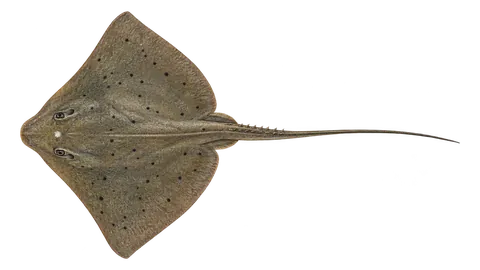
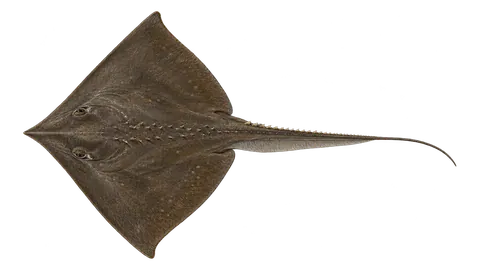
Large stingray with a diamond-shaped disc and tubercles on the back, common in the shallows of the tropical Atlantic, from Santos to the Antilles. Near Threatened worldwide; easily confused with protected stingrays.
Also called: arraia-lixa, arraia-branca, arraia-couro-de-lixa, longnose stingray, raya látigo hocicona
The arraia-lixa is a stingray of the tropical Atlantic, up to 200 cm disc width. It lives on the shelf bottom, down to at least 35 m, also in brackish water, and juveniles appear in tide pools. It eats mollusks, crustaceans, and worms from or near hard bottoms, as well as small fish. It is ovoviviparous. Commercial fishing is small: the flesh is sold salted, and the stingray is used for gelatin and good-quality oil. At least five specimens were sold as aquarium fish in Ceará between 1995 and 2000. The IUCN classifies it as Near Threatened. It is not on Brazil's national list, but similar stingrays are.
fun facts
At least five specimens were sold as aquarium fish in Ceará between 1995 and 2000, according to FishBase.
Juveniles appear in tide pools.
The stingray reaches 2 m disc width; the common size is 1.25 m.
how to recognize it
identification
Diamond-shaped disc, with blunt, closely spaced tubercles covering the central area. The snout, in front of the eyes, is about 1.4 times longer than the distance between the outer edges of the orbits. Dorsally it is brown, sometimes yellowish or olive; ventrally it is pure white or yellowish, with the skin fold under the tail and the upper keel black. Measurements in this profile are disc width. It resembles the protected raia-prego (H. berthalutzae), which has dark spots on the back: check before keeping any stingray.
how longnose stingray fishing looks
Loading the next 7 days…
Each card shows the day's index (0 to 100) and, below it, a strip with the index for each hour, from 0h to 23h. from poor to excellent.
Western Atlantic: from the southern Gulf of Mexico and the Antilles to Santos, São Paulo, Brazil, along the North, Northeast, and Southeast coasts. FishBase also lists Belize, Colombia, Costa Rica, Cuba, the Dominican Republic, French Guiana, Guatemala, Guyana, Honduras, Haiti, Jamaica, Mexico, Nicaragua, Panama, Puerto Rico, Suriname, Trinidad and Tobago, and Venezuela.
Habitat: Continental shelf bottom, from 1 to 36 m, on hard or nearby bottoms; also brackish water, and tide pools for juveniles.
coast
North CoastNortheast CoastSoutheast Coastcoastalshelf
calendar and clock
when to fish
best season
time of year
JanFebSeaAprMayJunJulAugSepOctNovDec
Estimate: present all year in the tropics, with no known fishing season.
best time of day
Night and twilight. No defined time in the sources we checked (estimate): it usually looks for food in the shallows at dusk and at night.
weather, water and behavior
what affects the longnose stingray
sensitivity The little bars show how much each factor affects this species. Five full: it feels it a lot.
cold and cold fronts
A cold front pushes it away from the shallows at the southern limits of its range.
atmospheric pressure
Little known direct effect.
moon
Little known effect.
rain
Heavy rain lowers salinity in estuaries and tide pools.
water level
Not applicable at sea.
noise
In clear, shallow water, it flees from heavy footsteps and motors.
wind
Little effect, except for heavy swell that muddies the shallows.
tide
It climbs onto the shoals on the rising tide to look for food.
spinning rod 7' to 9', 30 to 50 lb (from the beach, 10' to 12')
spinning / baitcasting reel
spinning reel 6000 to 10000 or baitcasting reel with plenty of line
line
40 to 60 lb braided line
leader
monofilament 0.90 to 1.2 mm, 1 m
hook
barbless circle hook 6/0 to 10/0
natural baits
shrimp
lula
caranguejo
mariscos
fish pieces
accessories
long-nose pliers
thick gloves
line cutter
tip from an angler
It fights hugging the bottom: keep steady pressure. Never pull the stingray by the tail or bring it into the boat. Anyone wading in shallow water should shuffle their feet.
what the law says
rules for the longnose stingray
Summary of the regulations we found, with the source for each. Rules change; before keeping or transporting fish, check with the state environmental agency. Conservation: Not on Brazil's national list (Portaria GM/MMA nº 1.667/2026). IUCN global assessment: NT (A2d, Jun 21, 2019). What matters is the protection of the similar stingrays that are on the list.
Watch out for similar protected stingrays
North CoastNortheast CoastSoutheast CoastSouth Coast
Several stingrays of the Brazilian coast are on the national list and have catch banned: raia-prego or raia-manteiga (Hypanus berthalutzae, VU), raia-mariquita (Hypanus marianae, VU, endemic to the Northeast), raia-prego (Bathytoshia centroura, CR), and raia-de-colares (Fontitrygon colarensis, VU), as well as raia-borboleta (Gymnura altavela, CR). The name «manteiga» applies to the protected raia-prego and also to other stingrays. If you are not sure of the species, release it without handling.
Finning banned: sharks and rays only whole, with their fins
fins naturally attached to the body
In Brazil, finning is banned: catching sharks and rays and keeping only the fins, discarding the body (art. 3). Sharks and rays landed must arrive with all fins naturally attached to the body; carrying an animal aboard without fins or with loose fins, and transferring sharks and rays between fishing vessels, is prohibited. This applies to any species that may be retained.
Mexico: rays fall under the general limit of 10 fish per day
10 marine fish per angler per day, no more than 5 of the same species
NOM-017-PESC-1994 gives its own bag limit only to billfish, sharks, and giant croaker (1 fish per day). Rays are not listed separately in the text we checked: the general limit of ten marine fish per angler per day applies, with no more than five of the same species (item 4.9.1 a). Anything over that must be returned alive to the water (item 4.9.5), and recreational catch may not be sold (item 4.11).
Colombia: marine sharks and rays are not fishery resources
commercial or sport extraction not permittedconfirm with the agency
In 2021 Colombia stopped treating marine sharks and rays as fishery resources and began treating them as hydrobiological resources. The recitals of Decree 281/2021 state that they may not be extracted for commercial or sport purposes, and the decree created an environmental protection plan. Later AUNAP rules addressed incidental catch in artisanal fishing; we did not check the consolidated text. When in doubt, release them into the water.
Panama: sharks and rays may not be caught in recreational fishing
catch, retention, and landing banned (from about Dec 10, 2026)
Executive Decree 9/2026 (art. 19) bans, throughout the national territory and in sport, recreational, or tourism fishing, the catch, retention, handling for recreational purposes, use, and landing of sharks and rays (subclass Elasmobranchii). If one is hooked by accident, it must be released immediately, without taking it fully out of the water and without unnecessary handling. It is also prohibited to promote them as targets in tournaments (art. 19) and to sell the catch (art. 20). The decree takes effect six months after its promulgation on June 10, 2026 (art. 40), around Dec 10, 2026, and repeals Resuelto ADM/ARAP 002/2012 (art. 39). Confirm the date with ARAP.
catch and release Releasing the fish alive, quickly and with a wet hand. During a closed season it isn't always allowed: what the regulation says applies.
The tail sting is serrated and venomous: the sting causes intense pain and a deep cut, and it can leave fragments in the wound. If stung, wash the area, immerse it in very hot water (not hot enough to burn), and seek medical care. Keep the stingray in the water, away from the tail; remove the hook with long-nose pliers or cut the line close to the mouth.
in the kitchen
Sold salted in some places, and the stingray is used for gelatin and good-quality oil (FishBase). Since it is easily confused with protected stingrays and is Near Threatened, prefer to release it.
calculator
how much it weighs without taking it out of the water
Length-weight relationship W = a·Lb (a = 0.00692, b = 3.13; FishBase (relação peso-comprimento bayesiana, estimativa da própria espécie)). It's an average: a fat or lean fish can vary by 10% to 20%.
estimated weight
—
sources and references
The season factors (months), the time of day, and the sensitivities (cold, pressure, moon, wind, rain, tide, strong light, murky water, and noise) are editorial estimates by the app, based on the literature cited below and on field experience of anglers and guides. They are not official data or measurements made for this species and may vary by region and year. Closed seasons and legal rules appear in the rules section, with the standard and link. The months indicate when anglers usually find the species near the coast, not a catch season.
scientificFishBase: Hypanus guttatus (ficha da espécie)Size, length-weight, depth, habitat, distribution, biology, and IUCN status. Page checked on Oct 13, 2026. Here the common size runs from the length at maturity to the reported common length.