

- common size
- 70–150 cm
- maximum
- 300 cm
- common weight
- 5–55 kg
- record/max.
- 450.0 kg
- depth
- 0–250 m
- ideal water
- 16–22 °C

the right time
to be on the water
Choose the place and the species. The index, from 0 to 100, combines weather, sun, moon and tide with each fish's habits. Up to 28 days, with each day's confidence.
Loading the forecast…
—
Looking for alerts within 30 km…
Looking for what anglers have logged near here…
what you need to fish herelicense, certification and boat documents
fish likely at this spot
Tap a fish to see its forecast.
hour by hour
slide your finger or mouse over the chart to see each hoursee hour-by-hour table
why this index at —?
choose the day
the fishing month at a glance
what's the best window for the crew?
Choose how many fishing days. We compare each stretch by its average index, discount days with a warning or closed season, and show the 3 best.
trend for the coming weeks
Line: the middle value of 31 simulations of the American GEFS model. Band: where 8 out of 10 fall. Narrow, firm trend; wide, high uncertainty.
everything about the pacific bluefin tuna
how to recognize it
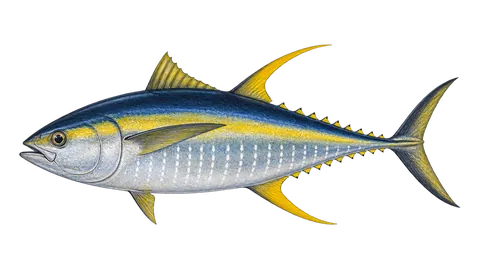
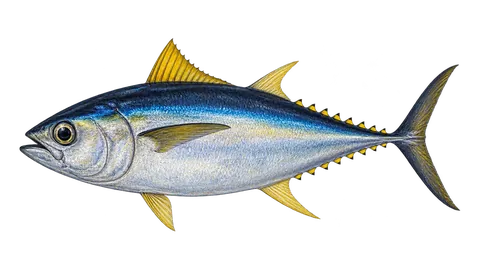
Very robust, torpedo-shaped body, dark blue back and silvery belly with light lines and dots. The pectoral fins are short and do not reach the base of the second dorsal, unlike the yellowfin and albacore, which have long pectorals. Yellow finlets with dark edges and dark tail keels. Yellowfin has a yellow second dorsal and anal fin, long in adults.
Also called: atum-rabilho-do-pacífico, atum-azul-do-pacífico, Pacific bluefin tuna
don't confuse with:
where found
open on the large mapWhere to look: Open sea and shelf edges, near banks, islands and temperature fronts; sometimes comes close to shore.
Not found in Brazil. North Pacific; in Latin America, mainly along the Pacific coast of Baja California (Mexico), at islands and offshore banks. There are rare records farther south, including Ecuador.
when to fish
best season
On the Pacific coast of Baja California, schools appear from late spring to autumn, with a peak usually between June and October.
best time of day
Daytime, with peaks at dawn and dusk. Hunts by day, with peaks at dawn and dusk; at night there is fishing with live bait and jigs under the boat lights.
what affects the pacific bluefin tuna
cold and cold fronts
It tolerates colder water than tropical tunas; temperature fronts concentrate bait and schools.
atmospheric pressure
Little direct effect; calm sea makes it easier to find the schools.
moon
During a full moon, fish feed more at night and are more selective by day.
rain
Little effect.
water level
Not applicable at sea.
noise
A school at the surface sinks when the boat is on top of it; approach from the front of the school, slowly.
wind
Rough seas make it hard to find and follow the schools.
tide
Little effect in open sea; near banks, current concentrates the bait.
depth
From the surface to more than 100 m; the schools rise when they hunt sardines.
how to fish
lures
- stickbait and popper 18 to 25 cm
- vertical jig 150 to 300 g
- trolling plugs
natural baits
- live sardine and mackerel
- lula
tip from an angler
With live bait, use the thinnest leader the fish's size allows and a small hook: bluefin see well and refuse thick line on clear-water days.
- rod
- stand-up 5'6" to 7', 50 to 130 lb; long casting rod for stickbaits
- spinning / baitcasting reel
- two-speed lever-drag baitcasting reel (size 30 to 80) or spinning reel 14000 to 30000
- line
- braided line 80 to 130 lb
- leader
- fluorocarbon 60 to 130 lb, 2 to 3 m
- hook
- circle hook 4/0 to 8/0 for live bait
accessories
- fighting belt and harness
- luvas
- bicheiro
catch and release
Tuna does not survive well out of water: if you release it, do it without lifting it from the sea, with the boat moving slowly so water passes over the gills. Use a circle hook to set in the corner of the mouth.
rules for the pacific bluefin tuna
Rules change; before keeping or transporting fish, check with the state environmental agency.
Mexico: bluefin tuna quota for sport fishing
up to 5 per angler per day under the general rule; earlier agreements set 2confirm with the agency details
Under the general rule for sport fishing in Mexican seawaters, each angler may keep up to 10 saltwater fish per day, no more than 5 of the same species. The bluefin quota agreements of 2017 and 2019-2020 limited sport fishing from Mexican boats to 2 bluefin per angler per day; the 2025-2026 biennial agreement covers only the commercial fleet. Check with Conapesca or your operator which limit applies this season, and release alive any fish over the limit.
Conservation: Stock recovering under quotas set by the Inter-American Tropical Tuna Commission (CIAT); Mexico sets the commercial catch volume every two years. IUCN global: NT · near threatened.
how much it weighs without taking it out of the water
estimated weight
—
how we calculate
Length-weight relationship W = a·Lb (a = 0.01349, b = 3.03; FishBase (estimativa bayesiana para o gênero e o formato do corpo)). It's an average: a fat or lean fish can vary by 10% to 20%.
more about the pacific bluefin tuna
Pacific bluefin tuna, from the Gulf of Alaska to Baja California and from the Sea of Okhotsk to the Philippines. It spawns in the western Pacific, near Japan, and many young fish cross the ocean to the California Current, where they spend a few years before returning. It forms schools by size and moves up the Baja California coast between June and September, coming close to shore at certain times. It eats schooling fish, squid and pelagic crabs. In Mexico it is commercially caught with purse seines and fattened on farms in Ensenada; in sport fishing, boats from Ensenada and other ports seek the schools on banks and islands, using live sardines, stickbaits and jigs. The IUCN classifies it as near threatened, and catch is controlled by international quotas.
Family: Scombridae · predator
fun facts
- Many bluefin are born near Japan and cross the Pacific while still young to the Baja California coast, where they spend a few years.
- Ensenada, in Baja California, is home to fattening farms that catch young bluefin at sea and feed them in cages.
in the kitchen
Red, fatty flesh, among the most prized in the world for sashimi; bleed and chill the fish right after the catch.
similar species
sources and references (6)
The season weights (months), the time of day and the sensitivities (cold, pressure, moon, wind, rain, tide, strong light, murky water and noise) are the app's editorial estimates, based on the literature below and on the field experience of anglers and guides. They are not official data nor a measurement made for this species, and they may vary by region and year. Closed seasons and legal rules appear in the rules section, with the norm and a link.
- scientific FishBase — Thunnus orientalis (ficha da espécie)Names, distribution, biology, length-weight relationship, list of countries and references. Page checked 13/10/2026. The FishBase country list includes Ecuador; in Latin America, fishing is concentrated in Mexico.
- scientific IUCN Red List — Thunnus orientalis (avaliação global: Quase Ameaçada, NT, 15/01/2021)Global assessment. Link given on the FishBase entry (Red List, version 2025-2).
- scientific Collette, B. B.; Nauen, C. E. (1983). FAO Species Catalogue. Vol. 2. Scombrids of the world. FAO Fisheries Synopsis 125(2). Roma: FAO.FishBase reference for the migration along Baja California between June and September.
- official DOF — Modificação da NOM-017-PESC-1994, para regular a pesca deportivo-recreativa em águas de jurisdição federal do México (publicada em 25/11/2013)Daily limits at sea (item 4.9.1) and in fresh water (4.9.2), one rod in inland waters (4.6 b), ban on live fish as bait in inland waters (4.7 c) and on fishing in closed areas and seasons (4.10).
- official DOF — Acordo que estabelece o volume de captura permissível de atum aleta azul (Thunnus orientalis) no Pacífico (20/03/2019)Art. 4º: 2 specimens per angler per day in sport fishing from Mexican boats. It applied in 2019 and 2020; the 2017 agreement (DOF 03/05/2017) had the same limit.
- official Sader/Conapesca — Acordo que estabelece o volume de captura permissível de atum aleta azul para o biênio 2025-2026 (assinado em 09/12/2024)Maximum volume of 11,127.81 t over the biennium for the commercial fleet; the text does not address sport fishing.
how we calculatewhere each number comes from
The weather comes from three independent global models, cross-checked hour by hour: when they agree, confidence goes up; when they diverge, the band between them shows on the chart. Beyond 16 days, we use the GEFS ensemble of 31 simulations: if 20 of the 31 predict rain, the chance of rain is 65%. Sun and moon are calculated astronomically, with no uncertainty.
The index adds up, weighted for each species: time of day (species curve anchored to real sunrise and sunset), moon (transits, rise and set, phase), pressure (3 h trend and 24 h swing), water temperature (in rivers, estimated from air temperature; at sea, estimated by an ocean model), wind, rain, clouds, tide and the month in the species' cycle.
sources for this lookup
how accurate the forecast is
Accuracy measured in the reference project (4 regions, 93 days, forecast vs. observed): maximum temperature is off by 0.6 °C on average the next day and 1.7 °C at 7 days; rain of 5 mm or more is detected 76% of the time the next day and 57% at 7 days. Detection isn't everything: the false alarm rate isn't published here yet, and 93 days in 4 regions is still a small sample. We now also measure every day, at the app's destinations: