

white margate
Haemulon album
One of the largest grunts in the Caribbean, silvery and muted in color, found over seagrass, reefs and wrecks. Rare in Brazil; it takes natural bait well on the bottom.
- common size
- 40–60 cm
- maximum
- 79 cm
- common weight
- 0.8–2.6 kg
- record/max.
- 7.1 kg
- depth
- 20–60 m
- ideal water
- 24–29 °C
how to recognize it
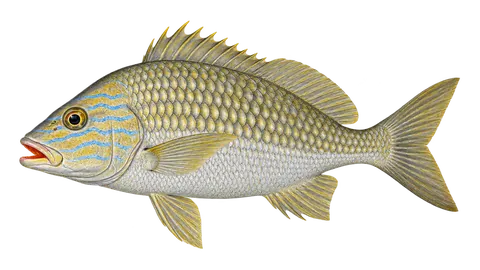
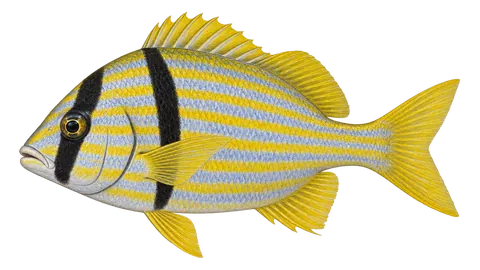
Large grunt with a moderately deep body and a dull silvery color, its fins generally gray and lacking black pigment below the upper edge of the preopercle. Continuous dorsal fin with 12 spines and 15 to 17 soft rays; anal fin with 3 spines and 7 to 8 rays. Scale rows below the lateral line run obliquely. Subadults may have a blackened back, dorsal fin and tail. It is told apart from the biquara (Haemulon plumierii) by its larger size and its plain, dull coloration.
Also called: roncador-branco, white margate, margate, margaret grunt
don't confuse with:
where found
open on the large mapWhere to look: Seagrass, sand banks, coral reefs and wrecks, in pairs or schools, from 20 to 60 m according to FishBase.
In Brazil there are few collection records, from Fernando de Noronha (PE) and the coast of São Paulo; FishBase only says the species goes "as far as Brazil". Outside Brazil, from Florida and Bermuda to the Bahamas and all the Antilles, and to the Guianas.
coast
states
Pernambuco, São Paulo
when to fish
next 7 days
Loading the next 7 days…
best season
There is no well-documented seasonality for the species. Calm seas and clear water matter more than the month; it can be fished all year wherever it occurs.
best time of day
Night and twilight. Like other grunts, it rests in groups by day near shelter and goes out to feed at dusk and at night; bottom fishing is best from late afternoon into early night.
what affects the white margate
cold and cold fronts
Cold water from a front or upwelling pushes the groups off shallow rock ledges.
atmospheric pressure
Rough seas after the front hurt boat fishing; when they calm, the bite returns.
moon
Small effect; dark nights favor feeding trips.
rain
Little relevance at sea; a storm is dangerous for anyone on a boat.
water level
Strong current over the reef or wreck scatters the schools.
noise
The school is wary of motor noise and of anchoring over the spot.
wind
Strong wind prevents bottom fishing from a boat.
tide
Moderate current during the tide change brings food and keeps the fish active.
depth
Between 20 and 60 m according to FishBase; deeper than the shallow-reef grunts.
how to fish
lures
- jig, 40 to 100 g
- jig head with small shad
natural baits
- shrimp
- squid strips
- sardine pieces
- sea worm (polychaete)
tip from an angler
Natural bait held still near the bottom, on the edge of the reef or wreck, in the late afternoon; if the fish comes up from deeper than 20 m and you are going to release it, use a descender.
- rod
- 6'0" to 7'0", 15 to 30 lb
- spinning / baitcasting reel
- spinning reel 4000 to 5000 or baitcasting reel 200 to 300
- line
- braided line 20 to 40 lb
- leader
- fluorocarbon 30 to 50 lb, 1 m
- hook
- circle hook 2/0 to 4/0
accessories
- sinker, 60 to 200 g depending on the current
- descender (fish descender)
- alicate
catch and release
A fish from 20 to 60 m may arrive with barotrauma (swim bladder out of the mouth, swollen belly): release it quickly with a descender. Support its belly and don't hold it by the mouth alone.
rules for the white margate
Rules change; before keeping or transporting fish, check with the state environmental agency.
Mexico: up to 10 marine fish per angler per day, no more than 5 of the same species
10 marine specimens per angler per day; no more than 5 of the same species details
In Mexico's federal waters, sport and recreational fishing for marine species has a limit of 10 specimens per angler per day, with no more than 5 of any one species. Fish over the limit may only be taken if released alive. Sport-caught fish belong to the permit holder and may not be sold; fish may not be landed as fillets (they may only be filleted on board for consumption during the trip). For spearfishing the limit is 5 fish per day. Fishing from a boat requires a permit.
Conservation: Data Deficient in the global assessment. Not on the Brazilian national list (Portaria GM/MMA nº 1.667/2026). We found no specific Brazilian federal rule for the species.
how much it weighs without taking it out of the water
estimated weight
—
how we calculate
Length-weight relationship W = a·Lb (a = 0.0123, b = 2.99; FishBase (relação peso-comprimento bayesiana, estimativa da própria espécie)). It's an average: a fat or lean fish can vary by 10% to 20%.
more about the white margate
The white grunt, or margate, is one of the largest grunts in the genus Haemulon: it reaches 79 cm and 7.1 kg, with a common length of 50 cm. It lives in the western Atlantic, from Florida and Bermuda to Brazil, over seagrass, sand banks, coral reefs and wrecks, between 20 and 60 m according to FishBase. It travels in pairs or schools and eats bottom invertebrates, which it digs up with its snout: peanut worms and heart urchins. FishBase lists it as a commercial and sport fish. In Brazil it is hardly seen, with few collection records from Fernando de Noronha and the coast of São Paulo state.
Family: Haemulidae · predator
fun facts
- It has been observed rooting in sand to eat buried peanut worms and heart urchins.
- Forms well-defined pairs during the spawning season, according to FishBase.
- In Brazil, GBIF has only 7 collection records for the species.
in the kitchen
White flesh, sold fresh. FishBase records ciguatera cases: in the Caribbean, be wary of very large reef specimens and ask local fishers.
similar species


sources and references (8)
The season weights (months), the time of day and the sensitivities (cold, pressure, moon, wind, rain, tide, strong light, murky water and noise) are the app's editorial estimates, based on the literature below and on the field experience of anglers and guides. They are not official data nor a measurement made for this species, and they may vary by region and year. Closed seasons and legal rules appear in the rules section, with the norm and a link.
- scientific FishBase: Haemulon album (ficha da espécie)Size, length-weight, depth, habitat, distribution, biology and IUCN status. Page checked Oct 13, 2026. The common weight was calculated from the length-weight relationship.
- scientific FishBase: nomes populares de Haemulon albumNames by country and language. FishBase gives no Portuguese name for the species: "roncador-branco" is an editorial designation, based on the Spanish "ronco blanco" and on the Portuguese name for the group (roncador), not an established name in Brazil.
- official Portaria GM/MMA nº 1.667, de 27 de abril de 2026: Lista Nacional Oficial de Espécies da Fauna Ameaçadas de Extinção (peixes e invertebrados aquáticos)The species is not on the list. Checked in the DOU of April 28, 2026.
- scientific IUCN Red List: Haemulon album (avaliação global: Dados Insuficientes, DD, 10/10/2015)Global assessment. Link given on the FishBase entry (Red List, version 2025-2).
- scientific GBIF: registros de Haemulon album no BrasilChecked on Oct 13, 2026 in GBIF's open database (country = Brazil). Records come from collections and observations and show where the species has been seen, not how abundant it is. There are only 7 records in Brazil, from Fernando de Noronha and the coast of São Paulo; the species is rare here.
- scientific Carpenter, K. E. (org.) (2002). The living marine resources of the Western Central Atlantic. Vol. 3: Bony fishes part 2 (Opistognathidae to Molidae). FAO Species Identification Guide for Fishery Purposes. Roma: FAO.Reference identification guide for the western Atlantic (Haemulidae chapter).
- official Code of Federal Regulations, 50 CFR Part 622, Subpart S: Porto Rico (NOAA Fisheries, EUA)Consolidated text from the eCFR, checked on Oct 13, 2026. Among the grunts, the federal reef-fish table lists only Haemulon plumierii; Haemulon album is not on it, so the federal limits for Puerto Rico do not apply to the species.
- official Modificação da NOM-017-PESC-1994, para regular a pesca deportivo-recreativa nas águas de jurisdição federal do México (DOF, 25/11/2013)Text read in the DOF: items 4.2 to 4.12 (quotas, underwater fishing, sales and fillets).