Skip to content
catalog Polyprionidae · predator

wreckfish

Polyprion americanus

Seanational list: CR · critically endangered

Large slope fish, with a big head and a bony crest on the gill cover, living in caves and wrecks between 100 and 600 m. It is Critically Endangered in Brazil: capture and possession prohibited; if you hook one, release it.

Also called: cherne-poveiro, cherne, wreckfish

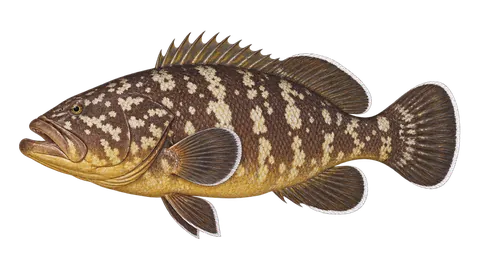
Scientific illustration of Wreckfish
common size
60–100 cm
maximum
210 cm
common weight
2.8–13 kg
record/max.
100.0 kg
depth
100–200 m
ideal water
10–16 °C
overview

who is the wreckfish

The cherne-poveiro is a large demersal fish with a wide distribution in temperate and subtropical regions around the world. It lives among rocks, caves and wrecks on the slope and outer shelf, usually between 100 and 200 m, and can reach 600 m. In Brazil it is fished south of Cabo Frio, with the greatest abundance at the southern end. Juveniles spend years near the surface, alongside floating objects, before descending to the bottom. Females only mature at about 78 cm and 10 years, spawning runs from July to October on the slope, and the species lives past 60 years. This long, slow life, combined with targeted longline fishing since the 1970s, brought catches down, and the 2026 national list classifies it as Critically Endangered.

fun facts

  • Juveniles spend up to four years near the surface, among floating objects, before descending to the bottom.
  • In southern Brazil the maximum recorded age was 76 years for males and 62 years for females.
  • Estimated annual catches in the South and Southeast fell 79% between 1989 and 2002, from 2,200 t to under 460 t.
how to recognize it

identification

Tall, laterally compressed fish with a large head, a big mouth and a rough bony ridge running across the top of the gill cover. Blue-gray back, lighter sides with a silvery sheen, and dark brown, almost black fins. Juveniles have black spots on the head and body. The dorsal fin has 10 to 12 spines and the anal fin has 3. It can be confused with groupers and sea basses from the same habitat, such as the snowy grouper: the ridge on the gill cover is the clue. When in doubt, release it.

how wreckfish fishing looks

Loading the next 7 days…

Each card shows the day's index (0 to 100) and, below it, a strip with the index for each hour, from 0h to 23h. from poor to excellent.

distribution

where found

open on the large map

In the eastern Atlantic it ranges from Norway to South Africa; in the western Atlantic, from Newfoundland to North Carolina and from Uruguay to Argentina; it also occurs in the Indian Ocean and New Zealand. In Latin America it lives on the slope off Brazil, from south of Cabo Frio (RJ) to Rio Grande do Sul, most abundant at the far south, and also in Uruguay and Argentina.

Habitat: Steep rocky reefs on the upper slope, caves and shipwrecks, usually at 100 to 200 m and down to 600 m or more; juveniles stay near floating objects.

coast

Southeast CoastSouth Coastshelfoceanic

states

Rio de Janeiro, São Paulo, Paraná, Santa Catarina, Rio Grande do Sul

calendar and clock

when to fish

best season

time of year
JanFebSeaAprMayJunJulAugSepOctNovDec

Spawning runs from July to October on the continental slope. In historical commercial fishing, the largest catches came from the far south in summer and autumn, and from 30 °S to 28 °S in winter and spring.

best time of day

0h6h12h18h sunrise ~6amsunset ~6pm

Any time. At 100 m or deeper sunlight barely reaches, and the sources do not indicate a peak time. It is generally a solitary fish that stays in caves and wrecks.

weather, water and behavior

what affects the wreckfish
sensitivity The little bars show how much each factor affects this species. Five full: it feels it a lot.

cold and cold fronts

On the slope the water is cold and stable; surface weather changes little affect activity.

atmospheric pressure

Little documented effect; what matters is rough seas after a cold front.

moon

Little effect in deep water.

rain

No direct effect on the bottom.

water level

Not applicable at sea.

noise

Not very sensitive to boat noise, since the boat sits 100 m or more above.

wind

Strong wind pulls the boat off the spot and leaves the line at an angle in deep water.

tide

Strong current calls for very heavy sinkers and makes it hard to feel the bottom.

depth

Usually 100 to 200 m; the largest specimens occupy the deepest bands.

technique, gear and bait

how to fish

rod
heavy deep-sea fishing gear; the species is not a permitted target in Brazil
spinning / baitcasting reel
electric reel
line
braided line 80 lb or more
leader
monofilament 100 lb or more
hook
barbless circle hook

accessories

  • descender or bottom-fish release tool
  • long-nose pliers

tip from an angler

Protected species, not to be targeted. If you hook one while bottom fishing, release it immediately with a descending device, without taking the fish out of the water.

what the law says

rules for the wreckfish

Summary of the regulations we found, with the source for each. Rules change; before keeping or transporting fish, check with the state environmental agency.
Conservation: On the national list of threatened species as CR. IUCN global assessment: DD.

Threatened species in Brazil: catch banned

full protection

The national list (Portaria GM/MMA nº 1.667/2026) classifies the species as CR. Under Portaria GM/MMA nº 1.666/2026 (art. 3), VU, EN and CR species have full protection: catch, transport, storage, processing and trade are banned. If you hook one by accident, release it right away, with minimal handling.

Source: Portaria GM/MMA nº 1.666/2026, art. 3º, and Portaria GM/MMA nº 1.667/2026
History: 10-year moratorium under IN MMA 37/2005

capture and trade banned since 2005confirm with the agency

Instrução Normativa MMA 37/2005 (normative instruction of the MMA), of October 6, 2005, banned the capture and sale of the wreckfish in Brazilian jurisdictional waters for 10 years, subject to review. We found no specific extension. Today protection comes from the national list (CR) and from Portaria GM/MMA 1.666/2026, and capture remains prohibited.

Source: Instrução Normativa MMA nº 37/2005, MMA

catch and release
catch and release Releasing the fish alive, quickly and with a wet hand. During a closed season it isn't always allowed: what the regulation says applies.

Protected species: release it right away. If it comes from 100 m or deeper, it suffers from decompression: use a descending device or a release tool, avoid taking the fish out of the water, and never use a gaff on its body.

in the kitchen

FishBase records fresh or frozen sales in other countries. In Brazil the high value of the wreckfish drove longline fishing and opened export markets; today capture, possession and sale are all prohibited.

calculator

how much it weighs without taking it out of the water

Length-weight relationship W = a·Lb (a = 0.01318, b = 3.0; FishBase (relação peso-comprimento bayesiana, estimativa da própria espécie)). It's an average: a fat or lean fish can vary by 10% to 20%.

estimated weight

—

sources and references

The season weights (months), the time of day and the sensitivities (cold, pressure, moon, wind, rain, tide, strong light, murky water and noise) are the app's editorial estimates, based on the literature below and on field experience from anglers and guides. They are not official data or measurements made for this species and may vary by region and year. Closed seasons and legal rules appear in the rules section, with the rule and link. The fishing depth range, the common size and the ideal water temperature range, when FishBase does not give a value, are editorial estimates based on the species' biology.

  1. scientific FishBase: Polyprion americanus (ficha da espécie)Size, length-weight, depth, habitat, distribution, biology, and IUCN status. Page checked on Oct 13, 2026.
  2. scientific FishBase: nomes populares de Polyprion americanusNames by country and language.
  3. official Portaria GM/MMA nº 1.667, de 27 de abril de 2026: Lista Nacional Oficial de Espécies da Fauna Ameaçadas de Extinção (peixes e invertebrados aquáticos)The species is on the list. Checked in the DOU of April 28, 2026.
  4. scientific Haimovici, M.; Peres, M. B. (2005). Polyprion americanus, cherne-poveiro. Série Revizee-Score Sul, IOUSPDistribution in the South and Southeast, fishery trends, age, growth, maturity (77.9 cm and 10.4 years in females) and spawning from July to October.
  5. official Instrução Normativa MMA nº 37, de 6 de outubro de 200510-year moratorium on the capture and sale of the wreckfish; history of its protection.
  6. official Portaria GM/MMA nº 1.666, de 27 de abril de 2026: proteção integral das espécies VU, EN e CRArt. 3º: ban on the capture, transport, storage, processing and sale of VU, EN and CR species. We found no specific fishing rule for this species in Argentina or Uruguay.
don't confuse

similar species