

- common size
- 60–100 cm
- maximum
- 210 cm
- common weight
- 2.8–13 kg
- record/max.
- 100.0 kg
- depth
- 100–200 m
- ideal water
- 10–16 °C

the right time
to be on the water
Choose the place and the species. The index, from 0 to 100, combines weather, sun, moon and tide with each fish's habits. Up to 28 days, with each day's confidence.
Loading the forecast…
—
Looking for alerts within 30 km…
Looking for what anglers have logged near here…
what you need to fish herelicense, certification and boat documents
fish likely at this spot
Tap a fish to see its forecast.
hour by hour
slide your finger or mouse over the chart to see each hoursee hour-by-hour table
why this index at —?
choose the day
the fishing month at a glance
what's the best window for the crew?
Choose how many fishing days. We compare each stretch by its average index, discount days with a warning or closed season, and show the 3 best.
trend for the coming weeks
Line: the middle value of 31 simulations of the American GEFS model. Band: where 8 out of 10 fall. Narrow, firm trend; wide, high uncertainty.
everything about the wreckfish
how to recognize it
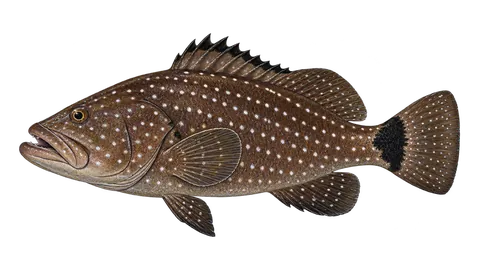
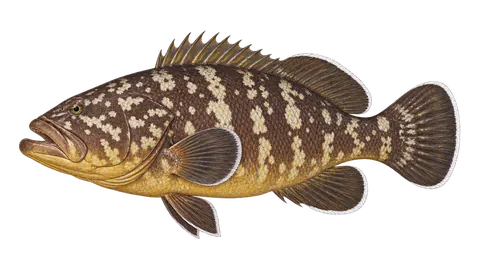
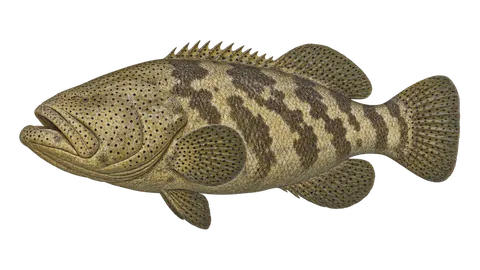
Tall, laterally compressed fish with a large head, a big mouth and a rough bony ridge running across the top of the gill cover. Blue-gray back, lighter sides with a silvery sheen, and dark brown, almost black fins. Juveniles have black spots on the head and body. The dorsal fin has 10 to 12 spines and the anal fin has 3. It can be confused with groupers and sea basses from the same habitat, such as the snowy grouper: the ridge on the gill cover is the clue. When in doubt, release it.
Also called: cherne-poveiro, cherne, wreckfish
don't confuse with:
where found
open on the large mapWhere to look: Steep rocky reefs on the upper slope, caves and shipwrecks, usually at 100 to 200 m and down to 600 m or more; juveniles stay near floating objects.
In the eastern Atlantic it ranges from Norway to South Africa; in the western Atlantic, from Newfoundland to North Carolina and from Uruguay to Argentina; it also occurs in the Indian Ocean and New Zealand. In Latin America it lives on the slope off Brazil, from south of Cabo Frio (RJ) to Rio Grande do Sul, most abundant at the far south, and also in Uruguay and Argentina.
coast
states
Rio de Janeiro, São Paulo, Paraná, Santa Catarina, Rio Grande do Sul
when to fish
best season
Spawning runs from July to October on the continental slope. In historical commercial fishing, the largest catches came from the far south in summer and autumn, and from 30 °S to 28 °S in winter and spring.
best time of day
Any time. At 100 m or deeper sunlight barely reaches, and the sources do not indicate a peak time. It is generally a solitary fish that stays in caves and wrecks.
what affects the wreckfish
cold and cold fronts
On the slope the water is cold and stable; surface weather changes little affect activity.
atmospheric pressure
Little documented effect; what matters is rough seas after a cold front.
moon
Little effect in deep water.
rain
No direct effect on the bottom.
water level
Not applicable at sea.
noise
Not very sensitive to boat noise, since the boat sits 100 m or more above.
wind
Strong wind pulls the boat off the spot and leaves the line at an angle in deep water.
tide
Strong current calls for very heavy sinkers and makes it hard to feel the bottom.
depth
Usually 100 to 200 m; the largest specimens occupy the deepest bands.
how to fish
tip from an angler
Protected species, not to be targeted. If you hook one while bottom fishing, release it immediately with a descending device, without taking the fish out of the water.
- rod
- heavy deep-sea fishing gear; the species is not a permitted target in Brazil
- spinning / baitcasting reel
- electric reel
- line
- braided line 80 lb or more
- leader
- monofilament 100 lb or more
- hook
- barbless circle hook
accessories
- descender or bottom-fish release tool
- long-nose pliers
catch and release
Protected species: release it right away. If it comes from 100 m or deeper, it suffers from decompression: use a descending device or a release tool, avoid taking the fish out of the water, and never use a gaff on its body.
rules for the wreckfish
Rules change; before keeping or transporting fish, check with the state environmental agency.
Threatened species in Brazil: catch banned
full protection details
The national list (Portaria GM/MMA nº 1.667/2026) classifies the species as CR. Under Portaria GM/MMA nº 1.666/2026 (art. 3), VU, EN and CR species have full protection: catch, transport, storage, processing and trade are banned. If you hook one by accident, release it right away, with minimal handling.
Source: Portaria GM/MMA nº 1.666/2026, art. 3º, and Portaria GM/MMA nº 1.667/2026
History: 10-year moratorium under IN MMA 37/2005
capture and trade banned since 2005confirm with the agency details
Instrução Normativa MMA 37/2005 (normative instruction of the MMA), of October 6, 2005, banned the capture and sale of the wreckfish in Brazilian jurisdictional waters for 10 years, subject to review. We found no specific extension. Today protection comes from the national list (CR) and from Portaria GM/MMA 1.666/2026, and capture remains prohibited.
Conservation: On the national list of threatened species as CR. IUCN global assessment: DD.
how much it weighs without taking it out of the water
estimated weight
—
how we calculate
Length-weight relationship W = a·Lb (a = 0.01318, b = 3.0; FishBase (relação peso-comprimento bayesiana, estimativa da própria espécie)). It's an average: a fat or lean fish can vary by 10% to 20%.
more about the wreckfish
The cherne-poveiro is a large demersal fish with a wide distribution in temperate and subtropical regions around the world. It lives among rocks, caves and wrecks on the slope and outer shelf, usually between 100 and 200 m, and can reach 600 m. In Brazil it is fished south of Cabo Frio, with the greatest abundance at the southern end. Juveniles spend years near the surface, alongside floating objects, before descending to the bottom. Females only mature at about 78 cm and 10 years, spawning runs from July to October on the slope, and the species lives past 60 years. This long, slow life, combined with targeted longline fishing since the 1970s, brought catches down, and the 2026 national list classifies it as Critically Endangered.
Family: Polyprionidae · predator
fun facts
- Juveniles spend up to four years near the surface, among floating objects, before descending to the bottom.
- In southern Brazil the maximum recorded age was 76 years for males and 62 years for females.
- Estimated annual catches in the South and Southeast fell 79% between 1989 and 2002, from 2,200 t to under 460 t.
in the kitchen
FishBase records fresh or frozen sales in other countries. In Brazil the high value of the wreckfish drove longline fishing and opened export markets; today capture, possession and sale are all prohibited.
similar species

sources and references (6)
The season weights (months), the time of day and the sensitivities (cold, pressure, moon, wind, rain, tide, strong light, murky water and noise) are the app's editorial estimates, based on the literature below and on field experience from anglers and guides. They are not official data or measurements made for this species and may vary by region and year. Closed seasons and legal rules appear in the rules section, with the rule and link. The fishing depth range, the common size and the ideal water temperature range, when FishBase does not give a value, are editorial estimates based on the species' biology.
- scientific FishBase: Polyprion americanus (ficha da espécie)Size, length-weight, depth, habitat, distribution, biology, and IUCN status. Page checked on Oct 13, 2026.
- scientific FishBase: nomes populares de Polyprion americanusNames by country and language.
- official Portaria GM/MMA nº 1.667, de 27 de abril de 2026: Lista Nacional Oficial de Espécies da Fauna Ameaçadas de Extinção (peixes e invertebrados aquáticos)The species is on the list. Checked in the DOU of April 28, 2026.
- scientific Haimovici, M.; Peres, M. B. (2005). Polyprion americanus, cherne-poveiro. Série Revizee-Score Sul, IOUSPDistribution in the South and Southeast, fishery trends, age, growth, maturity (77.9 cm and 10.4 years in females) and spawning from July to October.
- official Instrução Normativa MMA nº 37, de 6 de outubro de 200510-year moratorium on the capture and sale of the wreckfish; history of its protection.
- official Portaria GM/MMA nº 1.666, de 27 de abril de 2026: proteção integral das espécies VU, EN e CRArt. 3º: ban on the capture, transport, storage, processing and sale of VU, EN and CR species. We found no specific fishing rule for this species in Argentina or Uruguay.
how we calculatewhere each number comes from
The weather comes from three independent global models, cross-checked hour by hour: when they agree, confidence goes up; when they diverge, the band between them shows on the chart. Beyond 16 days, we use the GEFS ensemble of 31 simulations: if 20 of the 31 predict rain, the chance of rain is 65%. Sun and moon are calculated astronomically, with no uncertainty.
The index adds up, weighted for each species: time of day (species curve anchored to real sunrise and sunset), moon (transits, rise and set, phase), pressure (3 h trend and 24 h swing), water temperature (in rivers, estimated from air temperature; at sea, estimated by an ocean model), wind, rain, clouds, tide and the month in the species' cycle.
sources for this lookup
how accurate the forecast is
Accuracy measured in the reference project (4 regions, 93 days, forecast vs. observed): maximum temperature is off by 0.6 °C on average the next day and 1.7 °C at 7 days; rain of 5 mm or more is detected 76% of the time the next day and 57% at 7 days. Detection isn't everything: the false alarm rate isn't published here yet, and 93 days in 4 regions is still a small sample. We now also measure every day, at the app's destinations: