

midas cichlid
Amphilophus citrinellus
The mojarra of Nicaragua's great lakes, famous in the aquarium trade for its orange form. Small and feisty, it is light-tackle fishing from rocky shores.
- common size
- 15–22 cm
- maximum
- 25 cm
- common weight
- 0.1–0.3 kg
- record/max.
- 0.5 kg
- depth
- 0.5–10 m
- ideal water
- 25–30 °C
how to recognize it
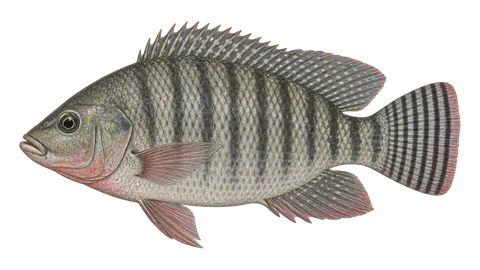
Deep, compressed body, small mouth with thin lips; adult males develop a bump on the nape and longer fins. Two color patterns: gray to brown with dark bars, or orange to gold, sometimes with black spots. The red devil (Amphilophus labiatus) has thick lips and a more pointed snout; tilapias have a different mouth and a dark spot on the dorsal fin of juveniles.
Also called: ciclídeo-midas, midas, mojarra-do-lago-nicarágua, Midas cichlid
don't confuse with:
where found
open on the large mapWhere to look: Rocky lake shores, with crevices and walls; calm stretches of low rivers.
Not found in Brazil. San Juan River basin in Nicaragua and Costa Rica: Lakes Nicaragua and Managua and crater lagoons such as Masaya and Apoyo. It was released outside its native range by aquarists (for example, in Puerto Rico), with no importance for fishing.
when to fish
next 7 days
Loading the next 7 days…
best season
Fishable all year. During spawning, pairs guard their crevices and strike any lure that comes close.
best time of day
Daytime. Active by day, feeding on the rocks in shallow water; at night it shelters in crevices.
what affects the midas cichlid
cold and cold fronts
Rare in the region.
atmospheric pressure
Little effect.
moon
Little effect.
rain
Heavy rain muddies the shore and reduces visual fishing.
water level
A stable level favors fishing on the rocks.
noise
Not very wary near the rocks.
wind
Strong waves on the rocky shore hinder light-tackle fishing.
depth
From 0.5 to 5 m near the rocks.
how to fish
lures
- micro jig 1 to 3 g
- spinner No. 0 to 1
- small nymphs and streamers for fly fishing
natural baits
- minhoca
- piece of shrimp
- massa
tip from an angler
Fish tight to the rocks with small bait: the midas nibbles a lot, so the hook must be small.
- rod
- light rod 5'6" to 6' (4 to 10 lb) or cane pole
- spinning / baitcasting reel
- spinning reel 1000 to 2000
- line
- monofilament 6 to 10 lb
- leader
- optional
- hook
- size 8 to 4
accessories
- small pliers
catch and release
Small, tough fish: remove the hook with pliers and release it quickly, near the rocks.
rules for the midas cichlid
Rules change; before keeping or transporting fish, check with the state environmental agency.
Nicaragua: mojarra at least 15 cm
15 cm details
The official table of minimum catch sizes from INPESCA for inland waters sets 15 cm for the mojarra (Amphilophus citrinellus). Smaller specimens must be returned to the water.
Source: INPESCA — Minimum catch sizes allowed, inland waters (2019)
how much it weighs without taking it out of the water
estimated weight
—
how we calculate
Length-weight relationship W = a·Lb (a = 0.02692, b = 3.03; FishBase (estimativa bayesiana para a família e o formato do corpo); peso máximo calculado por esta relação). It's an average: a fat or lean fish can vary by 10% to 20%.
more about the midas cichlid
Cichlid from the San Juan River basin in Nicaragua and Costa Rica, including Lakes Nicaragua (Cocibolca) and Managua (Xolotlán), and crater lagoons such as Masaya and Apoyo. It lives on rocky shores, with crevices where it spawns and guards its young, and is uncommon in rivers. It eats algae and what grows on the rocks, snails, larvae and small fish. About one in ten changes color as it grows and turns orange or gold; the rest are gray, brown or black, camouflaged on the bottom. It is the basis of one of the most studied cases of speciation in fishes. For anglers it is a light, fun target, caught with natural bait or micro-lures.
Family: Cichlidae · omnivore
fun facts
- In Nicaragua's crater lagoons, populations of the midas cichlid complex gave rise to new species, a classic case of sympatric speciation.
- The orange form, rare in nature, was the most sought after by the aquarium trade.
in the kitchen
Eaten fried whole in the region, like other mojarras.
similar species
sources and references (4)
The season weights (months), the time of day and the sensitivities (cold, pressure, moon, wind, rain, tide, strong light, murky water and noise) are the app's editorial estimates, based on the literature below and on the field experience of anglers and guides. They are not official data nor a measurement made for this species, and they may vary by region and year. Closed seasons and legal rules appear in the rules section, with the norm and a link.
- scientific FishBase — Amphilophus citrinellus (ficha da espécie)Names, distribution, biology, length-weight relationship, list of countries and references. Page checked 13/10/2026. The published maximum length is 24.4 cm standard length (without the tail).
- scientific IUCN Red List — Amphilophus citrinellus (avaliação global: Pouco Preocupante, LC, 07/11/2019)Global assessment. Link given on the FishBase entry (Red List, version 2025-2).
- official INPESCA (Nicarágua) — Tallas mínimas de captura permitidas: aguas continentales (2019)Official table with minimum sizes for mojarra, tiger guapote, lagunero guapote, gaspar, snook, roncador and tarpon.
- scientific Barluenga, M.; Stölting, K. N.; Salzburger, W.; Muschick, M.; Meyer, A. (2006). Sympatric speciation in Nicaraguan crater lake cichlid fish. Nature 439: 719-723.DOI checked in Crossref.