overview
who is the orangemouth corvina
Croaker endemic to the Mexican Pacific, from the Gulf of California to the Pacific coast of Mexico. It lives in coastal waters, bays and estuaries, over sand and mud bottoms, and preys on fish and shrimp. It reaches 1.29 m and 24.6 kg, making it one of the largest croakers in the genus. It has commercial importance in the gulf, and data on population status are scarce: the IUCN lists it as Data Deficient. It was introduced to the Salton Sea, a very salty lake in California, where it became a famous sport fish. For Mexican anglers it is a fish of beaches, boats and estuary mouths, caught with swimbaits, spoons, mid-water lures and live or cut fish.
fun facts
- It was introduced to the Salton Sea, a very salty lake in the California desert, where it came to support sport fishing.
- The name comes from the yellow-orange color inside its mouth.
how to recognize it
identification
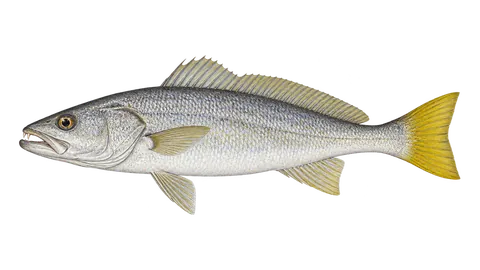
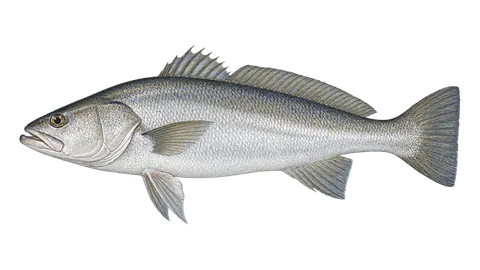
Elongated body, blue-gray back and silvery flank; large oblique mouth, protruding lower jaw and a pair of large canine teeth at the tip of the upper jaw. The inside of the mouth is yellow-orange, and the fins have a yellowish tone. The yellowtail croaker (corvina cola amarilla) is smaller and has a yellow tail; the Pacific white croaker does not have canines at the tip of the upper jaw.
how orangemouth corvina fishing looks
Loading the next 7 days…
Each card shows the day's index (0 to 100) and, below it, a strip with the index for each hour, from 0h to 23h. from poor to excellent.