

stolzmann's weakfish
Cynoscion stolzmanni
The Pacific yellowtail croaker, from the Gulf of California to Peru. Common in beaches, lagoons and estuaries, it is fished from the beach and from boats with natural bait and mid-water lures.
- common size
- 35–65 cm
- maximum
- 115 cm
- common weight
- 0.5–3 kg
- record/max.
- 9.5 kg
- depth
- 0.5–30 m
- ideal water
- 22–29 °C
how to recognize it
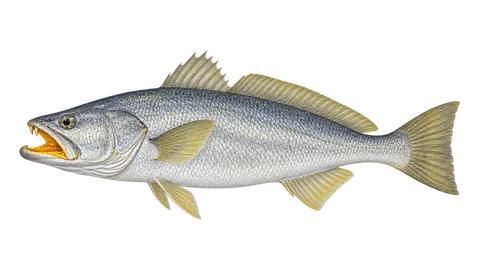
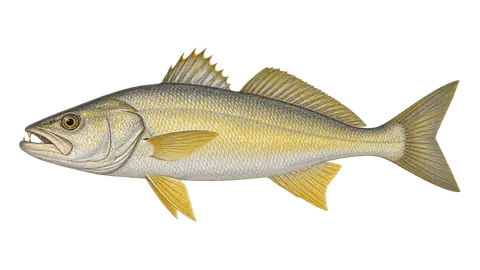
Elongated, silvery body, grayish back; large mouth with a pair of canines at the tip of the upper jaw. The tail is yellowish, hence the name coliamarilla. The orangemouth croaker, found only in Mexico, is larger and has an orange mouth inside; the Atlantic pescada amarela is a different species (Cynoscion acoupa).
Also called: corvina-rabo-amarelo, corvina-coliamarela, yellowtail corvina
don't confuse with:
where found
open on the large mapWhere to look: Beaches, coastal lagoons, estuaries and river mouths, over sand and mud; also offshore.
Not found in Brazil. Eastern Pacific, from the Gulf of California (Mexico) to Peru, through Central America, Colombia and Ecuador.
when to fish
next 7 days
Loading the next 7 days…
best season
Fishable all year in the tropical areas. Moon tides and river mouths with clear water produce more.
best time of day
Dawn and dusk. More active at dawn, dusk and night, when it enters shallow water.
what affects the stolzmann's weakfish
cold and cold fronts
Cold upwelling shuts down activity in the shallows.
atmospheric pressure
A front with a turning sea hinders beach fishing.
moon
Full-moon and new-moon tides move the water and activate the schools.
rain
Heavy rain muddies estuaries and river mouths; afterward, the murkier water can help with natural bait.
water level
Does not apply at sea. In the estuary, the rising tide brings fish inward.
noise
In shallow water, approach quietly.
wind
Strong wind raises surf and hinders beach fishing.
tide
Moving tide is best; slack tide tends to be weak.
depth
From the beach shallows out to about 20 m.
how to fish
lures
- jig head with 8 to 12 cm shad
- metal spoon
- jerkbait
natural baits
- live or dead shrimp
- fish pieces
- lula
tip from an angler
On the beach, look for channels between the sandbanks on the rising tide, and use shrimp on the bottom with a light sinker.
- rod
- 7' to 10', 12 to 25 lb (longer on the beach)
- spinning / baitcasting reel
- 3000 to 5000 spinning reel
- line
- braid 20 to 30 lb
- leader
- fluorocarbon 25 to 40 lb
- hook
- circle 1/0 to 4/0
accessories
- beach sinker 60 to 120 g
- alicate
catch and release
Hold it by the jaw with pliers or a fish grip, watch the canines, and release it quickly, facing the current.
rules for the stolzmann's weakfish
Rules change; before keeping or transporting fish, check with the state environmental agency.
Mexico: up to 5 per species and 10 saltwater fish per day
5 specimens of the species per angler per day, within the limit of 10 saltwater fish details
In recreational sport fishing in Mexican federal waters, each angler may keep up to 10 saltwater fish per day, no more than 5 of the same species. The yellowtail croaker (corvina coliamarilla) is not among the species reserved for sport fishing under art. 68 of the General Law of Sustainable Fishing and Aquaculture, and has no quota of its own. Fish over the limit must be returned alive to the water, and sport-caught fish may not be sold. Anglers fishing from a boat need a Conapesca permit.
how much it weighs without taking it out of the water
estimated weight
—
how we calculate
Length-weight relationship W = a·Lb (a = 0.00871, b = 3.06; FishBase (estimativa bayesiana para o gênero e o formato do corpo)). It's an average: a fat or lean fish can vary by 10% to 20%.
more about the stolzmann's weakfish
Eastern Pacific croaker, from the Gulf of California to Peru. It lives in coastal waters, lagoons and estuaries, also offshore, over sand and mud bottoms, and feeds mostly on small fish and shrimp. It reaches 1.15 m and 9.5 kg, but the common size is near 40 cm. It is of great commercial importance across the area, caught with nets and lines. For sport anglers it is a fish of beaches, river mouths and anchored boats, caught with shrimp, cut fish and mid-water lures, especially on moving tides.
Family: Sciaenidae · predator
fun facts
- One of the most commercially fished croakers in the tropical Pacific of the Americas.
- It changes name in each country: coliamarilla in Mexico, amarilla in Panama and guavina in Ecuador.
in the kitchen
Soft white flesh; fried, roasted or ceviche.
similar species
sources and references (4)
The season weights (months), the time of day and the sensitivities (cold, pressure, moon, wind, rain, tide, strong light, murky water and noise) are the app's editorial estimates, based on the literature below and on the field experience of anglers and guides. They are not official data nor a measurement made for this species, and they may vary by region and year. Closed seasons and legal rules appear in the rules section, with the norm and a link.
- scientific FishBase — Cynoscion stolzmanni (ficha da espécie)Names, distribution, biology, length-weight relationship, country list and references. Page checked on Oct 13, 2026.
- scientific IUCN Red List — Cynoscion stolzmanni (avaliação global: Pouco Preocupante, LC, 16/10/2019)Global assessment. Link given on the FishBase entry (Red List, version 2025-2).
- scientific Chao, L. N. (1995). Sciaenidae. Corvinas, barbiches, bombaches, corvinatas, corvinetas, corvinillas, lambes, pescadillas, roncachos, verrugatos. In: Fischer, W. et al. (eds.). Guía FAO para la identificación de especies para los fines de la pesca. Pacífico centro-oriental. Vol. 3, p. 1427-1518. Roma: FAO.FishBase reference for habitat, feeding and common size.
- official DOF — Modificação da NOM-017-PESC-1994, para regular a pesca deportivo-recreativa em águas de jurisdição federal do México (publicada em 25/11/2013)Daily limits at sea (item 4.9.1) and in fresh water (4.9.2), one rod in inland waters (4.6 b), ban on live fish as bait in inland waters (4.7 c) and on fishing in closed areas and seasons (4.10).