overview
who is the white seabass
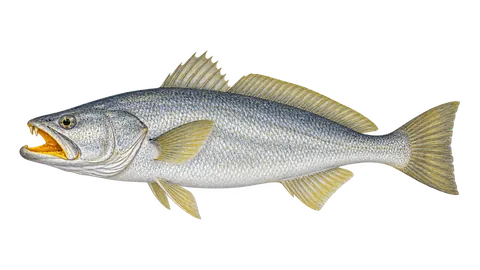
The largest croaker on the North American Pacific coast, reaching 1.66 m and 41 kg and living about 20 years. It occurs from Alaska to southern Baja California and in the Gulf of California, but is rare north of California. Adults travel in schools over rocky bottoms and in kelp forests, and sometimes enter the surf; juveniles live in bays and sandy beaches. It eats fish, squid and crustaceans. It is a difficult trophy: it appears and disappears, feeds heavily at night and during squid spawning, and fights with long runs. In Mexico it is fished from boats and from beaches along the Pacific coast of Baja California and the northern gulf.
fun facts
- Despite the name, it is not in the genus Cynoscion, of the best-known croakers and seatrouts, but in Atractoscion.
- In California, hatchery-reared juvenile release programs try to restore the species.
how to recognize it
identification
Elongated, slightly compressed body, blue-gray to bronze back, silvery flank and pale belly; juveniles have dark vertical bars. Large mouth, no chin barbel, and a fleshy fold at the base of the pelvic fins. Do not confuse it with the totoaba, which lives only in the Gulf of California and is protected, with fishing prohibited in Mexico: if in doubt, release. The orangemouth corvina has canine teeth at the tip of the upper jaw and an orange mouth inside.
how white seabass fishing looks
Loading the next 7 days…
Each card shows the day's index (0 to 100) and, below it, a strip with the index for each hour, from 0h to 23h. from poor to excellent.