

san francisco croaker
Pachyurus francisci
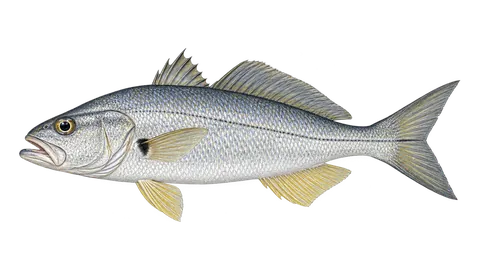
The corvina native to the São Francisco, with its mouth under the snout. A sand-bottom fish, good eating and common in bank fishing.
- common size
- 20–30 cm
- maximum
- 36 cm
- common weight
- 0.1–0.5 kg
- record/max.
- 0.8 kg
- depth
- 1–8 m
- ideal water
- 23–29 °C
how to recognize it
Elongated, silvery body, rounded snout projecting over the mouth, which sits underneath. Lateral line extending onto the tail and a dorsal fin split in two. The pescada-do-piauí has a large mouth at the tip of the snout and canine teeth.
Also called: corvina, curvina, corvina-de-água-doce, pescada, sofia
don't confuse with:
where found
open on the large mapWhere to look: Channel and eddies with sandy bottoms; reservoirs.
Endemic to the São Francisco basin, from the main channel in Minas Gerais to the lower course.
native to the basins
states
Minas Gerais, Bahia, Pernambuco, Alagoas, Sergipe
when to fish
next 7 days
Loading the next 7 days…
best season
Bites all year; best during falling water and with a clear river, August to October.
best time of day
Dawn and dusk. Most active at dawn and dusk, near the bottom.
what affects the san francisco croaker
cold and cold fronts
Strong cold reduces the bite.
atmospheric pressure
A cold front shuts down activity for a day or two.
moon
Little effect.
rain
Little effect, except in very muddy water.
water level
Stable or falling river.
noise
Moderately sensitive.
wind
Little effect.
depth
Bottom, 1 to 6 m.
how to fish
lures
- small jig dragged along the bottom
natural baits
- minhoca
- shrimp
- piece of fish
tip from an angler
Lure dragged slowly along the sandy bottom late in the afternoon.
- rod
- 6' to 6'6", medium action, 8 to 17 lb
- spinning / baitcasting reel
- spinning reel 2000 to 3000
- line
- monofilament 0.25 to 0.30 mm
- leader
- optional
- hook
- #2 to 1/0
accessories
- olive sinker
catch and release
Bottom fish: reel in slowly, unhook in the water and release.
rules for the san francisco croaker
Rules change; before keeping or transporting fish, check with the state environmental agency.
MG: minimum 30 cm
30 cmMG details
Minimum size for corvina (Pachyurus francisci) in Minas Gerais.
Source: Portaria IEF-MG nº 111/2003 (IEF minimum size table)
piracema and closed seasons
Each bar is the period when fishing is prohibited or restricted. The green line is today. Tap the name to see what is still allowed.
Spawning closure (piracema) in Minas Gerais (state rule)
Allowed: Only exotic or hybrid species, 3 kg plus one fish per day or outing, with handline, rod or pole with spinning or baitcasting reel (at most 5 per angler). Nets prohibited. Respect the minimum distances from dams, waterfalls and rapids and the marginal lagoons.
Source: Portarias IEF nº 154/2011 (São Francisco), 155/2011 (East) and 156/2011 (Grande/Paranaíba)
Closed season in Goiás (state rule)
Allowed: Sport and guided fishing only in reservoirs, catch and release with barbless hooks (no keeping, transporting or eating). Subsistence: up to 5 kg per day, for household consumption only.
Spawning closure (piracema) in the São Francisco River basin (rivers and reservoirs)
Allowed: Recreational fishing from a boat or from shore with handline, rod, spinning or baitcasting reel, up to 5 kg + 1 fish. Prohibited within 1,000 m of dams, waterfalls and rapids, and within 500 m of confluences. Floodplain lakes have a longer closed season (see next item).
Source: Portaria IBAMA nº 50/2007
São Francisco: floodplain lakes
Allowed: No fishing in the floodplain lakes during the period.
Source: Portaria IBAMA nº 50/2007
Conservation: Not on the national list (Portaria GM/MMA 1.667/2026). Global IUCN assessment: Data Deficient (DD).
how much it weighs without taking it out of the water
estimated weight
—
how we calculate
Length-weight relationship W = a·Lb (a = 0.00776, b = 3.15; FishBase). It's an average: a fat or lean fish can vary by 10% to 20%.
more about the san francisco croaker
Freshwater croaker endemic to the São Francisco basin, a relative of the corvinas and croakers of the sea. It lives in the channel and in eddies over sandy bottoms, where it feeds close to the bottom. It is commercially valuable in the region and a common catch for bottom anglers using worms and shrimp. The IUCN global assessment rates it Data Deficient. Don't confuse it with the pescada-do-piauí (Plagioscion squamosissimus), which has a large terminal mouth and also appears in São Francisco reservoirs.
Family: Sciaenidae · predator
fun facts
- Like other croakers, it can make drumming sounds with its swim bladder.
- Pachyurus means thick tail.
in the kitchen
White, soft flesh; fried as fillets or steaks.
similar species
sources and references (5)
The season weights (months), the time of day and the sensitivities (cold, pressure, moon, wind, rain, tide, strong light, murky water and noise) are the app's editorial estimates, based on the literature below and on the field experience of anglers and guides. They are not official data nor a measurement made for this species, and they may vary by region and year. Closed seasons and legal rules appear in the rules section, with the norm and a link.
- scientific FishBase — Pachyurus francisci (ficha da espécie)Names, distribution, biology, length-weight relationship and references. Page checked on October 13, 2026.
- official Portaria GM/MMA nº 1.667, de 27 de abril de 2026 — Lista Nacional Oficial de Espécies da Fauna Ameaçadas de Extinção (peixes e invertebrados aquáticos)Most recent national list. The species is not on it (search by scientific name in the text published in the DOU, checked on October 13, 2026).
- scientific IUCN Red List — Pachyurus francisci (avaliação global: Dados Insuficientes, DD, 30/07/2019)Global assessment. Link given on the FishBase entry (Red List, version 2025-2).
- official IEF-MG — Tamanhos mínimos de captura de peixes (Portaria IEF nº 111/2003)Official IEF table with common and scientific names; checked on Oct 13, 2026.
- scientific Pessali, T. C. et al. (2022). Length-weight relationships of 78 fish species from São Francisco River basin, Brazil. Journal of Applied Ichthyology.Length-weight relationship and maximum size used in FishBase for the species.