Skip to content
catalog Prochilodontidae · detritivore

curimatã-do-parnaíba

Prochilodus lacustris

Freshwater

The curimatã of the Parnaíba and Mearim rivers, in Piauí and Maranhão. A spawning-run fish (piracema) and mud eater, very common on riverside tables.

Also called: curimatã, curimatá, curimatã-do-parnaíba

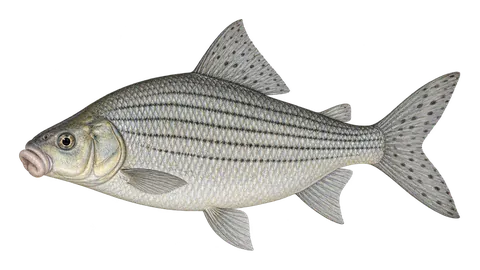
Scientific illustration of Curimatã-do-parnaíba
common size
20–32 cm
maximum
40 cm
common weight
0.3–0.9 kg
record/max.
1.1 kg
depth
0.5–5 m
ideal water
26–31 °C
overview

who is the curimatã-do-parnaíba

Prochilodus species from the Parnaíba (PI and MA) and Mearim (MA) basins, a relative of the curimbatá do Sul and the curimatãs of the São Francisco and eastern Northeast. It eats mud and organic matter from the bottom, scraping rocks and logs with thick lips, and forms shoals that run upriver to spawn at the start of the rains, in the piracema. FishBase records up to 34 cm standard length and 1.1 kg. In recreational fishing it is caught in numbers with dough and plant baits on small hooks, and it fights well for its size. It is protected by the piracema closures of the Parnaíba and the Maranhão rivers.

fun facts

  • Curimatãs are spawning-run fish (piracema): shoals run upriver at the start of the rains to spawn.
  • The FishBase length-weight relationship comes from fish from the Amazon coast of Maranhão.
how to recognize it

identification

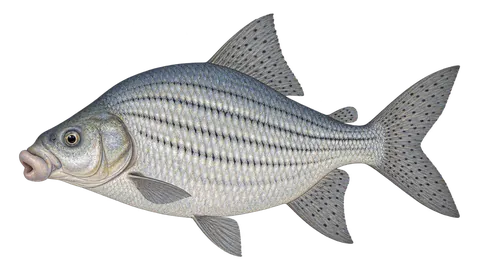
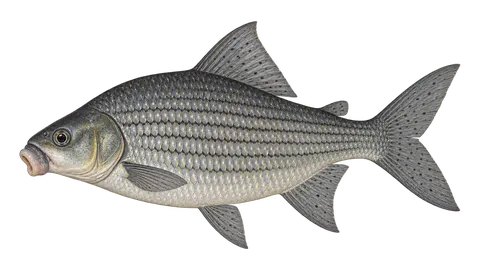
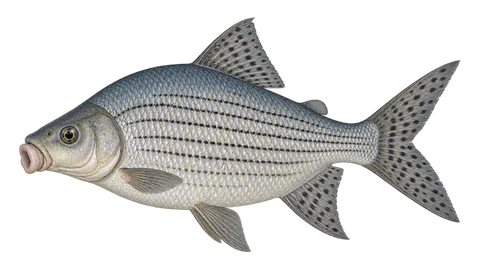
Tall, silvery body, rough scales, suction mouth with thick lips and rows of small teeth, facing forward. Dorsal and tail with dark spots or bands, as in other curimatãs. Told apart by area: it is the curimatã of the Parnaíba and the Maranhão rivers; the curimatã-comum (P. brevis) lives in the rivers of the eastern Northeast, the curimatã-pacu (P. argenteus) in the São Francisco and the curimatã (P. nigricans) in the Amazon.

how curimatã-do-parnaíba fishing looks

Loading the next 7 days…

Each card shows the day's index (0 to 100) and, below it, a strip with the index for each hour, from 0h to 23h. from poor to excellent.

distribution

where found

open on the large map

Parnaíba River (Piauí and Maranhão) and Mearim River (Maranhão) basins.

Habitat: Rivers, backwater lagoons and farm ponds (açudes); banks with mud, rocks and logs.

native to the basins

ParnaíbaWestern Northeast Atlantic

states

Piauí, Maranhão

calendar and clock

when to fish

best season

time of yearbest: May–Oct
JanFebSeaAprMayJunJulAugSepOctNovDec

Outside the spawning run (piracema), from mid to late dry season, with fish concentrated in pools and lagoons. During the piracema shoals run upriver to spawn and fishing closes.

best time of day

0h6h12h18h sunrise ~6amsunset ~6pm

Daytime. Feeds by day, scraping the bottom; more active early and late in the afternoon in heat.

weather, water and behavior

what affects the curimatã-do-parnaíba
sensitivity The little bars show how much each factor affects this species. Five full: it feels it a lot.

cold and cold fronts

Little relevance in the Northeast.

atmospheric pressure

Little effect.

moon

Little known effect.

rain

The first rains trigger the upstream run to spawn.

water level

In the dry season it stays in pools, lagoons and açudes.

noise

Moderate; the shoal is spooked by noise.

wind

Little effect.

depth

Mid-water and bottom, 0.5 to 3 m.

technique, gear and bait

how to fish

rod
cane pole or rod of 2.4 to 3 m, light action
spinning / baitcasting reel
spinning reel 1000 to 2500
line
monofilament 0.20 to 0.25 mm
leader
optional
hook
#8 to 12

natural baits

  • flour or bread dough
  • bran dough
  • boiled corn

accessories

  • small float
  • groundbait where permitted

tip from an angler

Small dough bait near the bottom, where the shoal is scraping. The bite is subtle: use a sensitive float.

what the law says

rules for the curimatã-do-parnaíba

Summary of the regulations we found, with the source for each. Rules change; before keeping or transporting fish, check with the state environmental agency.
Conservation: Not on the national list of threatened species (Portaria GM/MMA nº 1.667/2026). Other curimatãs on the list: Prochilodus britskii, P. harttii and P. vimboides.

We found no species-specific rule beyond the region's general rules.

piracema closures in the basins where the species lives

Spawning closure (piracema) in the Parnaíba River basin

15/11 to 16/03PIMACE

Allowed: Recreational fishing from a boat or from shore with handline, rod, spinning or baitcasting reel, up to 5 kg + 1 fish per day. Prohibited within 1,500 m of dams, waterfalls and rapids. Competitions prohibited.

Source: IN MMA nº 40/2005

Closed season in the Maranhão basins

01/12 to 30/03MA

Allowed: Recreational fishing from a boat or from shore with handline or rod, up to 5 kg or 1 fish. Transport only within the municipality. Competitions prohibited.

Source: Portaria IBAMA nº 85/2003

catch and release
catch and release Releasing the fish alive, quickly and with a wet hand. During a closed season it isn't always allowed: what the regulation says applies.

Handles quick handling well. Wet your hands and release it quickly.

in the kitchen

Tasty flesh with bones; roasted, fried or in fish stew.

calculator

how much it weighs without taking it out of the water

Length-weight relationship W = a·Lb (a = 0.02138, b = 2.99; FishBase). It's an average: a fat or lean fish can vary by 10% to 20%.

estimated weight

—

sources and references

The season weights (months), the time of day and the sensitivities (cold, pressure, moon, wind, rain, tide, strong light, murky water and noise) are the app's editorial estimates, based on the literature below and on the field experience of anglers and guides. They are not official data nor a measurement made for this species, and they may vary by region and year. Closed seasons and legal rules appear in the rules section, with the norm and a link.

  1. scientific FishBase — Prochilodus lacustris (ficha da espécie)Names, distribution, biology, length-weight relationship, country list and references. Page checked on Oct 13, 2026.
  2. scientific IUCN Red List — Prochilodus lacustris (avaliação global: Pouco Preocupante, LC, 07/11/2018)Global assessment. Link given on the FishBase entry (Red List, version 2025-2).
  3. official Portaria GM/MMA nº 1.667, de 27 de abril de 2026 — Lista Nacional Oficial de Espécies da Fauna Ameaçadas de Extinção (peixes e invertebrados aquáticos)The species is not on the list (checked against the text published in the DOU of 28/04/2026, section 1, p. 96).
  4. scientific Castro, R. M. C.; Vari, R. P. (2004). Detritivores of the South American fish family Prochilodontidae (Teleostei: Ostariophysi: Characiformes): a phylogenetic and revisionary study. Smithsonian Contributions to Zoology 622: 1-189.Revision of the family, the main reference for the species on FishBase. DOI checked on Crossref.
  5. scientific Santos, G. B. et al. (2019). Length-weight relationships of seven fish species from Amazonian Equatorial coast, Brazil. Journal of Applied Ichthyology 35: 1169-1171.Source of the maximum length and weight cited by FishBase. DOI checked on Crossref.
don't confuse

similar species