

- common size
- 20–32 cm
- maximum
- 40 cm
- common weight
- 0.3–0.9 kg
- record/max.
- 1.1 kg
- depth
- 0.5–5 m
- ideal water
- 26–31 °C

the right time
to be on the water
Choose the place and the species. The index, from 0 to 100, combines weather, sun, moon and tide with each fish's habits. Up to 28 days, with each day's confidence.
Loading the forecast…
—
Looking for alerts within 30 km…
Looking for what anglers have logged near here…
what you need to fish herelicense, certification and boat documents
fish likely at this spot
Tap a fish to see its forecast.
hour by hour
slide your finger or mouse over the chart to see each hoursee hour-by-hour table
why this index at —?
choose the day
the fishing month at a glance
what's the best window for the crew?
Choose how many fishing days. We compare each stretch by its average index, discount days with a warning or closed season, and show the 3 best.
trend for the coming weeks
Line: the middle value of 31 simulations of the American GEFS model. Band: where 8 out of 10 fall. Narrow, firm trend; wide, high uncertainty.
everything about the curimatã-do-parnaíba
how to recognize it
Tall, silvery body, rough scales, suction mouth with thick lips and rows of small teeth, facing forward. Dorsal and tail with dark spots or bands, as in other curimatãs. Told apart by area: it is the curimatã of the Parnaíba and the Maranhão rivers; the curimatã-comum (P. brevis) lives in the rivers of the eastern Northeast, the curimatã-pacu (P. argenteus) in the São Francisco and the curimatã (P. nigricans) in the Amazon.
Also called: curimatã, curimatá, curimatã-do-parnaíba
don't confuse with:
where found
open on the large mapWhere to look: Rivers, backwater lagoons and farm ponds (açudes); banks with mud, rocks and logs.
Parnaíba River (Piauí and Maranhão) and Mearim River (Maranhão) basins.
native to the basins
states
Piauí, Maranhão
when to fish
best season
Outside the spawning run (piracema), from mid to late dry season, with fish concentrated in pools and lagoons. During the piracema shoals run upriver to spawn and fishing closes.
best time of day
Daytime. Feeds by day, scraping the bottom; more active early and late in the afternoon in heat.
what affects the curimatã-do-parnaíba
cold and cold fronts
Little relevance in the Northeast.
atmospheric pressure
Little effect.
moon
Little known effect.
rain
The first rains trigger the upstream run to spawn.
water level
In the dry season it stays in pools, lagoons and açudes.
noise
Moderate; the shoal is spooked by noise.
wind
Little effect.
depth
Mid-water and bottom, 0.5 to 3 m.
how to fish
natural baits
- flour or bread dough
- bran dough
- boiled corn
tip from an angler
Small dough bait near the bottom, where the shoal is scraping. The bite is subtle: use a sensitive float.
- rod
- cane pole or rod of 2.4 to 3 m, light action
- spinning / baitcasting reel
- spinning reel 1000 to 2500
- line
- monofilament 0.20 to 0.25 mm
- leader
- optional
- hook
- #8 to 12
accessories
- small float
- groundbait where permitted
catch and release
Handles quick handling well. Wet your hands and release it quickly.
rules for the curimatã-do-parnaíba
Rules change; before keeping or transporting fish, check with the state environmental agency.
We found no species-specific rule beyond the region's general rules.
piracema and closed seasons
Each bar is the period when fishing is prohibited or restricted. The green line is today. Tap the name to see what is still allowed.
Spawning closure (piracema) in the Parnaíba River basin
Allowed: Recreational fishing from a boat or from shore with handline, rod, spinning or baitcasting reel, up to 5 kg + 1 fish per day. Prohibited within 1,500 m of dams, waterfalls and rapids. Competitions prohibited.
Source: IN MMA nº 40/2005
Closed season in the Maranhão basins
Allowed: Recreational fishing from a boat or from shore with handline or rod, up to 5 kg or 1 fish. Transport only within the municipality. Competitions prohibited.
Source: Portaria IBAMA nº 85/2003
Conservation: Not on the national list of threatened species (Portaria GM/MMA nº 1.667/2026). Other curimatãs on the list: Prochilodus britskii, P. harttii and P. vimboides.
how much it weighs without taking it out of the water
estimated weight
—
how we calculate
Length-weight relationship W = a·Lb (a = 0.02138, b = 2.99; FishBase). It's an average: a fat or lean fish can vary by 10% to 20%.
more about the curimatã-do-parnaíba
Prochilodus species from the Parnaíba (PI and MA) and Mearim (MA) basins, a relative of the curimbatá do Sul and the curimatãs of the São Francisco and eastern Northeast. It eats mud and organic matter from the bottom, scraping rocks and logs with thick lips, and forms shoals that run upriver to spawn at the start of the rains, in the piracema. FishBase records up to 34 cm standard length and 1.1 kg. In recreational fishing it is caught in numbers with dough and plant baits on small hooks, and it fights well for its size. It is protected by the piracema closures of the Parnaíba and the Maranhão rivers.
Family: Prochilodontidae · detritivore
fun facts
- Curimatãs are spawning-run fish (piracema): shoals run upriver at the start of the rains to spawn.
- The FishBase length-weight relationship comes from fish from the Amazon coast of Maranhão.
in the kitchen
Tasty flesh with bones; roasted, fried or in fish stew.
similar species
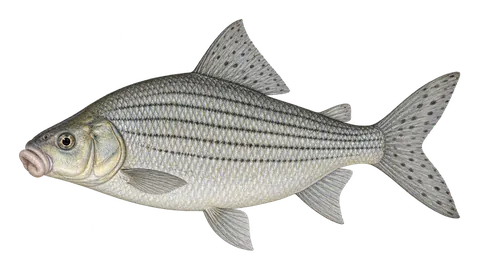
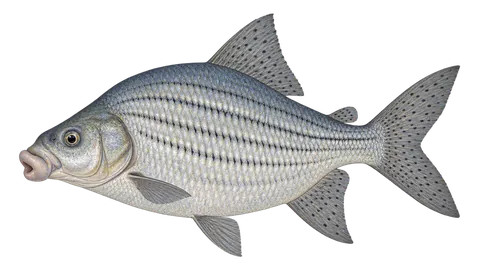
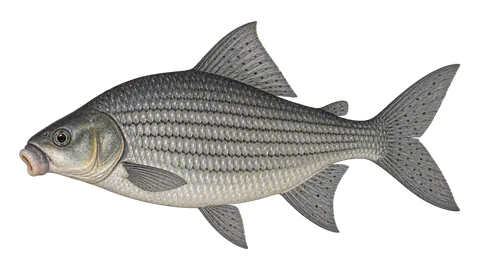
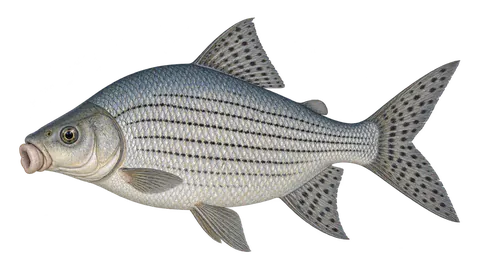
sources and references (5)
The season weights (months), the time of day and the sensitivities (cold, pressure, moon, wind, rain, tide, strong light, murky water and noise) are the app's editorial estimates, based on the literature below and on the field experience of anglers and guides. They are not official data nor a measurement made for this species, and they may vary by region and year. Closed seasons and legal rules appear in the rules section, with the norm and a link.
- scientific FishBase — Prochilodus lacustris (ficha da espécie)Names, distribution, biology, length-weight relationship, country list and references. Page checked on Oct 13, 2026.
- scientific IUCN Red List — Prochilodus lacustris (avaliação global: Pouco Preocupante, LC, 07/11/2018)Global assessment. Link given on the FishBase entry (Red List, version 2025-2).
- official Portaria GM/MMA nº 1.667, de 27 de abril de 2026 — Lista Nacional Oficial de Espécies da Fauna Ameaçadas de Extinção (peixes e invertebrados aquáticos)The species is not on the list (checked against the text published in the DOU of 28/04/2026, section 1, p. 96).
- scientific Castro, R. M. C.; Vari, R. P. (2004). Detritivores of the South American fish family Prochilodontidae (Teleostei: Ostariophysi: Characiformes): a phylogenetic and revisionary study. Smithsonian Contributions to Zoology 622: 1-189.Revision of the family, the main reference for the species on FishBase. DOI checked on Crossref.
- scientific Santos, G. B. et al. (2019). Length-weight relationships of seven fish species from Amazonian Equatorial coast, Brazil. Journal of Applied Ichthyology 35: 1169-1171.Source of the maximum length and weight cited by FishBase. DOI checked on Crossref.
how we calculatewhere each number comes from
The weather comes from three independent global models, cross-checked hour by hour: when they agree, confidence goes up; when they diverge, the band between them shows on the chart. Beyond 16 days, we use the GEFS ensemble of 31 simulations: if 20 of the 31 predict rain, the chance of rain is 65%. Sun and moon are calculated astronomically, with no uncertainty.
The index adds up, weighted for each species: time of day (species curve anchored to real sunrise and sunset), moon (transits, rise and set, phase), pressure (3 h trend and 24 h swing), water temperature (in rivers, estimated from air temperature; at sea, estimated by an ocean model), wind, rain, clouds, tide and the month in the species' cycle.
sources for this lookup
how accurate the forecast is
Accuracy measured in the reference project (4 regions, 93 days, forecast vs. observed): maximum temperature is off by 0.6 °C on average the next day and 1.7 °C at 7 days; rain of 5 mm or more is detected 76% of the time the next day and 57% at 7 days. Detection isn't everything: the false alarm rate isn't published here yet, and 93 days in 4 regions is still a small sample. We now also measure every day, at the app's destinations: