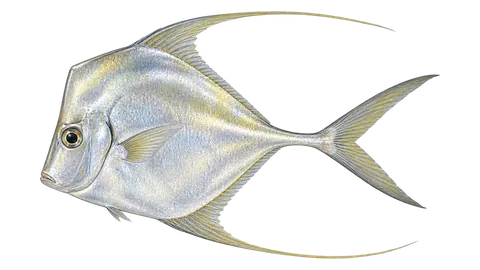
atlantic spadefish
Chaetodipterus faber
Disc-shaped fish, silvery with dark bands, that travels in schools around piers, wrecks, and platforms. Fights well and is good eating.
Also called: enxada, paru, paru-branco, peixe-enxada, parum

- common size
- 25–45 cm
- maximum
- 91 cm
- common weight
- 0.4–2.5 kg
- record/max.
- 9.0 kg
- depth
- 1–45 m
- ideal water
- 22–28 °C
who is the atlantic spadefish
The enxada, or paru, is an ephippid with a disc-shaped body, very tall and compressed, common in shallow coastal waters, from mangroves and beaches to ports, piers, wrecks, and platforms, from Massachusetts in the United States to Rio Grande do Sul. Adults form schools of hundreds of fish and often circle divers. Juveniles, almost black, live in estuaries and mimic dead leaves or mangrove propagules floating on their side. It eats bottom invertebrates such as crustaceans, mollusks, worms, and cnidarians, and also plankton. It is caught with shrimp and shellfish from piers and boats and fights well for its size. The flesh is good and sold fresh.
fun facts
- Juveniles, almost black, mimic leaves and floating mangrove propagules.
- Schools of adults often circle divers.
identification
Disc-shaped body, very tall and compressed, short, blunt snout, small mouth. Silver to gray with wide, irregular, vertical dark bands that fade with age. Second dorsal and anal fins with tall, sickle-shaped front lobes. Juveniles almost entirely black. Unmistakable on the Brazilian coast.
Loading the next 7 days…
Each card shows the day's index (0 to 100) and, below it, a strip with the index for each hour, from 0h to 23h. from poor to excellent.
where found
All along the coast, from Amapá to Rio Grande do Sul.
Habitat: Shallow coastal waters: mangroves, beaches, ports, piers, wrecks, reefs, and platforms; juveniles in estuaries.
coast
states
Amapá, Pará, Maranhão, Piauí, Ceará, Rio Grande do Norte, Paraíba, Pernambuco, Alagoas, Sergipe, Bahia, Espírito Santo, Rio de Janeiro, São Paulo, Paraná, Santa Catarina, Rio Grande do Sul
when to fish
best season
In the Southeast and South, schools come close in the warm months; in the Northeast, all year.
best time of day
Daytime. Active by day, in schools around structures.
what affects the atlantic spadefish
sensitivity The little bars show how much each factor affects this species. Five full: it feels it a lot.
cold and cold fronts
Cold water keeps schools away from the coast.
atmospheric pressure
A cold front shuts down activity.
moon
Small effect.
rain
Not very sensitive.
water level
Juveniles use the estuaries.
noise
Curious; often approaches divers and stopped boats.
wind
Rough seas prevent fishing at structures.
tide
Moving tide brings food to structures.
depth
2 to 30 m around piers, wrecks, and platforms.
how to fish
- rod
- 6'0" to 7'0", 10 to 20 lb
- spinning / baitcasting reel
- spinning reel 2500 to 4000
- line
- braided 15 to 20 lb
- leader
- fluorocarbon 20 to 30 lb
- hook
- chinu 2 to 5 or maruseigo 10 to 14 (small mouth)
natural baits
- shrimp
- marisco
- sea worm (polychaete)
- squid cut into small pieces
accessories
- light sinker
- ceva
tip from an angler
Use a small hook: the enxada has a small mouth and nibbles before swallowing.
rules for the atlantic spadefish
Summary of the regulations we found, with the source for each. Rules change; before keeping or transporting fish, check with the state environmental agency.
Conservation: Not on the national list (Portaria GM/MMA 1.667/2026). We found no specific federal rule for this species.
We found no species-specific rule beyond the region's general rules.
catch and release
catch and release Releasing the fish alive, quickly and with a wet hand. During a closed season it isn't always allowed: what the regulation says applies.
Hold it by the base of the tail and under the belly, without squeezing. Release it quickly at the same spot.
in the kitchen
White, tasty flesh, good baked, fried, or in moqueca. There are ciguatera records in other regions.
how much it weighs without taking it out of the water
Length-weight relationship W = a·Lb (a = 0.03388, b = 2.95; FishBase (estimativa bayesiana, comprimento total)). It's an average: a fat or lean fish can vary by 10% to 20%.
estimated weight
—
sources and references
The season weights (months), the time of day and the sensitivities (cold, pressure, moon, wind, rain, tide, strong light, murky water and noise) are the app's editorial estimates, based on the literature below and on the field experience of anglers and guides. They are not official data nor a measurement made for this species, and they may vary by region and year. Closed seasons and legal rules appear in the rules section, with the norm and a link.
- scientific FishBase — Chaetodipterus faber (ficha da espécie)Names, distribution, biology, length-weight relationship and references. Page checked on October 13, 2026.
- official Portaria GM/MMA nº 1.667, de 27 de abril de 2026 — Lista Nacional Oficial de Espécies da Fauna Ameaçadas de Extinção (peixes e invertebrados aquáticos)Most recent national list. The species is not on it (search by scientific name in the text published in the DOU, checked on October 13, 2026).
- official ICMBio/SALVE — Ficha de Chaetodipterus faber (avaliação nacional do risco de extinção)ICMBio national assessment, published in 2025. DOI checked on Crossref.
- scientific IUCN Red List — Chaetodipterus faber (avaliação global: Pouco Preocupante, LC, 29/01/2013)Global assessment. Link given on the FishBase entry (Red List, version 2025-2).
- scientific Figueiredo, J. L.; Santos, A. P.; Yamaguti, N.; Bernardes, R. A.; Rossi-Wongtschowski, C. L. D. B. (2002). Peixes da zona econômica exclusiva da região Sudeste-Sul do Brasil: levantamento com rede de meia-água. São Paulo: Edusp; Imprensa Oficial. 242 p.Printed work; the URL is the bibliographic record on FishBase, which cites this work for the species.
- scientific Szpilman, M. (2000). Peixes marinhos do Brasil: guia prático de identificação. Rio de Janeiro: Instituto Ecológico Aqualung. 288 p.Printed work; the URL is the bibliographic record on FishBase, which cites this work for the species.
- scientific Menezes, N. A.; Buckup, P. A.; Figueiredo, J. L.; Moura, R. L. (orgs.) (2003). Catálogo das espécies de peixes marinhos do Brasil. São Paulo: Museu de Zoologia da USP. 160 p.List of marine species recorded in Brazil. Printed work; the URL is the bibliographic record in FishBase, which cites this work for the species.