

mackerel scad
Decapterus macarellus
Small, slender schooling carangid that lives in blue water near islands and reef edges. It is worth more as live bait or in strips than as a sport fish.
- common size
- 25–35 cm
- maximum
- 46 cm
- common weight
- 0.2–0.5 kg
- record/max.
- — kg
- depth
- 40–200 m
- ideal water
- 22–28 °C
how to recognize it
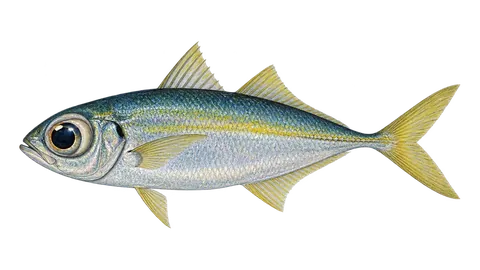
Spindle-shaped, slender carangid, blue-green on the back and silvery below, with a small black spot on the upper edge of the gill cover and a yellow-green tail. No teeth. The last ray of the dorsal and anal fins forms a loose finlet. Bony scutes on the straight part of the lateral line. The membrane in front of the upper jaw is white in adults. The bigeye scad (Selar crumenophthalmus) is deeper-bodied, with a much larger eye; in the Northeast, 'garapau' is also a local name for the bigeye scad.
Also called: garapau, olhão, oião, cavalinha-de-reis, mackerel scad, cigarfish
don't confuse with:
where found
open on the large mapWhere to look: Clear blue water near islands and along reef edges that drop into deep water, usually 40 to 200 m; sometimes near the surface.
In Brazil, from the North to the Southeast, down to around Rio de Janeiro, according to FishBase; artisanal fishers in Ceará and Pernambuco know it. In Latin America, FishBase's list includes Mexico, Central America, the Caribbean, Colombia, Venezuela, the Guianas and Ecuador.
coast
when to fish
next 7 days
Loading the next 7 days…
best season
Present all year in tropical water; closer to islands and shoals when the water is blue and warm in summer.
best time of day
Daytime, with peaks at dawn and dusk. Schools by day; rises nearer the surface in late afternoon and at dawn.
what affects the mackerel scad
cold and cold fronts
A warm, blue-water fish: it leaves the fishing zone when the water cools or turns green.
atmospheric pressure
Small effect.
moon
Small effect; the school concentrates in spring tide currents.
rain
Little effect in open sea; muddy river water pushes the school away.
water level
Not applicable at sea. The equivalent is clear blue water over the reef edge.
noise
Small effect.
wind
Rough seas make it hard to hold position over the school marked on the sonar.
tide
Current over points and reef edges concentrates plankton and schools.
depth
40 to 200 m for most catches; on the sonar it shows as patches over the reef edge.
how to fish
lures
- feather or glow sabiki
- small jig, 10 to 30 g
natural baits
- squid strips
- shrimp
- fish pieces
tip from an angler
Mark the school on the sonar, drop the sabiki to depth and reel up slowly with pauses. For live bait, keep the garapau in a live well with running water.
- rod
- 6' to 7', fast action, 8 to 15 lb
- spinning / baitcasting reel
- spinning reel 2500 to 4000
- line
- braided line 10 to 20 lb
- leader
- fluorocarbon 15 to 25 lb, 1 m
- hook
- sabiki with small hooks or a simple hook no. 4 to 1/0
accessories
- live well with circulating water
- bucket with aerator
- alicate
catch and release
Small, delicate fish that stresses out of the water: release it quickly, with wet hands, or use it as live bait. Cut the leader close to the mouth if the hook is deep.
rules for the mackerel scad
Rules change; before keeping or transporting fish, check with the state environmental agency.
Mexico: up to 5 per species and 10 saltwater fish per day
5 specimens of the species per angler per day, within the limit of 10 saltwater fish details
In recreational fishing in Mexican federal waters, each angler may keep up to 10 marine fish per day, no more than 5 of the same species. The garapau is not among the species reserved for recreational fishing and has no quota of its own. Fish over the limit go back into the water alive, and fish caught in recreational fishing may not be sold. Anyone fishing from a boat needs the recreational fishing permits set out in the rule.
Conservation: Not on the Brazilian national list (Portaria GM/MMA nº 1.667/2026). Outside Mexico we found no specific rule for the species.
how much it weighs without taking it out of the water
estimated weight
—
how we calculate
Length-weight relationship W = a·Lb (a = 0.01202, b = 2.99; FishBase (relação peso-comprimento bayesiana, estimativa da própria espécie)). It's an average: a fat or lean fish can vary by 10% to 20%.
more about the mackerel scad
The garapau (mackerel scad) is a small, slender schooling carangid that lives in clear and oceanic waters worldwide. In the western Atlantic it ranges from Nova Scotia and Bermuda to around Rio de Janeiro, and FishBase says it seems to be absent from the Gulf of Mexico. It prefers blue water near islands, usually between 40 and 200 m, in fast schools along reef edges near deep water, sometimes near the surface. It feeds mainly on zooplankton. It reaches 46 cm, with a common length of 30 cm. It is caught with purse seines and trawls and sold fresh, salted or dried; FishBase lists its use as bait. Ciguatera has been recorded. Artisanal fishers in Ceará and Pernambuco call it garapau, olhão and oião.
Family: Carangidae · forage fish
fun facts
- FishBase records the use of garapau as bait ('bait: usually').
- In the Northeast, 'garapau' is also a local name for the bigeye scad, which mixes the two species in dockside talk.
- Schools race at high speed along the edge of reefs that drop into the deep sea (FishBase).
in the kitchen
Small, with dark, firm flesh, sold fresh, salted or dried. FishBase records ciguatera cases in this species: check with local fishers before eating it.
similar species

sources and references (5)
The season weights (months), the time of day and the sensitivities (cold, pressure, moon, wind, rain, tide, strong light, murky water and noise) are the app's editorial estimates, based on the literature below and on the field experience of anglers and guides. They are not official data nor a measurement made for this species, and they may vary by region and year. Closed seasons and legal rules appear in the rules section, with the norm and a link.
- scientific FishBase: Decapterus macarellus (ficha da espécie)Size, length-weight, depth, habitat, distribution, biology and IUCN status. Page checked Oct 13, 2026. The common size range is an editorial estimate around the common length of 30 cm reported by FishBase.
- scientific FishBase: nomes populares de Decapterus macarellusNames by country and language.
- official Portaria GM/MMA nº 1.667, de 27 de abril de 2026: Lista Nacional Oficial de Espécies da Fauna Ameaçadas de Extinção (peixes e invertebrados aquáticos)The species is not on the list. Checked in the DOU of April 28, 2026.
- scientific Pinto, M. F.; Mourão, J. S.; Alves, R. R. N. (2015). Use of ichthyofauna by artisanal fishermen at two protected areas along the coast of Northeast Brazil. Journal of Ethnobiology and Ethnomedicine.Common names recorded from artisanal fishers in Tamandaré (PE) and the Batoque Extractive Reserve (CE).
- official NOM-017-PESC-1994 (pesca deportivo-recreativa em águas de jurisdição federal do México), modificação publicada no DOF em 25/11/2013 (Sagarpa/Conapesca)Limit of 10 marine fish per angler per day, no more than 5 of the same species (item 4.9.1), return of the excess (4.9.5) and ban on selling sport-caught fish (4.11). Text checked Oct 13, 2026. The rule sets no quota of its own for this species.