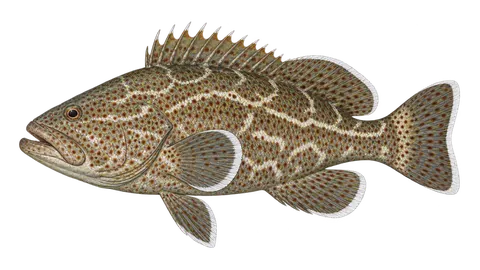
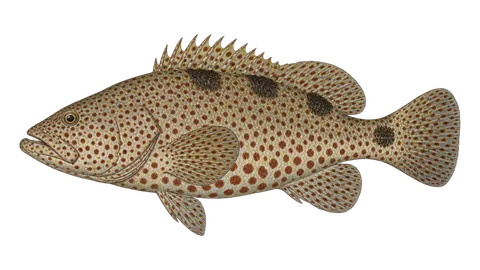
Eastern Pacific grouper, beige to gray and covered with reddish-brown specks, reaching over 1 m and 22 kg. Lives on rocky reefs and shallow estuaries, from California to Peru, and is heavily fished in the Gulf of California.
Also called: garoupa-moteada, cabrilla pinta, mero pintado, Spotted cabrilla, Spotted grouper
Eastern Pacific grouper, from southern California (USA) to Peru, including the Revillagigedo, Clipperton, Cocos, Malpelo and Galápagos islands; according to FishBase, it is the most abundant small grouper in the northern Gulf of California. Lives on rocky reefs and reef patches, on rock and sand bottoms and in shallow estuaries, at least 50 m deep and, according to STRI, down to 107 m. Eats crustaceans and fish and, in winter, comes closer to shore to feed on schools of the red pelagic crab Pleuroncodes planipes. It exceeds 1 m: the IGFA record, 22.31 kg, was caught at Cedros, Baja California, in 1990, according to a Mexican guide. It is a highly sought-after food fish.
fun facts
The Mexican guide says it can be mistaken for the juvenile Pacific grouper (Epinephelus quinquefasciatus) and the sand cabrilla (Paralabrax maculatofasciatus).
According to FishBase, in winter it comes closer to shore following the swarms of the red pelagic crab.
how to recognize it
identification
Elongated, robust body, grayish beige to light reddish-brown, covered with many reddish-brown specks, pupil-sized on the body and smaller on the head and fins. It has four broad, faded dark bars on the upper half of the flank, which run up onto the dorsal; juveniles have relatively larger specks and stronger bars. The tail is rounded and the edge of the preopercle is serrated. The starry grouper (Epinephelus labriformis) is more olive-green, with white spots and a black saddle at the base of the tail.
how spotted grouper fishing looks
Loading the next 7 days…
Each card shows the day's index (0 to 100) and, below it, a strip with the index for each hour, from 0h to 23h. from poor to excellent.
Does not occur in Brazil. Eastern Pacific, from southern California (USA) to Peru, including Revillagigedo, Clipperton, Cocos, Malpelo and Galápagos; in Mexico, in all Pacific waters. FishBase lists Mexico, Guatemala, El Salvador, Honduras, Nicaragua, Costa Rica, Panama, Colombia, Ecuador and Peru.
Habitat: Rocky reefs and reef patches, rock and sand bottoms and shallow estuaries; in winter it comes closer to shore.
calendar and clock
when to fish
best season
time of yearbest: Dec–Mar
JanFebSeaAprMayJunJulAugSepOctNovDec
In winter it comes closer to shore to feed on schools of the red pelagic crab (Pleuroncodes planipes), according to FishBase, which improves fishing on shallow rocks; the app gives more weight to December through March.
best time of day
Dawn and dusk. The Mexican guide says it hunts crustaceans at night and fish by day. The app's estimate gives more weight to dawn and dusk.
weather, water and behavior
what affects the spotted grouper
sensitivity The little bars show how much each factor affects this species. Five full: it feels it a lot.
cold and cold fronts
Cold water reduces activity; in winter the fish tends to move.
atmospheric pressure
A strong front with rough seas hurts rock fishing and boat fishing.
moon
Small effect and no study for the species.
rain
Little effect at sea; a river flowing in murky near the estuary scatters the fish.
water level
Not applicable at sea.
noise
A boat knocking on the rocks and a nearby motor scare the fish; approach drifting or with an electric motor.
wind
Rough seas hamper rocky-shore and boat fishing.
tide
A current running past the rock and bringing food is best.
depth
From 5 to 50 m near rocks and reefs; it can go much deeper.
low-profile or small conventional reel, or spinning reel 6000 to 8000, with strong drag
line
braid 40 to 65 lb
leader
fluorocarbon 60 to 80 lb, 1 to 2 m
hook
circle 5/0 to 8/0 on natural bait; assist hooks on jigs
lures
metal jig 80 to 200 g
large shad on a heavy jig head
deep-diving plug alongside the rocks
natural baits
live or dead sardine or mackerel
whole or strip squid
caranguejo
accessories
descender for bottom fish
long-nose pliers
luvas
boga-grip
tip from an angler
On the hookset, set the hook and bring the fish up right away: it runs into the rock and the line scrapes. Bring a descender to release fish that exceed the limit or the size.
what the law says
rules for the spotted grouper
Summary of the regulations we found, with the source for each. Rules change; before keeping or transporting fish, check with the state environmental agency. Conservation: Of little concern globally. The author of the Mexican guide consulted says that in areas of the central Gulf of California with decades of intense fishing it has almost disappeared, because it grows and reproduces slowly. Not listed in Mexico's NOM-059-SEMARNAT-2010.
Mexico: up to 5 per species and 10 saltwater fish per day
5 specimens of the species per angler per day, within the limit of 10 saltwater fish
In federal waters of Mexico, recreational sport fishing allows each angler to keep up to 10 marine fish per day, no more than 5 of the same species. The spotted grouper (garoupa-moteada) is not among the species reserved for sport fishing (marlins, sailfish, swordfish, "sábalo o chiro" (tarpon), roosterfish and dorado, up to 50 nautical miles from shore, item 0.3 of the standard) and has no quota of its own. Fish over the quota must go back alive (item 4.9.5), and sport-caught fish may not be sold. Anyone fishing from a boat needs the permits under the Federal Duties Law; from shore, no (item 4.3).
Nicaragua (Pacific): groupers and cabrillas at least 35 cm
35 cmconfirm with the agency
The minimum catch size table for Nicaragua's Pacific coast sets 35 cm for groupers of the genera Epinephelus and Mycteroperca, a group that includes the spotted grouper (Epinephelus analogus). The Pacific table does not say which kind of length applies (the Caribbean table uses total length), so measure total length. We did not confirm whether another rule replaced the 2012 resolution.
Personal Incopesca license, for people over 16confirm with the agency
In the regulation of the Fisheries and Aquaculture Law (Decree 36782, of May 24, 2011), art. 69, sport fishing is authorized only for natural persons over 16, with a license issued by Incopesca; tourists, whether national or foreign, also need the license. Art. 68 limits the landing of large pelagics to 5 per trip, and art. 66 promotes catch and release, but the rule sets no quota for this species. The decree was later amended (Decree 39458), so confirm the current rule with Incopesca.
Panama: new sport fishing decree in force from Dec 10, 2026
Executive Decree No. 9 (Jun 10, 2026), in force from Dec 10, 2026confirm with the agency
ARAP published Executive Decrees No. 9 and No. 10, of Jun 10, 2026, in the Official Gazette. The first regulates sport fishing throughout the territory; the second protects billfish (sailfish and marlins). Both take effect on Dec 10, 2026, after six months of adaptation. We did not verify the text: the press report gives no catch limits, sizes or license requirements. Before fishing in Panama, check with ARAP.
Colombia: AUNAP license and catch-and-release in sport fishing
Individual AUNAP license; catch-and-release guidanceconfirm with the agency
AUNAP Resolution 0549 of 2022 sets the guidelines for sport fishing for recreational purposes in Colombia. Anyone fishing needs a permit: for a natural person, Colombian or foreign, it is a personal, non-transferable license (art. 6). The rule uses "capture and release" as guidance. We did not verify the daily limit or the minimum sizes by species: check with AUNAP before keeping any fish.
catch and release Releasing the fish alive, quickly and with a wet hand. During a closed season it isn't always allowed: what the regulation says applies.
A deep-water rockfish can rise with an inflated swim bladder: use a descender to return it to depth. Don't puncture the bladder. Hold it by the mouth with a boga-grip and support its belly.
in the kitchen
White, firm flesh, highly prized; fillets, ceviche or baked. The Mexican guide treats it as an excellent food fish in high demand.
calculator
how much it weighs without taking it out of the water
Length-weight relationship W = a·Lb (a = 0.01148, b = 3.04; FishBase (relação peso-comprimento bayesiana, estimativa pelo gênero e formato do corpo)). It's an average: a fat or lean fish can vary by 10% to 20%.
estimated weight
—
sources and references
The seasonal weights (months), time of day and sensitivities (cold, pressure, moon, wind, rain, tide, strong light, murky water and noise) are the app's editorial estimates, based on the literature below and on the field experience of anglers and guides. They are not official data or measurements made for this species, and they may vary by region and year. Closed seasons and legal rules appear in the rules section, with the rule and link. The common size is an editorial estimate (FishBase gives no common length for this species), supported by the specimens photographed in the Mexican guide; the common weight is calculated from the length-weight relationship.
technicalMexican Fish (mexican-fish.com): ficha do Spotted Cabrilla (Epinephelus analogus)Independent guide to fishes of the Mexican Pacific, with catch photos and the author's observations; not an official source. Page checked Oct 13, 2026. Reports the IGFA record of 22.31 kg (Cedros, 1990), presence throughout the Mexican Pacific, and the overfishing warning for the central Gulf of California, which is the author's opinion. We did not verify the record on the IGFA website.