Skip to content
catalog Epinephelidae · predator

leopard grouper

Mycteroperca rosacea

Sea

The most common grouper in the Gulf of California, which hunts sardine schools along rocky shores. It strikes jigs and mid-water lures at dawn and dusk; some are entirely golden.

Also called: badejo-sardinheiro, cabrilla sardinera, leopard grouper

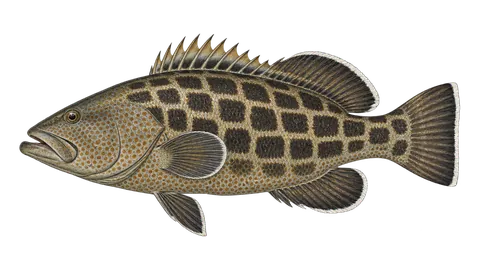
Scientific illustration of Leopard grouper
common size
35–60 cm
maximum
86 cm
common weight
0.5–2.5 kg
record/max.
9.6 kg
depth
1–50 m
ideal water
20–28 °C
overview

who is the leopard grouper

Mexican grouper: it lives on the southwest coast of Baja California, throughout the Gulf of California and along the mainland coast to Jalisco. It prefers shallow rocky shores and reefs, down to about 50 m. Adults hunt sardine and anchovy schools, hence the name cabrilla sardinera, and feed most at dawn and dusk, peaking about 20 minutes after sunset; juveniles eat fish and crustaceans from the bottom throughout the day. Unlike most groupers, which are born female and turn male, studies in the gulf indicate separate sexes. It is one of the most fished species from rocky shores and boats in the gulf, caught with jigs, mid-water lures and live bait.

fun facts

  • A small part of the population is entirely golden-yellow (xanthic form), sometimes with black spots.
  • A study in the Gulf of California found separate sexes, which is rare among groupers.
how to recognize it

identification

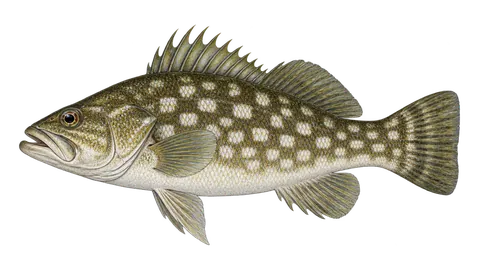
Robust body, gray-green to brown, covered in reddish-brown dots and irregular pale spots and lines; fins with white edges. A small share of fish are entirely golden-yellow, sometimes with black spots. The baya (Mycteroperca jordani), larger and gray with dark spots, has a limit of just 2 per day in Mexico: do not confuse them.

how leopard grouper fishing looks

Loading the next 7 days…

Each card shows the day's index (0 to 100) and, below it, a strip with the index for each hour, from 0h to 23h. from poor to excellent.

distribution

where found

open on the large map

Not found in Brazil. Only in Mexico: southwest coast of Baja California, the whole Gulf of California and the Pacific coast to Jalisco.

Habitat: Rocky shores, rocky reefs and shallow loose rocks where sardine schools pass.

calendar and clock

when to fish

best season

time of yearbest: Apr–Jul
JanFebSeaAprMayJunJulAugSepOctNovDec

Fishable all year in the Gulf of California; spring, with plenty of sardines along the coast, is usually the best period.

best time of day

0h6h12h18h sunrise ~6amsunset ~6pm

Dawn and dusk. Adults feed mostly at dawn and dusk, peaking about 20 minutes after sunset. By day they stay among the rocks.

weather, water and behavior

what affects the leopard grouper
sensitivity The little bars show how much each factor affects this species. Five full: it feels it a lot.

cold and cold fronts

Cold winter water in the northern gulf reduces activity.

atmospheric pressure

A front with strong wind churns the sea and gets in the way.

moon

Moderate effect; in a full moon it hunts more at night.

rain

Little effect.

water level

Not applicable at sea.

noise

A boat hitting the rocks spooks fish; approach with an electric motor or drifting.

wind

Choppy seas hinder rocky shore fishing.

tide

A current that pushes sardines against the rocks is best.

depth

From 2 to 30 m near the rocks.

technique, gear and bait

how to fish

rod
6'6" to 7', 20 to 40 lb
spinning / baitcasting reel
spinning reel 4000 to 6000 or small conventional baitcasting reel
line
braid 30 to 50 lb
leader
fluorocarbon 40 to 60 lb
hook
circle hook 3/0 to 5/0; assist hooks on the jig

lures

  • metal jig 40 to 120 g
  • jig head with shad
  • deep-diving jerkbait and crankbait along the rocks

natural baits

  • live sardine
  • lula

accessories

  • descender for bottom fish
  • alicate

tip from an angler

At dusk, cast the jig to the edge of the rocks and reel fast mid-water: the cabrilla sardinera rises to catch the fleeing sardine.

what the law says

rules for the leopard grouper

Summary of the regulations we found, with the source for each. Rules change; before keeping or transporting fish, check with the state environmental agency.
Conservation: Endemic to Mexico. Not listed in the NOM-059-SEMARNAT-2010 list of species at risk (2010 text).

Mexico: up to 5 per species and 10 saltwater fish per day

5 specimens of the species per angler per day, within the limit of 10 saltwater fish

In recreational sport fishing in Mexican federal waters, each angler may keep up to 10 saltwater fish per day, no more than 5 of the same species. The cabrilla sardinera (badejo-sardinheiro) is not among the species reserved for sport fishing under art. 68 of the General Law of Sustainable Fishing and Aquaculture, and has no quota of its own. Fish over the limit must be returned alive to the water, and sport-caught fish may not be sold. Anglers fishing from a boat need a Conapesca permit.
Source: Amendment to NOM-017-PESC-1994 (recreational sport fishing in federal waters of Mexico), published in the DOF on Nov 25, 2013, items 4.9.1 and 4.9.5 (Sagarpa/Conapesca)

catch and release
catch and release Releasing the fish alive, quickly and with a wet hand. During a closed season it isn't always allowed: what the regulation says applies.

Deep-rock fish can float up with an inflated swim bladder: use a descender to return it to depth. Do not puncture the bladder.

in the kitchen

White, firm flesh, highly valued; fillets, ceviche or roasted.

calculator

how much it weighs without taking it out of the water

Length-weight relationship W = a·Lb (a = 0.00912, b = 3.05; FishBase (estimativa bayesiana para o gênero e o formato do corpo)). It's an average: a fat or lean fish can vary by 10% to 20%.

estimated weight

—

sources and references

The season weights (months), the time of day and the sensitivities (cold, pressure, moon, wind, rain, tide, strong light, murky water and noise) are the app's editorial estimates, based on the literature below and on the field experience of anglers and guides. They are not official data nor a measurement made for this species, and they may vary by region and year. Closed seasons and legal rules appear in the rules section, with the norm and a link.

  1. scientific FishBase — Mycteroperca rosacea (ficha da espécie)Names, distribution, biology, length-weight relationship, country list and references. Page checked on Oct 13, 2026.
  2. scientific IUCN Red List — Mycteroperca rosacea (avaliação global: Pouco Preocupante, LC, 18/11/2016)Global assessment. Link given on the FishBase entry (Red List, version 2025-2).
  3. scientific Craig, M. T.; Sadovy de Mitcheson, Y. J.; Heemstra, P. C. (2011). Groupers of the world: a field and market guide. CRC Press. 356 p.FishBase reference for identification and the golden form.
  4. scientific Erisman, B. E.; Rosales-Casián, J. A.; Hastings, P. A. (2008). Evidence of gonochorism in a grouper, Mycteroperca rosacea, from the Gulf of California, Mexico. Environmental Biology of Fishes 82: 23-33.DOI checked on Crossref (published online in 2007).
  5. official DOF — Modificação da NOM-017-PESC-1994, para regular a pesca deportivo-recreativa em águas de jurisdição federal do México (publicada em 25/11/2013)Daily limits at sea (item 4.9.1) and in fresh water (4.9.2), one rod in inland waters (4.6 b), ban on live fish as bait in inland waters (4.7 c) and on fishing in closed areas and seasons (4.10).
don't confuse

similar species