

aimara
Hoplerythrinus unitaeniatus
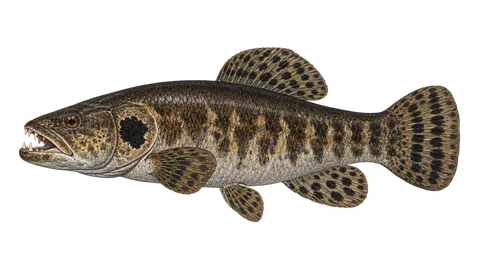
A small relative of the trahira, with a cylindrical body, a dark flank stripe and an eyespot behind the gill cover. Breathes air, lives in swamps and is live bait in the Pantanal.
- common size
- 15–25 cm
- maximum
- 33 cm
- common weight
- 0.1–0.3 kg
- record/max.
- 0.5 kg
- depth
- 0.1–1.5 m
- ideal water
- 23–30 °C
how to recognize it
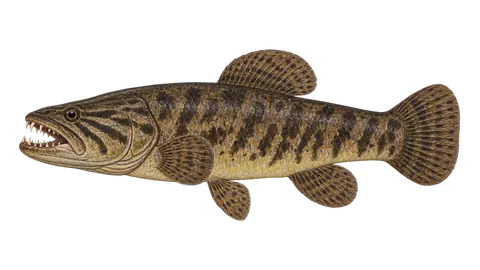
Cylindrical body like the trahira's, rounded head and smaller mouth. A dark longitudinal stripe from snout to tail and a dark spot with a pale edge (eyespot) just behind the gill cover. Olive-green to brown back, yellowish belly. The trahira has no continuous stripe or eyespot and has a larger mouth with stronger teeth.
where found
open on the large mapWhere to look: Swamps, flooded areas, flooded fields, shallow lagoons and ditches with vegetation and little current.
Amazon, São Francisco and Paraguay-Paraná basins, plus the Orinoco, Magdalena and Guianas rivers. In the upper Paraná (Paranaíba, in GO) it is treated as non-native.
native to the basins
introduced in
states
Amazonas, Pará, Amapá, Rondônia, Mato Grosso, Mato Grosso do Sul, Tocantins, Minas Gerais, Bahia, Goiás
when to fish
next 7 days
Loading the next 7 days…
best season
Found all year; in the dry season it concentrates in pools and lagoons.
best time of day
Daytime, with peaks at dawn and dusk. Active by day and at dusk; it rises to the surface constantly to breathe.
what affects the aimara
cold and cold fronts
Cold reduces activity.
atmospheric pressure
Little effect.
moon
Little known effect.
rain
Little effect.
water level
In the dry season it gets trapped in pools and shallow lagoons.
noise
Moderate.
wind
Little effect.
depth
Shallow, near the surface.
how to fish
natural baits
- minhoca
- piece of fish
- insetos
tip from an angler
Small bait near vegetation, where it rises to breathe.
- rod
- bamboo cane or telescopic rod, 2 to 3 m
- spinning / baitcasting reel
- optional
- line
- monofilament 0.20 to 0.25 mm
- leader
- optional
- hook
- #8 to 12
accessories
- bucket with water to keep the baits
catch and release
It handles well. Release it in the same place; never take it to another basin.
rules for the aimara
Rules change; before keeping or transporting fish, check with the state environmental agency.
MS: minimum size for jeju
10 cmMS details
In MS, jeju caught as bait in the wild must be at least 10 cm.
MS: commercial bait catch only by professionals
licensed professional fisher; amateur without cast net or netMS details
In MS, catching jeju as live bait for sale may only be done by licensed professional fishers, with an Imasul permit and transport slip. Amateur anglers and riverside residents may not use cast nets or mesh gear to catch bait. Catching is banned within 200 m of waterfalls, rapids, springs and confluences, and within 1,000 m of dams and nesting colonies. During the spawning closure, commercial bait catch reopens only from February 20.
GO: jeju non-native in the Paranaíba
free catch and transport; banned as live bait in the basinGO details
In the Paranaíba basin, in Goiás, the jeju is on the list of non-native species with catch and transport allowed without size or quantity limits. Using a non-native species from the basin as live bait is treated as release and is banned.
Source: IN Semad-GO nº 17/2026, art. 5º, art. 7º, § 6º, and Annex II (Paranaíba basin)
piracema and closed seasons
Each bar is the period when fishing is prohibited or restricted. The green line is today. Tap the name to see what is still allowed.
Spawning closure (piracema) in Minas Gerais (state rule)
Allowed: Only exotic or hybrid species, 3 kg plus one fish per day or outing, with handline, rod or pole with spinning or baitcasting reel (at most 5 per angler). Nets prohibited. Respect the minimum distances from dams, waterfalls and rapids and the marginal lagoons.
Source: Portarias IEF nº 154/2011 (São Francisco), 155/2011 (East) and 156/2011 (Grande/Paranaíba)
Closed season in Goiás (state rule)
Allowed: Sport and guided fishing only in reservoirs, catch and release with barbless hooks (no keeping, transporting or eating). Subsistence: up to 5 kg per day, for household consumption only.
Spawning closure (piracema) in the Pantanal of Mato Grosso do Sul
Allowed: Subsistence by riverside and artisanal fishers: on land or in a rowboat, with a pole, handline and hook, up to 3 kg or 1 fish per day, with no sale or transport.
Spawning closure (piracema) in Mato Grosso (all basins)
Allowed: All fishing modalities are prohibited in rivers, including catch and release (Law 9.096/2009, art. 19-A). Exceptions: subsistence fishing from shore (3 kg or 1 fish, no transport or sale) and scientific fishing. Law 13.159/2025 now allows licensed sport fishing in UHE/PCH hydropower reservoirs, natural lakes and border rivers, subject to a scientific study and a license from the environmental agency. We have not confirmed whether these licenses are already being issued.
Spawning closure (piracema) in the Araguaia River basin
Allowed: Recreational fishing only in reservoirs, with handline, rod, or spinning or baitcasting reel. Fish may only be eaten on site, not transported. Competitions prohibited. Subsistence: 3 kg + 1 fish. State rules (GO and TO) may be stricter.
Spawning closure (piracema) in the Tocantins and Gurupi river basins
Allowed: Recreational fishing only in reservoirs, with on-site consumption. Subsistence: 5 kg + 1 fish. State rules may be stricter.
Spawning closure (piracema) in Tocantins (state rule)
Allowed: Recreational catch and release with barbless hooks and a recreational fishing card; subsistence fishing by riverside and artisanal fishers from the bank or a rowboat, with a cane pole, handline and hook, with no transport or sale.
Spawning closure (piracema) in the São Francisco River basin (rivers and reservoirs)
Allowed: Recreational fishing from a boat or from shore with handline, rod, spinning or baitcasting reel, up to 5 kg + 1 fish. Prohibited within 1,000 m of dams, waterfalls and rapids, and within 500 m of confluences. Floodplain lakes have a longer closed season (see next item).
Source: Portaria IBAMA nº 50/2007
São Francisco: floodplain lakes
Allowed: No fishing in the floodplain lakes during the period.
Source: Portaria IBAMA nº 50/2007
Closed season in the Amazon basin in Amazonas
Allowed: Under Portaria 48/2007 (art. 2, II), the recreational angler who fishes with handline or rod, line and hook is outside the Annex II prohibitions, unless a stricter state rule applies. Recreational angler bag limit: 5 kg + 1 fish. Competitions prohibited.
Source: Portaria IBAMA nº 48/2007
Closed season in the Amazon basin in Acre
Allowed: Recreational anglers with handline or rod, line and hook are outside the Annex II prohibitions, with a bag limit of 5 kg + 1 fish, unless a stricter state rule applies. On the Acre River, no fishing of any species during the period.
Source: Portaria IBAMA nº 48/2007; IN IBAMA nº 205/2008 (Acre River)
Closed season in the Acre river
Allowed: IN Ibama 205/2008 prohibits fishing in the Acre river and its tributaries during the closed season, with no exception for recreational anglers: treat it as prohibited.
Source: IN IBAMA nº 205/2008
Closed season in the Amazon basin in Pará
Allowed: Recreational anglers with handline or rod, line and hook are outside the Annex II prohibitions, with a bag limit of 5 kg + 1 fish, unless a stricter state rule applies.
Source: Portaria IBAMA nº 48/2007
Closed season in the rivers of Marajó Island (PA)
Allowed: The same recreational-angler exceptions as in Portaria 48/2007 apply (handline or rod, 5 kg + 1 fish), unless a stricter state rule applies.
Source: Portaria IBAMA nº 48/2007
Amazon basin closed season in Rondônia
Allowed: In the Madeira, Mamoré, Jamari, Abunã, Machado and Roosevelt river basins and in the main channel of the Guaporé, licensed recreational anglers may fish only for non-protected species, using a single simple gear per person (handline, rod with or without a reel, or a simple pole with a single hook). The limit is up to 5 kg or 1 fish per week; if the fish is over 5 kg, you keep only that one. You may not sell, trade or give away the catch. Catch and release is allowed only with non-protected species. Fishing is always banned within 200 m of dams, rapids, waterfalls, fish ladders and river mouths.
Closed season in the Amazon basin in Amapá
Allowed: Recreational anglers with handline or rod, line and hook are outside the Annex II prohibitions, with a bag limit of 5 kg + 1 fish, unless a stricter state rule applies.
Source: Portaria IBAMA nº 48/2007
Closed season in Roraima
Border rivers MT/RO and MT/PA
Allowed: See the exceptions in Portaria 48/2007 and the state rules for each bank.
Source: Portaria IBAMA nº 48/2007
Conservation: Not on the national list of threatened species (Portaria GM/MMA nº 1.667/2026).
how much it weighs without taking it out of the water
estimated weight
—
how we calculate
Length-weight relationship W = a·Lb (a = 0.01023, b = 3.14; FishBase). It's an average: a fat or lean fish can vary by 10% to 20%.
more about the aimara
A fish of the trahira family that rarely exceeds 30 cm. It lives in swamps, flooded areas, flooded fields and lagoons with little current, and must surface to breathe air: it is an obligate air breather and can survive out of water for a long time. This habit exposes it to predators, including the poraquê. It eats aquatic invertebrates and, to a lesser extent, fish, and matures at about 16 cm. In the Pantanal it is used as live bait, with a minimum size set in MS. It occurs across much of tropical South America, from the Orinoco and Magdalena to the Paraná and São Francisco basins. In the Paranaíba, in Goiás, the state rule treats it as a non-native species.
Family: Erythrinidae · predator
fun facts
- It is an obligate air breather: if it cannot reach the surface, it drowns.
- The scientific name unitaeniatus means 'with a single stripe', the dark stripe on the flank.
in the kitchen
White flesh with many bones; its main use is as bait.
similar species
sources and references (7)
The season weights (months), the time of day and the sensitivities (cold, pressure, moon, wind, rain, tide, strong light, murky water and noise) are the app's editorial estimates, based on the literature below and on the field experience of anglers and guides. They are not official data nor a measurement made for this species, and they may vary by region and year. Closed seasons and legal rules appear in the rules section, with the norm and a link.
- scientific FishBase — Hoplerythrinus unitaeniatus (ficha da espécie)Distribution, obligate air breathing, diet, maturity (about 16 cm), maximum size, length-weight relationship and country list. Page checked on Oct 13, 2026.
- scientific IUCN Red List — Hoplerythrinus unitaeniatus (avaliação global: Pouco Preocupante, LC, 07/11/2018)Global assessment. Link given on the FishBase entry (Red List, version 2025-2).
- official Portaria GM/MMA nº 1.667, de 27 de abril de 2026 — Lista Nacional Oficial de Espécies da Fauna Ameaçadas de Extinção (peixes e invertebrados aquáticos)The species is not on the list (checked against the text published in the DOU of 28/04/2026, section 1, p. 96).
- official Resolução SEMAC-MS nº 3/2011 (com a redação da Resolução SEMAC nº 22/2011) — captura, transporte, comércio e cultivo de iscas vivas em MSMinimum sizes of live baits, commercial catch only by professional fishers, distances and permitted gear. Imasul text checked on Oct 13, 2026.
- official Lei estadual MS nº 2.898/2004 — iscas vivasLive bait catch only by licensed professional fishers; banned below minimum size and during spawning; in the Alto Paraguay, only baits native to the basin. Page checked on Oct 13, 2026.
- official IN Semad-GO nº 17/2026 — normas de pesca em GoiásAnnex II, Paranaíba basin: jeju (Hoplerythrinus unitaeniatus) non-native. Page checked on Oct 13, 2026.
- official Portaria MPA nº 532, de 23 de setembro de 2025 — nomes comuns das espécies de peixes de interesse comercialOfficial name: jeju. Page checked on Oct 13, 2026.