colorado snapper
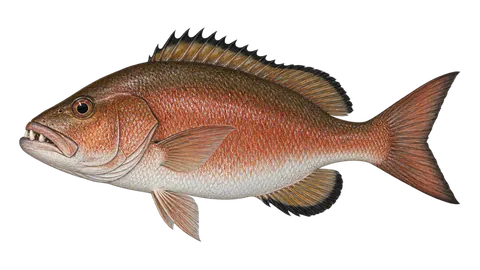
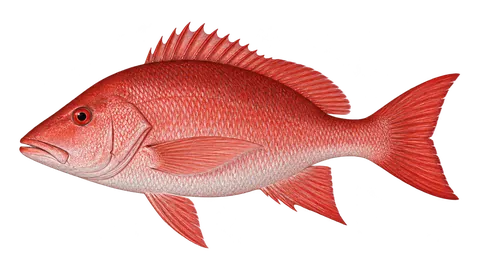
Lutjanus colorado
Red snapper of the Pacific rocky shores and reefs, from Mexico to Panama. A good fighter and good eating, it takes natural bait and jigs near the rocks.
Also called: pargo-colorado, pargo-vermelho-do-pacífico, colorado snapper

- common size
- 35–60 cm
- maximum
- 91 cm
- common weight
- 1–4 kg
- record/max.
- 9.3 kg
- depth
- 1–70 m
- ideal water
- 22–28 °C
who is the colorado snapper
Eastern Pacific snapper, from southern California to Panama; unconfirmed records reach northern Peru. Adults live alone over hard-bottom reefs and rocky shores, from 1 to 70 m; juveniles appear in shallow coastal waters and estuaries. It eats crustaceans, other invertebrates and fish. In sport fishing in Mexico and Central America it is fished from boats over rocks and shoals with natural bait on the bottom, jigs and mid-water lures, and also from rocky shores near river mouths. On the first run it dives for the rock. The flesh is highly valued, and the species is also fished commercially.
fun facts
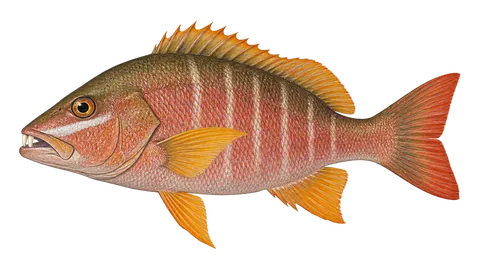
- Juveniles have vertical bars that fade with age, when the fish turns fully red.
- In Mexico, cage farming of this species is being tested.
identification
Body and fins almost entirely red, sometimes with a blue stripe under the eye; juveniles have vertical bars. Weak notch on the preopercle. The Pacific dog snapper is darker, copper to olive-brown, with larger canine teeth and a black edge on the dorsal and anal fins.
Loading the next 7 days…
Each card shows the day's index (0 to 100) and, below it, a strip with the index for each hour, from 0h to 23h. from poor to excellent.
where found
Does not occur in Brazil. Eastern Pacific, from southern California (rare north of Baja California) to Panama and the Colombian coast; unconfirmed records to northern Peru.
Habitat: Rocky reefs and hard-bottom shores, shoals and rock edges; juveniles in shallow coastal waters and estuaries.
famous destinations
when to fish
best season
Fished all year. Current and clean water over the rocks matter more than the month.
best time of day
Dawn and dusk. Feeds most at dawn, late afternoon and early evening; by day it stays by the rocks and responds best to natural bait.
what affects the colorado snapper
sensitivity The little bars show how much each factor affects this species. Five full: it feels it a lot.
cold and cold fronts
Cold upwelling shuts down activity.
atmospheric pressure
A front with the sea turning rough hampers bottom fishing.
moon
Strong moons move more water over the rocks; moonlit nights are usually good.
rain
Little effect on the bottom; heavy rain muddies the shore.
water level
Not applicable at sea. The equivalent is current over the shoal.
noise
An anchor and hull knocking on the rock spook fish; anchor upstream and let the bait drift in.
wind
Strong wind makes it hard to keep the boat over the rock.
tide
Moderate current is best; still water is usually slow.
depth
Rocky shores and stones from 5 to 40 m.
how to fish
- rod
- 6'6" to 7', 20 to 40 lb; from the rocky shore, 9' to 11'
- spinning / baitcasting reel
- spinning reel 4000 to 6000 or baitcasting reel 300
- line
- braid 30 to 50 lb
- leader
- fluorocarbon 40 to 60 lb, 1.5 m
- hook
- circle 3/0 to 6/0
lures
- metal jig 40 to 100 g
- jig head 1 to 2 oz with shad
- mid-water near shallow rocks
natural baits
- whole or filleted sardine
- lula
- live baitfish
accessories
- sinker 50 to 150 g
- descender (descompressor) for releasing bottom fish
- alicate
tip from an angler
When you feel the bite, lift the fish in the first few metres: if it reaches the rock, it will cut the line.
rules for the colorado snapper
Summary of the regulations we found, with the source for each. Rules change; before keeping or transporting fish, check with the state environmental agency.
Conservation: Old global assessment; the species supports artisanal fishing across its entire range.
We found no species-specific rule beyond the region's general rules.
catch and release
catch and release Releasing the fish alive, quickly and with a wet hand. During a closed season it isn't always allowed: what the regulation says applies.
A bottom fish can float up with an inflated swim bladder: use a descender to return it to depth. Do not puncture the bladder.
in the kitchen
White flesh, firm and very tasty; roasted whole, fried or in ceviche.
how much it weighs without taking it out of the water
Length-weight relationship W = a·Lb (a = 0.01202, b = 2.94; FishBase). It's an average: a fat or lean fish can vary by 10% to 20%.
estimated weight
—
sources and references
The season weights (months), the time of day and the sensitivities (cold, pressure, moon, wind, rain, tide, strong light, murky water and noise) are the app's editorial estimates, based on the literature below and on the field experience of anglers and guides. They are not official data nor a measurement made for this species, and they may vary by region and year. Closed seasons and legal rules appear in the rules section, with the norm and a link.
- scientific FishBase — Lutjanus colorado (ficha da espécie)Names, distribution, biology, length-weight relationship, country list and references. Page checked on Oct 13, 2026.
- scientific IUCN Red List — Lutjanus colorado (avaliação global: Pouco Preocupante, LC, 25/05/2007)Global assessment. Link given on the FishBase entry (Red List, version 2025-2).
- scientific Allen, G. R. (1985). FAO species catalogue. Vol. 6. Snappers of the world: an annotated and illustrated catalogue of lutjanid species known to date. FAO Fisheries Synopsis 125(6). Roma: FAO.
- scientific Santamaría-Miranda, A. et al. (2005). Hábitos alimenticios del pargo amarillo Lutjanus argentiventris y del pargo rojo Lutjanus colorado (Pisces: Lutjanidae) en el norte de Sinaloa, México. Revista de Biología Marina y Oceanografía 40(1).DOI checked in Crossref.