pacific dog snapper
Lutjanus novemfasciatus
The largest eastern Pacific snapper, a brute with canine teeth that lives on rocky shores. It attacks poppers and live bait with violence and runs for the rock.
Also called: pargo-dentão-do-pacífico, pargo-prieto, Pacific dog snapper, cubera-do-pacífico

- common size
- 50–100 cm
- maximum
- 170 cm
- common weight
- 3–15 kg
- record/max.
- 35.7 kg
- depth
- 0–60 m
- ideal water
- 23–29 °C
who is the pacific dog snapper
The largest eastern Pacific snapper, from northern Mexico to northern Peru, with records of over 1.5 m and 35 kg. Adults live on rocky shores and coral reefs down to at least 60 m, usually between 5 and 12 m; juveniles stay in mangrove estuaries and river mouths. It eats crabs, shrimp and fish. It is the Pacific counterpart of the Atlantic cubera snapper: wary, strong and with large canine teeth. In sport fishing in Mexico, Costa Rica and Panama it is sought with poppers and stickbaits in the foam around the rocks, and with live bait on the bottom. The fight is short and decisive: if the fish reaches the rock, the line is cut.
fun facts
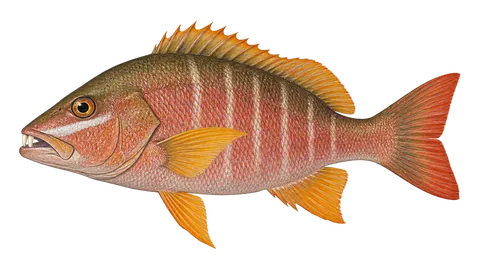
- The name novemfasciatus means nine bands, referring to the dark bars of juveniles.
- Many anglers call it the Pacific cubera, because it resembles the Atlantic cubera snapper in size, temperament and teeth.
identification
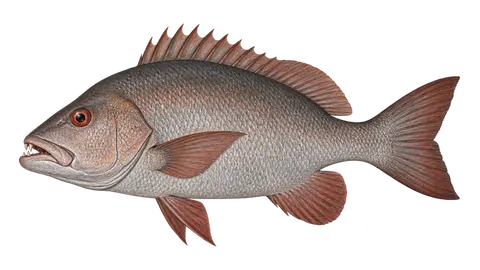
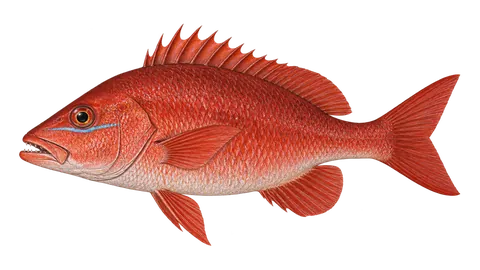
Dark olive-brown to copper-reddish back and flanks, lightening toward the belly. Large canine teeth, visible with the mouth closed. Edge of the spiny dorsal fin and almost all of the anal fin black. Juveniles have nine dark bars on the body, which gives the scientific name. The red snapper is all red and smaller; the Atlantic cubera snapper looks similar but does not occur in the Pacific.
Loading the next 7 days…
Each card shows the day's index (0 to 100) and, below it, a strip with the index for each hour, from 0h to 23h. from poor to excellent.
where found
Does not occur in Brazil. Eastern Pacific, from northern Mexico (including the Gulf of California) to northern Peru: rocky shores and reefs along the whole coast of Central America, Colombia and Ecuador.
Habitat: Rocky shores and coral reefs, rock points with foam, shallow banks; juveniles in mangrove estuaries and river mouths.
when to fish
best season
Fished all year round. In the Gulf of California and the Mexican Pacific, summer, with warmer water, is usually the best season; in Central America, current and bait availability matter more than the month.
best time of day
Dawn and dusk. Bites at dawn and dusk in the foam around rocks; at night it feeds on the bottom. In midday sun it hides in crevices.
what affects the pacific dog snapper
sensitivity The little bars show how much each factor affects this species. Five full: it feels it a lot.
cold and cold fronts
Cold upwelling water shuts down the bite.
atmospheric pressure
Sea turning with a front spoils rock fishing.
moon
Strong moons move more water and often switch on night bottom fishing.
rain
Little direct effect.
water level
Does not apply at sea. The equivalent is current and foam on the rock.
noise
Very wary: a boat too close to the rock spooks it.
wind
Sea with foam on the rock helps the popper; strong wind makes approaching dangerous.
tide
Moderate current and tide changes concentrate the strike windows.
depth
Foam over shallow rocks (1 to 5 m) with a popper; 10 to 40 m with live bait on the bottom.
how to fish
- rod
- popper: 7'6" to 8', 50 to 100 lb; bottom: 6' to 7', 40 to 80 lb
- spinning / baitcasting reel
- spinning reel 10000 to 18000 with locked drag; baitcasting reel 400 to 600 for the bottom
- line
- braid 65 to 100 lb
- leader
- monofilament or fluorocarbon 100 to 150 lb, 2 m
- hook
- treble hooks 4X to 5X; circle 7/0 to 10/0 on live bait
lures
- popper 15 to 20 cm
- floating stickbait 18 to 22 cm
- metal jig 100 to 200 g
natural baits
- live bonito, mackerel or mullet
- whole squid
- large crab
accessories
- fighting belt and vest
- luvas
- long-nose pliers
- descender (fish descender)
tip from an angler
Noisy popper on the foam, close to the rocks. On the strike, lock the drag and move the fish away from the rock in the first few metres; there is no second chance.
rules for the pacific dog snapper
Summary of the regulations we found, with the source for each. Rules change; before keeping or transporting fish, check with the state environmental agency.
Conservation: Old global assessment (2007).
We found no species-specific rule beyond the region's general rules.
catch and release
catch and release Releasing the fish alive, quickly and with a wet hand. During a closed season it isn't always allowed: what the regulation says applies.
Watch the canine teeth: use long pliers and a gaff. A fish brought up from depth may need a descender. Take quick photos, supporting it under the belly.
in the kitchen
Good white meat. In sport fishing, most trophies are released.
how much it weighs without taking it out of the water
Length-weight relationship W = a·Lb (a = 0.01514, b = 2.96; FishBase). It's an average: a fat or lean fish can vary by 10% to 20%.
estimated weight
—
sources and references
The season weights (months), the time of day and the sensitivities (cold, pressure, moon, wind, rain, tide, strong light, murky water and noise) are the app's editorial estimates, based on the literature below and on the field experience of anglers and guides. They are not official data nor a measurement made for this species, and they may vary by region and year. Closed seasons and legal rules appear in the rules section, with the norm and a link.
- scientific FishBase — Lutjanus novemfasciatus (ficha da espécie)Names, distribution, biology, length-weight relationship, country list and references. Page checked on Oct 13, 2026.
- scientific IUCN Red List — Lutjanus novemfasciatus (avaliação global: Pouco Preocupante, LC, 23/05/2007)Global assessment. Link given on the FishBase entry (Red List, version 2025-2).
- scientific Allen, G. R. (1985). FAO species catalogue. Vol. 6. Snappers of the world: an annotated and illustrated catalogue of lutjanid species known to date. FAO Fisheries Synopsis 125(6). Roma: FAO.