The largest red snapper on the coast, king of the rocky shores. Vulnerable: recreational anglers may only practise catch and release, with a closed season in August and September.
The cubera snapper (caranha) is the largest red snapper on the Brazilian coast, over 1.5 m and 50 kg. Juveniles live in mangroves and estuaries; adults occupy deep rocky shores, patch reefs, ledges and wrecks, down to about 70 m, and gather in aggregations to spawn. A nocturnal hunter of fish, squid and crabs, it is very wary and fights hard back into the rock. That makes it the great challenge of rocky-shore fishing in the Southeast. The species is Vulnerable on the national list and has a recovery plan: for recreational anglers, catch and release only, and no fishing during the August and September closed season. A large fish pulled from depth suffers barotrauma, so release needs technique and the right gear.
fun facts
It can live more than 50 years.
It is the largest lutjanid in the western Atlantic.
how to recognize it
identification
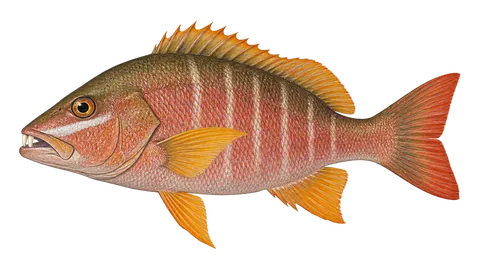
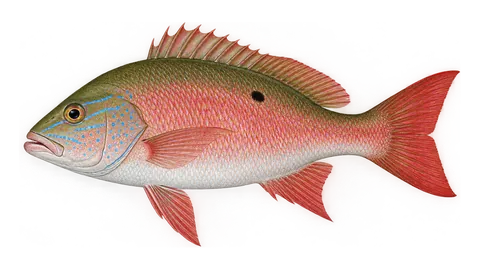
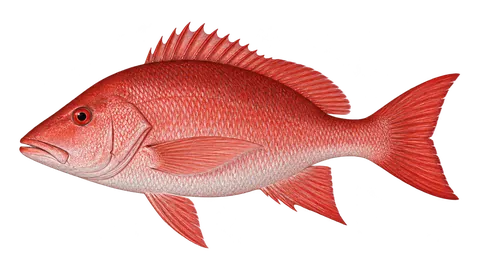
A large snapper, silver-grey to reddish-grey, without spots or marked stripes. Thick lips and strong canines. Difference from the dentão (dog snapper): the dentão is coppery, has a pale triangle under the eye and a conspicuous large canine. From the cioba: the cioba has a black spot on the flank and blue lines on the head. From the ariacó: the ariacó is small, pink with yellow stripes.
how cubera snapper fishing looks
Loading the next 7 days…
Each card shows the day's index (0 to 100) and, below it, a strip with the index for each hour, from 0h to 23h. from poor to excellent.
From Pará to Santa Catarina. In the Southeast and South it is a fish of rocky shores and islands (north coast of SP, Rio de Janeiro, Espírito Santo and the SC islands); in the Northeast, of reefs and wrecks.
Habitat: Deep rocky shores, islands, ledges, reef flats and wrecks; juveniles in mangroves and estuaries.
coast
North CoastNortheast CoastSoutheast CoastSouth Coastcoastalshelf
states
Pará, Maranhão, Piauí, Ceará, Rio Grande do Norte, Paraíba, Pernambuco, Alagoas, Sergipe, Bahia, Espírito Santo, Rio de Janeiro, São Paulo, Paraná, Santa Catarina
In the Southeast, the most active season on rocky shores is summer, from December to March, with warm water. Legal closed season from August 1 to September 30.
best time of day
Night and twilight. Hunts mainly at dusk and at night. By day it stays hidden or still in the shade of rocks.
weather, water and behavior
what affects the cubera snapper
sensitivity The little bars show how much each factor affects this species. Five full: it feels it a lot.
cold and cold fronts
Cold water (upwelling on the rocky shore) drives the cubera away from the shore.
atmospheric pressure
Stable weather and the pre-frontal period are usually better.
moon
Rocky-shore anglers prefer the new moon and dark nights; a full moon makes it more wary.
rain
Rain doesn't bother it; lightning on the rocky shore is a real danger.
water level
Surge on the rocky shore is a life-threatening danger; don't fish in heavy seas.
noise
Very wary: a flashlight in the water, shadow and footsteps scare it. Fish quietly.
wind
Strong onshore wind makes safe fishing on the rocky shore impossible.
tide
It prefers current: on the rising tide it moves up to the corner of the rocky shore behind the bait; on the falling tide it stays at the mouths of crevices and channels. At slack the bite drops, but it can still strike at night.
depth
On the rocky shore, 3 to 15 m; on patch reefs and wrecks, 20 to 70 m.
rocky shore: 9 to 11 ft, 30 to 60 lb; boat: 5'6" to 6'6", 30 to 60 lb
spinning / baitcasting reel
8000 to 10000 spinning reel or 400 baitcaster with strong drag
line
braided line 50 to 80 lb
leader
fluorocarbon 80 to 120 lb, 1.5 to 2 m
hook
circle 6/0 to 8/0 (makes release easier)
lures
metal jig 80 to 200 g
jig head 2 to 3 oz with large shad
natural baits
whole squid
sardinha
live xerelete or small mullet
caranguejo
accessories
descender (descompresor) for release on the bottom
luvas
headlamp with red light
tip from an angler
The cubera can only be released. Use a circle hook and lock the drag to pull it off the rock in the first metres. A fish brought up from more than 15 m depth goes back down with a descender.
Summary of the regulations we found, with the source for each. Rules change; before keeping or transporting fish, check with the state environmental agency. Conservation: Use only under the terms of the recovery plan (Interministerial Ordinance 59-C/2018).
Amateur fishing for catch and release only
mandatory catch and release
Amateur and sport fishing for the cubera (caranha) is allowed only as catch and release, in all Brazilian waters. Targeted fishing, transport, landing and trade outside the ordinance's rules are prohibited. Underwater fishing is not compatible with catch and release.
Authorized commercial fishing may only retain, transport and sell cubera 50 cm or more in total length. It doesn't apply to recreational anglers, who must release all fish.
The cubera is on the national list of threatened species (Vulnerable (VU)). Use is only allowed under the terms of the recovery plan; Ordinance GM/MMA 1.666/2026 ordered the plans and rules reviewed, and they remain in force during the review. Check whether there have been changes before fishing.
Closed season for caranha, sirigado/badejo-quadrado (black grouper), garoupa-são-tomé and badejo-amarelo
01/08 to 30/09North CoastNortheast CoastSoutheast CoastSouth Coastconfirm with the agency
Closed season for threatened reef fish whose use is regulated by the recovery plan (Portaria MMA 292/2018 and PI 59-C/2018). Period confirmed in the 2026 official closed-season calendar of Sema-BA. We could not read PI 59-C (sizes and recreational-angler rules). Black grouper (badejo-quadrado) moved to EN in the 2026 list, and the plan is under review.
Black grouper (badejo-quadrado, EN) and caranha (VU): use only under the reef fish plan
North CoastNortheast CoastSoutheast CoastSouth Coastconfirm with the agency
Sirigado or badejo-quadrado (Mycteroperca bonaci, black grouper) moved from VU to EN on the 2026 list. Caranha (Lutjanus cyanopterus, cubera snapper) remains VU. Both have recognized use under Portaria MMA 292/2018, with rules in PI SEAP-PR/MMA 59-C/2018: closed season Aug 1 to Sep 30 and sizes we could not confirm. Because the black grouper moved up a category, the plan is under review (Portaria 1.666/2026, art. 11). If in doubt, release.
catch and release Releasing the fish alive, quickly and with a wet hand. During a closed season it isn't always allowed: what the regulation says applies.
Catch and release is mandatory for recreational anglers. A fish brought up from depth inflates its swim bladder: release it with a descender, without puncturing it. Don't lift a large fish by the mouth; support its body.
in the kitchen
Recreational fishing is catch and release only. In regulated trade, the meat is white and firm.
calculator
how much it weighs without taking it out of the water
Length-weight relationship W = a·Lb (a = 0.01288, b = 2.98; FishBase (estimativa bayesiana, comprimento total)). It's an average: a fat or lean fish can vary by 10% to 20%.
estimated weight
—
sources and references
The season weights (months), the time of day and the sensitivities (cold, pressure, moon, wind, rain, tide, strong light, murky water and noise) are the app's editorial estimates, based on the literature below and on the field experience of anglers and guides. They are not official data nor a measurement made for this species, and they may vary by region and year. Closed seasons and legal rules appear in the rules section, with the norm and a link.