Skip to content
catalog Lutjanidae · predator

golden snapper

Lutjanus inermis

Sea

Small reddish snapper of the eastern Pacific, with a very pointed snout and yellow tail, which forms daytime schools over rocky and coral reefs. Light bottom and midwater fishing.

Also called: pargo-dourado, golden snapper, pargo-barbirrubia, rabirrubia

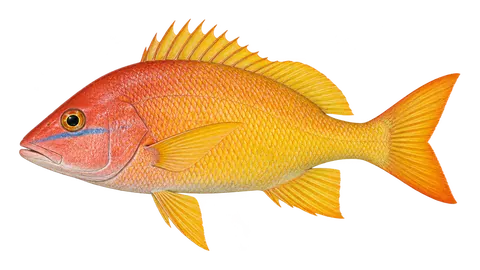
Scientific illustration of Golden snapper
common size
20–30 cm
maximum
34 cm
common weight
0.1–0.3 kg
record/max.
— kg
depth
0–40 m
ideal water
23–29 °C
overview

who is the golden snapper

Small snapper of the eastern Pacific, from Mexico to Panama (STRI goes as far as Colombia and the Cocos, Malpelo and Galápagos islands). Lives in coastal rocky and coral reefs down to at least 40 m (STRI cites up to 70 m) and, by day, forms schools of 30 or more fish that sometimes hover in midwater. Juveniles appear with schools of the damselfish Chromis atrilobata, which they may mimic. Eats invertebrates and fish, and may also take plankton. Reaches 34 cm (STRI cites 39 cm). FishBase lists it as of potential fishing interest and as a sport fish, and it is sold fresh and frozen. For the angler it is a light-line fish, caught from a boat over rocks, with natural bait or a light jig.

fun facts

  • In Mexico it is known as barbirrubia or rabirrubia, and some authors place it in the genus Rabirubia (FishBase).
  • Juveniles follow the schools of the damselfish Chromis atrilobata and may mimic it (FishBase and STRI).
  • The daytime school sometimes hangs motionless in midwater, 30 fish or more.
how to recognize it

identification

Elongated body, very pointed snout, relatively small mouth with the maxilla reaching in front of the eye, and large eyes. Overall reddish color, with narrow brown stripes on the flanks, the ones above the lateral line sloping; peduncle and tail yellowish, and a white to yellow spot below the last dorsal rays. The dorsal has 10 spines and 13 soft rays, and the tail is forked; the notch and knob of the preopercle are weak. The Pacific yellow snapper (Lutjanus argentiventris), cited by STRI as similar, is much larger.

how golden snapper fishing looks

Loading the next 7 days…

Each card shows the day's index (0 to 100) and, below it, a strip with the index for each hour, from 0h to 23h. from poor to excellent.

distribution

where found

open on the large map

Does not occur in Brazil. Eastern Pacific: from Mexico to Panama (and as far as Colombia, according to STRI), with the Cocos, Malpelo and Galápagos islands.

Habitat: Coastal rocky and coral reefs, in daytime schools that sometimes hover in midwater; juveniles with schools of Chromis atrilobata.

calendar and clock

when to fish

best season

time of yearbest: May–Oct
JanFebSeaAprMayJunJulAugSepOctNovDec

Fished all year. Clear water and the presence of the school over the reef matter more than the month.

best time of day

0h6h12h18h sunrise ~6amsunset ~6pm

Daytime. Forms schools by day over the reefs, sometimes hovering in midwater; this is the time to fish with light baits.

weather, water and behavior

what affects the golden snapper
sensitivity The little bars show how much each factor affects this species. Five full: it feels it a lot.

cold and cold fronts

Cold upwelling water drives the schools away from the reef.

atmospheric pressure

Little direct effect.

moon

Small effect.

rain

Little effect; runoff muddies the water near the coast.

water level

Not applicable at sea.

noise

A midwater school scatters if a motor passes over it; approach drifting.

wind

Strong wind and a churned-up sea make it hard to keep the boat over the reef.

tide

Moderate current along the rock moves the school.

depth

From midwater to about 40 m over reefs.

technique, gear and bait

how to fish

rod
6' to 6'6", 8 to 15 lb
spinning / baitcasting reel
spinning reel 2500 to 3000
line
braided line 10 to 20 lb
leader
fluorocarbon 15 to 25 lb, 1 m
hook
circle 1/0 to 2/0 or J hook no. 2 to 1/0

lures

  • light jig 15 to 30 g
  • jig head with 5 cm shad
  • sabiki

natural baits

  • shrimp
  • small strips of squid
  • sardine pieces

accessories

  • alicate
  • ruler to check the size

tip from an angler

When the school hovers in midwater, lower a light jig or small bait to its depth and work it slowly, without spooking it.

what the law says

rules for the golden snapper

Summary of the regulations we found, with the source for each. Rules change; before keeping or transporting fish, check with the state environmental agency.
Conservation: Of little concern globally, in an old assessment. We did not check national assessments in the countries on the entry.

Mexico: up to 5 per species and 10 saltwater fish per day

5 specimens of the species per angler per day, within the limit of 10 saltwater fish

In federal waters of Mexico, recreational sport fishing allows each angler to keep up to 10 marine fish per day, no more than 5 of the same species. The golden snapper (pargo dorado) is not among the species reserved for sport fishing (marlins, sailfish, swordfish, tarpon (sábalo), roosterfish and dorado, up to 50 nautical miles from shore, item 0.3 of the standard) and has no quota of its own. Fish over the quota must go back alive, and sport-caught fish may not be sold. Anyone fishing from a boat needs an individual permit; from shore, no.

Source: Amendment to NOM-017-PESC-1994 (recreational sport fishing in federal waters of Mexico), published in the DOF on Nov 25, 2013, items 0.3, 4.3, 4.9.1, 4.9.5, 4.11 and 4.14 (Sagarpa/Conapesca)

Colombia: sport fishing has ceased to exist as a category; tourist fishing applies (Law 2501/2025)

Transition period: confirm with AUNAP before fishingconfirm with the agency

In Judgment C-148 of Apr 27, 2022, the Constitutional Court declared unconstitutional the rules that provided for sport fishing, with effects postponed by one year. Law 2501, enacted on Jul 28, 2025, created the tourist fishing category, and the rules (gear, quantities, minimum sizes, methods, zones and seasons) depend on regulations from the Ministry of Agriculture with AUNAP. We have not confirmed whether the decrees have been issued: check with AUNAP and use a licensed tourism operator before fishing or keeping any fish.

Source: Constitutional Court of Colombia, Judgment C-148/2022; Law 2501 of 2025 (Congress of Colombia)

catch and release
catch and release Releasing the fish alive, quickly and with a wet hand. During a closed season it isn't always allowed: what the regulation says applies.

A bottom fish can rise with an inflated swim bladder: use a descender to return it to depth. Don't puncture the bladder. Keep the fish in the water as long as possible and release those over the bag limit.

in the kitchen

Sold fresh or frozen. Small fish with white flesh: fried whole or baked.

calculator

how much it weighs without taking it out of the water

Length-weight relationship W = a·Lb (a = 0.01479, b = 2.96; FishBase (relação peso-comprimento bayesiana, estimativa pelo gênero e formato do corpo)). It's an average: a fat or lean fish can vary by 10% to 20%.

estimated weight

—

sources and references

The season weights (months), the time of day and the sensitivities (cold, pressure, moon, wind, rain, tide, strong light, murky water and noise) are the app's editorial estimates, based on the literature below and on the field experience of anglers and guides. They are not official data nor a measurement made for this species, and they may vary by region and year. Closed seasons and legal rules appear in the rules section, with the norm and a link.

  1. scientific FishBase: Lutjanus inermis (ficha da espécie)Size, length-weight, depth, habitat, distribution, biology and IUCN status. Page checked on 13/10/2026. The common size range on this page is an editorial estimate, because FishBase does not give a common length. STRI cites 39 cm and a depth of 0 to 70 m; the page keeps FishBase's 34 cm and depth down to 40 m.
  2. scientific FishBase: nomes populares de Lutjanus inermisNames by country and language.
  3. scientific Robertson, D. R. & Allen, G. R. (2024). Shorefishes of the Eastern Pacific online information system, versão 3.0. Smithsonian Tropical Research Institute: Lutjanus inermisDescription, colors, size (39 cm), depth of 0 to 70 m and distribution (Mexico to Colombia and oceanic islands). Page checked on 13/10/2026.
  4. scientific IUCN Red List: Lutjanus inermis (avaliação global)Least Concern (LC), assessed May 23, 2007. Assessment checked in the FishBase entry (Red List, version 2025-2); the species' Red List link was not opened.
  5. official DOF: Modificação da NOM-017-PESC-1994, para regular a pesca deportivo-recreativa em águas de jurisdição federal do México (publicada em 25/11/2013)Reserves species for sport fishing (item 0.3), permits (4.3 and 4.14), rods and hooks (4.6), bait (4.7), chumming in tournaments (4.8), daily limits at sea (4.9.1) and in fresh water (4.9.2), catch and release (4.9.5), closed zones, seasons and protected areas (4.10), a ban on selling the catch (4.11) and filleting (4.12). Text checked on Oct 13, 2026; the DOF records publication on Nov 25, 2013 and signature on Oct 14, 2013. We found no specific Conapesca federal closed season for this species.
  6. official Corte Constitucional da Colômbia: Sentença C-148 de 27 de abril de 2022 (pesca deportiva)We checked the date and summary of the judgment, which holds sport fishing unconstitutional. The one-year postponement of effects comes from press reports on the decision; we did not read the full operative part.
  7. press Agenda del Mar: Pesca de turismo, qué se aprobó y qué falta (Lei 2501 de 2025)Reports the enactment of Law 2501 on Jul 28, 2025 and the regulatory deadlines (six months for tourism and one year for zones, species, methods and seasons). We could not open the official text of the law or confirm whether the decrees have been issued.
don't confuse

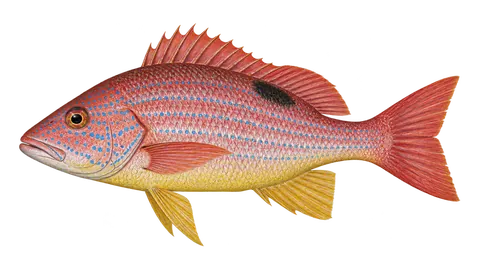
similar species