

- common size
- 20–30 cm
- maximum
- 34 cm
- common weight
- 0.1–0.3 kg
- record/max.
- — kg
- depth
- 0–40 m
- ideal water
- 23–29 °C

the right time
to be on the water
Choose the place and the species. The index, from 0 to 100, combines weather, sun, moon and tide with each fish's habits. Up to 28 days, with each day's confidence.
Loading the forecast…
—
Looking for alerts within 30 km…
Looking for what anglers have logged near here…
what you need to fish herelicense, certification and boat documents
fish likely at this spot
Tap a fish to see its forecast.
hour by hour
slide your finger or mouse over the chart to see each hoursee hour-by-hour table
why this index at —?
choose the day
the fishing month at a glance
what's the best window for the crew?
Choose how many fishing days. We compare each stretch by its average index, discount days with a warning or closed season, and show the 3 best.
trend for the coming weeks
Line: the middle value of 31 simulations of the American GEFS model. Band: where 8 out of 10 fall. Narrow, firm trend; wide, high uncertainty.
everything about the golden snapper
how to recognize it
Elongated body, very pointed snout, relatively small mouth with the maxilla reaching in front of the eye, and large eyes. Overall reddish color, with narrow brown stripes on the flanks, the ones above the lateral line sloping; peduncle and tail yellowish, and a white to yellow spot below the last dorsal rays. The dorsal has 10 spines and 13 soft rays, and the tail is forked; the notch and knob of the preopercle are weak. The Pacific yellow snapper (Lutjanus argentiventris), cited by STRI as similar, is much larger.
Also called: pargo-dourado, golden snapper, pargo-barbirrubia, rabirrubia
don't confuse with:
where found
open on the large mapWhere to look: Coastal rocky and coral reefs, in daytime schools that sometimes hover in midwater; juveniles with schools of Chromis atrilobata.
Does not occur in Brazil. Eastern Pacific: from Mexico to Panama (and as far as Colombia, according to STRI), with the Cocos, Malpelo and Galápagos islands.
when to fish
best season
Fished all year. Clear water and the presence of the school over the reef matter more than the month.
best time of day
Daytime. Forms schools by day over the reefs, sometimes hovering in midwater; this is the time to fish with light baits.
what affects the golden snapper
cold and cold fronts
Cold upwelling water drives the schools away from the reef.
atmospheric pressure
Little direct effect.
moon
Small effect.
rain
Little effect; runoff muddies the water near the coast.
water level
Not applicable at sea.
noise
A midwater school scatters if a motor passes over it; approach drifting.
wind
Strong wind and a churned-up sea make it hard to keep the boat over the reef.
tide
Moderate current along the rock moves the school.
depth
From midwater to about 40 m over reefs.
how to fish
lures
- light jig 15 to 30 g
- jig head with 5 cm shad
- sabiki
natural baits
- shrimp
- small strips of squid
- sardine pieces
tip from an angler
When the school hovers in midwater, lower a light jig or small bait to its depth and work it slowly, without spooking it.
- rod
- 6' to 6'6", 8 to 15 lb
- spinning / baitcasting reel
- spinning reel 2500 to 3000
- line
- braided line 10 to 20 lb
- leader
- fluorocarbon 15 to 25 lb, 1 m
- hook
- circle 1/0 to 2/0 or J hook no. 2 to 1/0
accessories
- alicate
- ruler to check the size
catch and release
A bottom fish can rise with an inflated swim bladder: use a descender to return it to depth. Don't puncture the bladder. Keep the fish in the water as long as possible and release those over the bag limit.
rules for the golden snapper
Rules change; before keeping or transporting fish, check with the state environmental agency.
Mexico: up to 5 per species and 10 saltwater fish per day
5 specimens of the species per angler per day, within the limit of 10 saltwater fish details
In federal waters of Mexico, recreational sport fishing allows each angler to keep up to 10 marine fish per day, no more than 5 of the same species. The golden snapper (pargo dorado) is not among the species reserved for sport fishing (marlins, sailfish, swordfish, tarpon (sábalo), roosterfish and dorado, up to 50 nautical miles from shore, item 0.3 of the standard) and has no quota of its own. Fish over the quota must go back alive, and sport-caught fish may not be sold. Anyone fishing from a boat needs an individual permit; from shore, no.
Colombia: sport fishing has ceased to exist as a category; tourist fishing applies (Law 2501/2025)
Transition period: confirm with AUNAP before fishingconfirm with the agency details
In Judgment C-148 of Apr 27, 2022, the Constitutional Court declared unconstitutional the rules that provided for sport fishing, with effects postponed by one year. Law 2501, enacted on Jul 28, 2025, created the tourist fishing category, and the rules (gear, quantities, minimum sizes, methods, zones and seasons) depend on regulations from the Ministry of Agriculture with AUNAP. We have not confirmed whether the decrees have been issued: check with AUNAP and use a licensed tourism operator before fishing or keeping any fish.
Source: Constitutional Court of Colombia, Judgment C-148/2022; Law 2501 of 2025 (Congress of Colombia)
Conservation: Of little concern globally, in an old assessment. We did not check national assessments in the countries on the entry.
how much it weighs without taking it out of the water
estimated weight
—
how we calculate
Length-weight relationship W = a·Lb (a = 0.01479, b = 2.96; FishBase (relação peso-comprimento bayesiana, estimativa pelo gênero e formato do corpo)). It's an average: a fat or lean fish can vary by 10% to 20%.
more about the golden snapper
Small snapper of the eastern Pacific, from Mexico to Panama (STRI goes as far as Colombia and the Cocos, Malpelo and Galápagos islands). Lives in coastal rocky and coral reefs down to at least 40 m (STRI cites up to 70 m) and, by day, forms schools of 30 or more fish that sometimes hover in midwater. Juveniles appear with schools of the damselfish Chromis atrilobata, which they may mimic. Eats invertebrates and fish, and may also take plankton. Reaches 34 cm (STRI cites 39 cm). FishBase lists it as of potential fishing interest and as a sport fish, and it is sold fresh and frozen. For the angler it is a light-line fish, caught from a boat over rocks, with natural bait or a light jig.
Family: Lutjanidae · predator
fun facts
- In Mexico it is known as barbirrubia or rabirrubia, and some authors place it in the genus Rabirubia (FishBase).
- Juveniles follow the schools of the damselfish Chromis atrilobata and may mimic it (FishBase and STRI).
- The daytime school sometimes hangs motionless in midwater, 30 fish or more.
in the kitchen
Sold fresh or frozen. Small fish with white flesh: fried whole or baked.
similar species
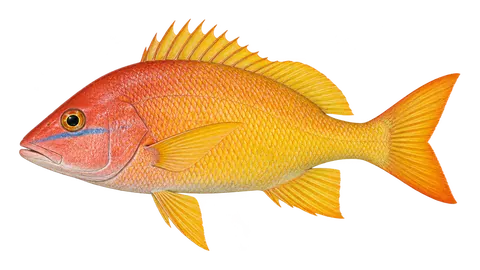


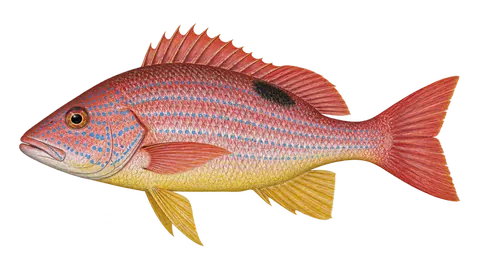
sources and references (7)
The season weights (months), the time of day and the sensitivities (cold, pressure, moon, wind, rain, tide, strong light, murky water and noise) are the app's editorial estimates, based on the literature below and on the field experience of anglers and guides. They are not official data nor a measurement made for this species, and they may vary by region and year. Closed seasons and legal rules appear in the rules section, with the norm and a link.
- scientific FishBase: Lutjanus inermis (ficha da espécie)Size, length-weight, depth, habitat, distribution, biology and IUCN status. Page checked on 13/10/2026. The common size range on this page is an editorial estimate, because FishBase does not give a common length. STRI cites 39 cm and a depth of 0 to 70 m; the page keeps FishBase's 34 cm and depth down to 40 m.
- scientific FishBase: nomes populares de Lutjanus inermisNames by country and language.
- scientific Robertson, D. R. & Allen, G. R. (2024). Shorefishes of the Eastern Pacific online information system, versão 3.0. Smithsonian Tropical Research Institute: Lutjanus inermisDescription, colors, size (39 cm), depth of 0 to 70 m and distribution (Mexico to Colombia and oceanic islands). Page checked on 13/10/2026.
- scientific IUCN Red List: Lutjanus inermis (avaliação global)Least Concern (LC), assessed May 23, 2007. Assessment checked in the FishBase entry (Red List, version 2025-2); the species' Red List link was not opened.
- official DOF: Modificação da NOM-017-PESC-1994, para regular a pesca deportivo-recreativa em águas de jurisdição federal do México (publicada em 25/11/2013)Reserves species for sport fishing (item 0.3), permits (4.3 and 4.14), rods and hooks (4.6), bait (4.7), chumming in tournaments (4.8), daily limits at sea (4.9.1) and in fresh water (4.9.2), catch and release (4.9.5), closed zones, seasons and protected areas (4.10), a ban on selling the catch (4.11) and filleting (4.12). Text checked on Oct 13, 2026; the DOF records publication on Nov 25, 2013 and signature on Oct 14, 2013. We found no specific Conapesca federal closed season for this species.
- official Corte Constitucional da Colômbia: Sentença C-148 de 27 de abril de 2022 (pesca deportiva)We checked the date and summary of the judgment, which holds sport fishing unconstitutional. The one-year postponement of effects comes from press reports on the decision; we did not read the full operative part.
- press Agenda del Mar: Pesca de turismo, qué se aprobó y qué falta (Lei 2501 de 2025)Reports the enactment of Law 2501 on Jul 28, 2025 and the regulatory deadlines (six months for tourism and one year for zones, species, methods and seasons). We could not open the official text of the law or confirm whether the decrees have been issued.
how we calculatewhere each number comes from
The weather comes from three independent global models, cross-checked hour by hour: when they agree, confidence goes up; when they diverge, the band between them shows on the chart. Beyond 16 days, we use the GEFS ensemble of 31 simulations: if 20 of the 31 predict rain, the chance of rain is 65%. Sun and moon are calculated astronomically, with no uncertainty.
The index adds up, weighted for each species: time of day (species curve anchored to real sunrise and sunset), moon (transits, rise and set, phase), pressure (3 h trend and 24 h swing), water temperature (in rivers, estimated from air temperature; at sea, estimated by an ocean model), wind, rain, clouds, tide and the month in the species' cycle.
sources for this lookup
how accurate the forecast is
Accuracy measured in the reference project (4 regions, 93 days, forecast vs. observed): maximum temperature is off by 0.6 °C on average the next day and 1.7 °C at 7 days; rain of 5 mm or more is detected 76% of the time the next day and 57% at 7 days. Detection isn't everything: the false alarm rate isn't published here yet, and 93 days in 4 regions is still a small sample. We now also measure every day, at the app's destinations: