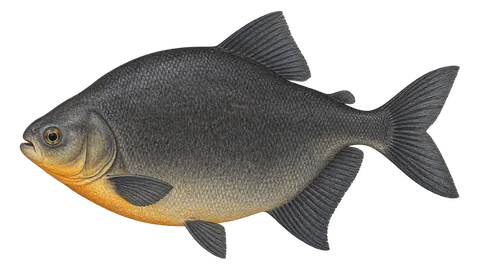
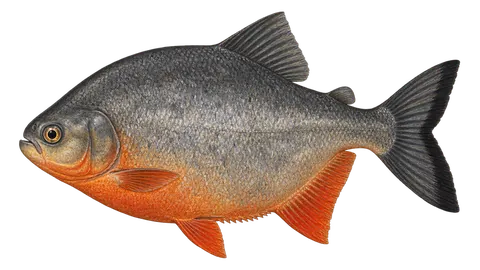
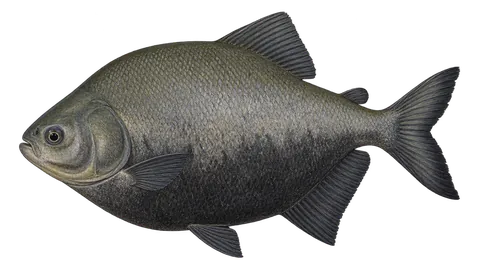
A hybrid produced in fish farming by crossing pacu (Piaractus mesopotamicus) with pirapitinga (P. brachypomus), the two species of the genus Piaractus. Along with tambacu and tambatinga, it is one of the round-fish hybrids raised in Brazil and turns up in pay lakes, where it feeds and fights like a pacu. A pond study showed growth similar to pacu, unlike its reputation for growing much bigger. It does not exist in the wild: when it appears in a river, it is an escape from a tank or an irregular release. Because hybrids in this group interbreed with the species that produced them, release threatens the genetics of the native pacu of the Plata basin. Releasing patinga into a river, lake or reservoir without a licence is an environmental offence. At a pay lake, follow the house rules.
fun facts
The name combines pacu and pirapitinga.
Portaria MPA nº 532/2025 recognizes patinga as the official trade name of the hybrid Piaractus mesopotamicus × P. brachypomus.
how to recognize it
identification
Tall, rounded body like the pacu's, and colour intermediate between the parents: dark grey to silvery on the back and flanks, with pale chest and belly, sometimes yellowish or orange. In practice it cannot be safely separated from pacu or other hybrids by appearance: only genetic testing confirms it. At a pay lake, the name the house uses usually shows what was stocked.
how patinga fishing looks
Loading the next 7 days…
Each card shows the day's index (0 to 100) and, below it, a strip with the index for each hour, from 0h to 23h. from poor to excellent.
Fish farms and pay lakes, with published records in SP and MS. There is no natural population; fish in rivers and reservoirs come from escapes or releases.
Habitat: Pay lake ponds, tanks and reservoirs; in rivers, near fish farms.
introduced in
Paraná
states
São Paulo, Mato Grosso do Sul
calendar and clock
when to fish
best season
time of yearbest: Oct–Apr
JanFebSeaAprMayJunJulAugSepOctNovDec
Warm months. In winter it feeds little, mainly in SP and the South.
best time of day
Daytime, with peaks at dawn and dusk. Feeds during the day; at pay lakes, feeding time with pellets and late afternoon are best.
weather, water and behavior
what affects the patinga
sensitivity The little bars show how much each factor affects this species. Five full: it feels it a lot.
cold and cold fronts
Water below 22 °C reduces activity.
atmospheric pressure
Hot, muggy days are the best.
moon
Little effect.
rain
Cold rain slows activity; summer rain may activate it.
water level
Not very relevant at pay lakes.
noise
Used to people, but it spooks at a thump on the deck.
wind
Wind pushes the feed and concentrates the fish on the downwind bank.
depth
At the surface when it eats feed; mid-water and bottom in the cold.
spinning reel 4000 to 5000 or baitcasting reel 200
line
monofilament 0.40 to 0.50 mm or braided 30 to 40 lb
leader
fluorocarbon or monofilament 50 to 60 lb
hook
2/0 to 5/0 heavy, chinu or maruseigo type
lures
artificial EVA pellet
rubber fruit lure
natural baits
pellet feed
feed dough
fruit (guava, grape)
accessories
groundbait float
alicate
boga-grip
large passaguá
tip from an angler
Groundbait float with feed and a hook 20 to 40 cm down. Set the hook when the float moves off and hold the first run: its teeth cut thin line.
what the law says
rules for the patinga
Summary of the regulations we found, with the source for each. Rules change; before keeping or transporting fish, check with the state environmental agency. Conservation: Risk of hybridization with native pacu if released into the wild.
Releasing into the wild without a license is an offense
releasing or introducing fish into rivers, reservoirs and lakes is prohibitedconfirm with the agency
Introducing an exotic species, a hybrid or a fish outside its natural range without a technical opinion and licence is a federal environmental offence. This includes releasing fish from a tank, pay lake or aquarium into a river or reservoir.
GO: releasing hybrids into natural environments banned
release banned in natural aquatic environmentsGO
In Goiás it is banned to release genetically modified organisms, hybrids, non-native or exotic organisms into natural aquatic environments. Patinga does not appear in Annex II of species with free catch, which lists tambacu.
release banned; exempt from size rulesPRParanáSoutheast Atlantic
In the inland basins of the Paraná, non-native, exotic and hybrid fish are exempt from size rules, and it is banned to release those caught while fishing.
MT: introducing a species without a licence brings a fine
fine of R$6,000 to R$100,000MT
Mato Grosso's fishing law penalizes anyone who introduces native, exotic or non-native species without authorization from the environmental agency, with a surcharge per kilogram or per fish.
catch and release Releasing the fish alive, quickly and with a wet hand. During a closed season it isn't always allowed: what the regulation says applies.
At a pay lake, follow the house rules. In a river, don't release it: it is a hybrid outside its natural environment; in Paraná, releasing hybrids is banned.
in the kitchen
Fatty, tasty flesh of a round-bodied fish; ribs and flank roasted over coals.
calculator
how much it weighs without taking it out of the water
Length-weight relationship W = a·Lb (a = 0.02455, b = 3.0; estimado (pacu, FishBase)). It's an average: a fat or lean fish can vary by 10% to 20%.
estimated weight
—
sources and references
The season weights (months), the time of day and the sensitivities (cold, pressure, moon, wind, rain, tide, strong light, murky water and noise) are the app's editorial estimates, based on the literature below and on the field experience of anglers and guides. They are not official data nor a measurement made for this species, and they may vary by region and year. Closed seasons and legal rules appear in the rules section, with the norm and a link.
scientificFishBase — Piaractus mesopotamicus (ficha do pacu, espécie parental)Patinga is a captive hybrid and has no entry of its own on FishBase. Length-weight relationship used as an estimate; the app's entry sizes were estimated from the parent species. Page checked on Oct 13, 2026.