Hybrid produced in fish farming by crossing a female tambaqui with a male pacu. Grows fast, tolerates cold better than the tambaqui, and became the base fish of pay lakes in the Center-South. Fights with strong, heavy runs. It doesn't exist in nature: when it turns up in a river, it has escaped from a tank or been released illegally. Because it is a hybrid of species that live in the Center-South, it can breed with native pacu and mix the genetics. Releasing tambacu into a river, lake or reservoir without a license is an environmental offense. At pay lakes, follow the house rules.
fun facts
It is made from a female tambaqui and a male pacu; the reverse cross is called paqui.
It can be fertile, so releasing it threatens the genetics of the pacu.
how to recognize it
identification
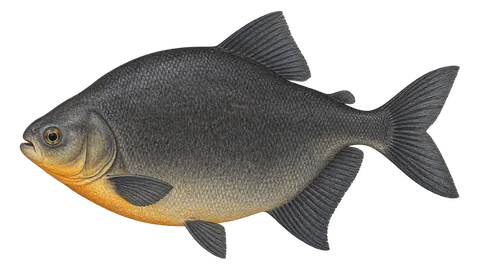
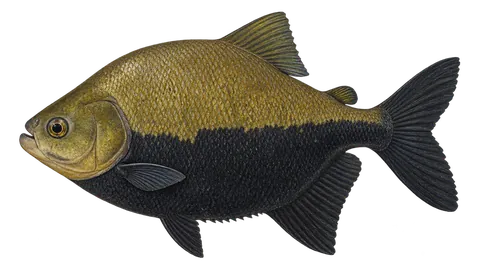
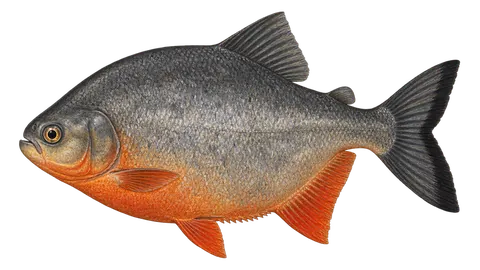
Tall, round body, between pacu and tambaqui. Head larger than the pacu's. Dark back; the lower flank and belly are darker than the pacu's, without the sharp, dark lower half of the tambaqui. In practice: if it isn't clearly a pacu (grey with a light belly) or a tambaqui, at a pay lake it is a tambacu. Only genetic testing confirms it.
how tambacu fishing looks
Loading the next 7 days…
Each card shows the day's index (0 to 100) and, below it, a strip with the index for each hour, from 0h to 23h. from poor to excellent.
Pay lakes and fish farms in SP, MG, GO, MS, MT and PR. Escapes recorded in rivers and reservoirs of the Paraná, Paraguay, São Francisco and Tocantins-Araguaia basins.
Habitat: Pay lake ponds, tanks and reservoirs; in rivers, near fish farms.
Summary of the regulations we found, with the source for each. Rules change; before keeping or transporting fish, check with the state environmental agency. Conservation: Risk of hybridization with native pacu if released into the wild.
Releasing it into the natural environment without a license is an offense
releasing or introducing fish into rivers, reservoirs and lakes is prohibitedSPMGGOMSMTPRconfirm with the agency
Introducing an exotic species, or one outside its natural range, without a technical opinion and a license is a federal environmental offense. This includes releasing a fish from a tank, pay lake or aquarium into a river or reservoir. In MG, the IEF states that stocking without a license is prohibited.
MT: introducing an exotic species without a license carries a fine
fine of R$6,000 to R$100,000MT
Mato Grosso's fishing law penalizes anyone who introduces native, exotic or non-native species without authorization from the environmental agency, with a surcharge per kilogram or per fish.
MS: tambacu (hybrid) outside the native-fish limit
specimens may be added to the limit, subject to the closed seasonMS
In MS, tambacu (hybrid) is on the list of exotic, allochthonous and hybrid species whose specimens may be added to the angler's limit (1 native + 5 piranhas), subject to the closed season.
MT: catch and transport of exotics have their own rules
under Cepesca Resolution No. 02/2024MT
Cepesca Resolution No. 02/2024 regulates the catch and transport of exotic fish in the rivers of the Paraguay, Amazon and Araguaia-Tocantins basins in MT. Check with Sema-MT on the municipalities and conditions before transporting.
catch and release Releasing the fish alive, quickly and with a wet hand. During a closed season it isn't always allowed: what the regulation says applies.
At pay lakes, follow the house rules. In rivers, don't return it: it is a hybrid outside its natural environment.
in the kitchen
Fatty, tasty meat; ribs and belly grilled over coals.
calculator
how much it weighs without taking it out of the water
Length-weight relationship W = a·Lb (a = 0.0235, b = 3.0; estimado (média de pacu e tambaqui, FishBase)). It's an average: a fat or lean fish can vary by 10% to 20%.
estimated weight
—
sources and references
The season weights (months), the time of day and the sensitivities (cold, pressure, moon, wind, rain, tide, strong light, murky water and noise) are the app's editorial estimates, based on the literature below and on the field experience of anglers and guides. They are not official data nor a measurement made for this species, and they may vary by region and year. Closed seasons and legal rules appear in the rules section, with the norm and a link.