

- common size
- 30–50 cm
- maximum
- 80 cm
- common weight
- 1.5–6 kg
- record/max.
- 20.0 kg
- depth
- 0.5–4 m
- ideal water
- 26–31 °C

the right time
to be on the water
Choose the place and the species. The index, from 0 to 100, combines weather, sun, moon and tide with each fish's habits. Up to 28 days, with each day's confidence.
Loading the forecast…
—
Looking for alerts within 30 km…
Looking for what anglers have logged near here…
what you need to fish herelicense, certification and boat documents
fish likely at this spot
Tap a fish to see its forecast.
hour by hour
slide your finger or mouse over the chart to see each hoursee hour-by-hour table
why this index at —?
choose the day
the fishing month at a glance
what's the best window for the crew?
Choose how many fishing days. We compare each stretch by its average index, discount days with a warning or closed season, and show the 3 best.
trend for the coming weeks
Line: the middle value of 31 simulations of the American GEFS model. Band: where 8 out of 10 fall. Narrow, firm trend; wide, high uncertainty.
everything about the patinga
how to recognize it
Tall, rounded body like the pacu's, and colour intermediate between the parents: dark grey to silvery on the back and flanks, with pale chest and belly, sometimes yellowish or orange. In practice it cannot be safely separated from pacu or other hybrids by appearance: only genetic testing confirms it. At a pay lake, the name the house uses usually shows what was stocked.
Also called: patinga
don't confuse with:
where found
open on the large mapWhere to look: Pay lake ponds, tanks and reservoirs; in rivers, near fish farms.
Fish farms and pay lakes, with published records in SP and MS. There is no natural population; fish in rivers and reservoirs come from escapes or releases.
introduced in
states
São Paulo, Mato Grosso do Sul
when to fish
best season
Warm months. In winter it feeds little, mainly in SP and the South.
best time of day
Daytime, with peaks at dawn and dusk. Feeds during the day; at pay lakes, feeding time with pellets and late afternoon are best.
what affects the patinga
cold and cold fronts
Water below 22 °C reduces activity.
atmospheric pressure
Hot, muggy days are the best.
moon
Little effect.
rain
Cold rain slows activity; summer rain may activate it.
water level
Not very relevant at pay lakes.
noise
Used to people, but it spooks at a thump on the deck.
wind
Wind pushes the feed and concentrates the fish on the downwind bank.
depth
At the surface when it eats feed; mid-water and bottom in the cold.
how to fish
lures
- artificial EVA pellet
- rubber fruit lure
natural baits
- pellet feed
- feed dough
- fruit (guava, grape)
tip from an angler
Groundbait float with feed and a hook 20 to 40 cm down. Set the hook when the float moves off and hold the first run: its teeth cut thin line.
- rod
- 6' to 7', medium-heavy action, 17 to 40 lb
- spinning / baitcasting reel
- spinning reel 4000 to 5000 or baitcasting reel 200
- line
- monofilament 0.40 to 0.50 mm or braided 30 to 40 lb
- leader
- fluorocarbon or monofilament 50 to 60 lb
- hook
- 2/0 to 5/0 heavy, chinu or maruseigo type
accessories
- groundbait float
- alicate
- boga-grip
- large passaguá
catch and release
At a pay lake, follow the house rules. In a river, don't release it: it is a hybrid outside its natural environment; in Paraná, releasing hybrids is banned.
rules for the patinga
Rules change; before keeping or transporting fish, check with the state environmental agency.
Releasing into the wild without a license is an offense
releasing or introducing fish into rivers, reservoirs and lakes is prohibitedconfirm with the agency details
Introducing an exotic species, a hybrid or a fish outside its natural range without a technical opinion and licence is a federal environmental offence. This includes releasing fish from a tank, pay lake or aquarium into a river or reservoir.
Source: Lei federal nº 9.605/1998, art. 31, and Decreto federal nº 6.514/2008, art. 25
GO: releasing hybrids into natural environments banned
release banned in natural aquatic environmentsGO details
In Goiás it is banned to release genetically modified organisms, hybrids, non-native or exotic organisms into natural aquatic environments. Patinga does not appear in Annex II of species with free catch, which lists tambacu.
PR: captured hybrids may not be released
release banned; exempt from size rulesPR details
In the inland basins of the Paraná, non-native, exotic and hybrid fish are exempt from size rules, and it is banned to release those caught while fishing.
MT: introducing a species without a licence brings a fine
fine of R$6,000 to R$100,000MT details
Mato Grosso's fishing law penalizes anyone who introduces native, exotic or non-native species without authorization from the environmental agency, with a surcharge per kilogram or per fish.
Source: Lei estadual MT nº 9.096/2009, art. 46 (as amended by Lei nº 12.197/2023) - Sema-MT
Conservation: Risk of hybridization with native pacu if released into the wild.
how much it weighs without taking it out of the water
estimated weight
—
how we calculate
Length-weight relationship W = a·Lb (a = 0.02455, b = 3.0; estimado (pacu, FishBase)). It's an average: a fat or lean fish can vary by 10% to 20%.
more about the patinga
A hybrid produced in fish farming by crossing pacu (Piaractus mesopotamicus) with pirapitinga (P. brachypomus), the two species of the genus Piaractus. Along with tambacu and tambatinga, it is one of the round-fish hybrids raised in Brazil and turns up in pay lakes, where it feeds and fights like a pacu. A pond study showed growth similar to pacu, unlike its reputation for growing much bigger. It does not exist in the wild: when it appears in a river, it is an escape from a tank or an irregular release. Because hybrids in this group interbreed with the species that produced them, release threatens the genetics of the native pacu of the Plata basin. Releasing patinga into a river, lake or reservoir without a licence is an environmental offence. At a pay lake, follow the house rules.
Family: Serrasalmidae · omnivore
fun facts
- The name combines pacu and pirapitinga.
- Portaria MPA nº 532/2025 recognizes patinga as the official trade name of the hybrid Piaractus mesopotamicus × P. brachypomus.
in the kitchen
Fatty, tasty flesh of a round-bodied fish; ribs and flank roasted over coals.
similar species
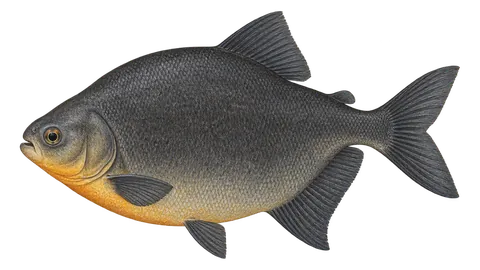
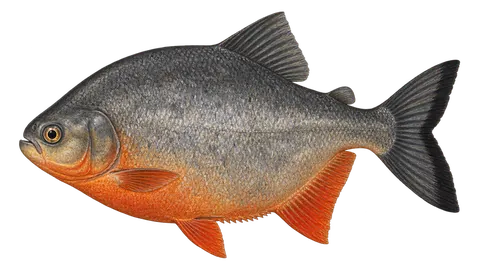
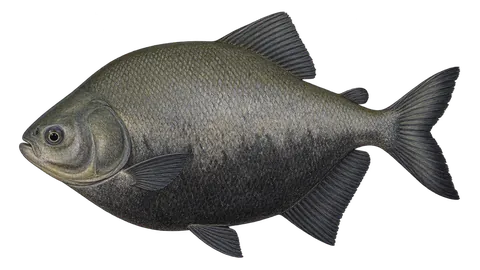
sources and references (8)
The season weights (months), the time of day and the sensitivities (cold, pressure, moon, wind, rain, tide, strong light, murky water and noise) are the app's editorial estimates, based on the literature below and on the field experience of anglers and guides. They are not official data nor a measurement made for this species, and they may vary by region and year. Closed seasons and legal rules appear in the rules section, with the norm and a link.
- scientific FishBase — Piaractus mesopotamicus (ficha do pacu, espécie parental)Patinga is a captive hybrid and has no entry of its own on FishBase. Length-weight relationship used as an estimate; the app's entry sizes were estimated from the parent species. Page checked on Oct 13, 2026.
- scientific FishBase — Piaractus brachypomus (ficha da pirapitinga, espécie parental)Patinga is a captive hybrid and has no entry of its own on FishBase. Page checked on Oct 13, 2026.
- scientific Hashimoto, D. T.; Senhorini, J. A.; Foresti, F.; Porto-Foresti, F. (2012). Interspecific fish hybrids in Brazil: management of genetic resources for sustainable use. Reviews in Aquaculture 4: 108-118.Round-fish hybrids (tambacu, tambatinga and patinga) and the risk of interbreeding with the parent species.
- scientific Seraphim, G. et al. (2020). Growth curve of pacu and the patinga hybrid farmed in a semi-intensive system. Semina: Ciências Agrárias 41(5 supl. 1): 2285-2296.Growth of patinga similar to that of pacu. DOI checked on Crossref.
- scientific Franceschini, L. et al. (2013). Parasitic infections of Piaractus mesopotamicus and hybrid (P. mesopotamicus x Piaractus brachypomus) cultured in Brazil. Revista Brasileira de Parasitologia Veterinária 22(3): 407-414.Patingas in fish farms and in a pay lake in northwestern SP. DOI checked on Crossref.
- official Portaria MPA nº 532, de 23 de setembro de 2025 — nomes comuns das espécies de peixes de interesse comercialHybrid fish: Piaractus mesopotamicus x Piaractus brachypomus = Patinga. Page checked on Oct 13, 2026.
- official IN Semad-GO nº 17/2026 — normas de pesca em GoiásArt. 7º, § 5º. Page checked on Oct 13, 2026.
- official Portaria IAT nº 650/2025 — pesca nas bacias interiores do ParanáArt. 3º. Page checked on Oct 13, 2026.
how we calculatewhere each number comes from
The weather comes from three independent global models, cross-checked hour by hour: when they agree, confidence goes up; when they diverge, the band between them shows on the chart. Beyond 16 days, we use the GEFS ensemble of 31 simulations: if 20 of the 31 predict rain, the chance of rain is 65%. Sun and moon are calculated astronomically, with no uncertainty.
The index adds up, weighted for each species: time of day (species curve anchored to real sunrise and sunset), moon (transits, rise and set, phase), pressure (3 h trend and 24 h swing), water temperature (in rivers, estimated from air temperature; at sea, estimated by an ocean model), wind, rain, clouds, tide and the month in the species' cycle.
sources for this lookup
how accurate the forecast is
Accuracy measured in the reference project (4 regions, 93 days, forecast vs. observed): maximum temperature is off by 0.6 °C on average the next day and 1.7 °C at 7 days; rain of 5 mm or more is detected 76% of the time the next day and 57% at 7 days. Detection isn't everything: the false alarm rate isn't published here yet, and 93 days in 4 regions is still a small sample. We now also measure every day, at the app's destinations: