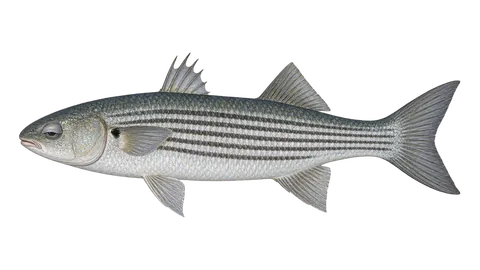
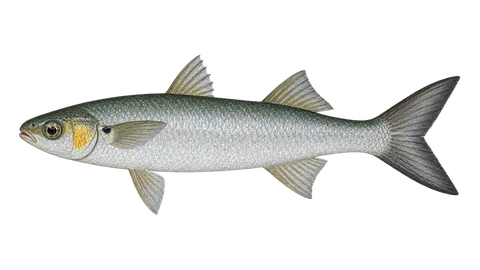
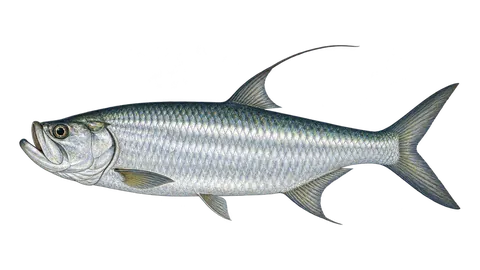
Silvery, slender fish with a large, deeply forked tail, living in coastal schools and estuaries across the Indo-Pacific and the eastern Pacific. It eats algae and plankton, which makes it hard to tempt with ordinary bait; it can exceed 1 m.
Also called: peixe-leite, chano, sabalote, Milkfish
The milkfish (chano, or sabalote in Mexico) is the only member of the family Chanidae and has a huge range: from South Africa and the Red Sea to Hawaii and the Marquesas, north to Japan, and in the eastern Pacific from San Pedro (California) to the Galápagos. It lives in small to large schools near the coast and near reef islands, in bays and estuaries, in water above 20 °C; adults enter estuaries and, now and then, rivers. It eats algae, cyanobacteria, small bottom invertebrates and even fish eggs and larvae, so ordinary fish bait tends to produce little. It reaches 1.8 m and 14 kg, according to FishBase; a Mexican guide cites an IGFA record of 19.7 kg, from El Salvador. In Mexico, where it is called sabalote, the guide consulted cites only one 51 cm fish caught from shore and limited use as live bait for tuna.
fun facts
It is the only member of the family Chanidae.
The larvae are collected in rivers and grown out in ponds; most of the world's production comes from Indonesia, the Philippines, Taiwan and Hawaii, according to the Mexican guide.
In Los Cabos, Mexico, it is called lizón; the same guide says it serves as live bait for tuna, on a small scale.
how to recognize it
identification
Elongated, slightly flattened body, silvery, with an olive-green back; pointed head, large eye and small toothless mouth. It has a single dorsal fin in the middle of the body and a large, deeply forked tail; the inner face of the pectoral and pelvic fins is black, and there are no scutes on the belly. Mullets, which can look similar from a distance, have two separate dorsal fins; the milkfish has just one.
how milkfish fishing looks
Loading the next 7 days…
Each card shows the day's index (0 to 100) and, below it, a strip with the index for each hour, from 0h to 23h. from poor to excellent.
Not found in Brazil. Indo-Pacific, from South Africa and the Red Sea to Hawaii and the Marquesas, north to Japan and south to Victoria (Australia); in the eastern Pacific, from San Pedro (California) to the Galápagos. In Mexico it lives in the Pacific and along all coastal waters, except the northern two-thirds of the Gulf of California. FishBase lists, in Latin America, Mexico, Guatemala, El Salvador, Honduras, Nicaragua, Costa Rica, Panama, Ecuador and Peru.
Habitat: Shallow coastal waters, bays, estuaries and lagoons, and reefs near islands; juveniles use mangroves and estuaries, and adults spawn only in fully salt water.
calendar and clock
when to fish
best season
time of yearbest: Jun–Sep
JanFebSeaAprMayJunJulAugSepOctNovDec
Occurs all year in water above 20 °C and spawns year-round, according to the Mexican guide. The app gives more weight to the warmer months.
best time of day
Daytime. No time-of-day studies for fishing. Since it feeds on algae and plankton, the app's estimate puts it more active by day.
weather, water and behavior
what affects the milkfish
sensitivity The little bars show how much each factor affects this species. Five full: it feels it a lot.
cold and cold fronts
Below 20 °C it disappears from the coast; cold winters drive the schools away.
atmospheric pressure
Rough sea from a strong front hurts shore fishing.
moon
No known effect.
rain
Muddy river water at the mouths scatters the schools.
water level
Not applicable at sea.
noise
Shoreline schools spook at shadows, boats and footsteps on the bank.
wind
Strong wind stirs up the water and makes it hard to read the schools.
tide
Current at the mouths and in the channels concentrates the algae and plankton it feeds on.
depth
From 1 to 30 m; small fish stay near sandy beaches and large ones move out to the shelf.
Reports of sport fishing for milkfish are rare; what follows is general guidance for schooling fish that eat algae and plankton. Look for schools with their mouths at the surface, cast lightly and ahead of the school, and let the bait sit still.
what the law says
rules for the milkfish
Summary of the regulations we found, with the source for each. Rules change; before keeping or transporting fish, check with the state environmental agency. Conservation: Of least concern globally, with stable populations and a wide distribution. It is farmed on a large scale in aquaculture. It is not listed in Mexico's NOM-059-SEMARNAT-2010.
Mexico: «sábalo o chiro» is reserved for sport fishing, but the standard does not say which species it is
If the standard covers this species: up to 2 fish per angler per dayconfirm with the agency
NOM-017 reserves «sábalo o chiro» for sport fishing, up to 50 nautical miles from shore, and limits it to 2 fish per angler per day (items 0.3 and 4.9.1), without giving a scientific name. «Sábalo» is usually the camurupim (Megalops atlanticus). FishBase records «sábalo» among the popular names of the milkfish in Mexico, and the Mexican guide consulted says the common name is sabalote. We found no source saying whether the standard covers the milkfish (Chanos chanos). When in doubt, keep no more than 2 a day and prefer to release it.
Mexico: up to 5 per species and 10 saltwater fish per day
5 specimens of the species per angler per day, within the limit of 10 saltwater fish
In recreational sport fishing in Mexican federal waters, each angler may keep up to 10 marine fish per day, no more than 5 of the same species. The milkfish is not among the species reserved for sport fishing (marlin, sailfish, swordfish, "sábalo o chiro," roosterfish and dorado, up to 50 nautical miles from shore, item 0.3 of the standard) and has no quota of its own. Fish over the limit go back alive (item 4.9.5), and sport-caught fish may not be sold. Anglers fishing from a boat need the permits of the Federal Duties Law; anglers fishing from shore do not (item 4.3).
Personal Incopesca license, for people over 16confirm with the agency
In the regulation of the Fisheries and Aquaculture Law (Decree 36782, of May 24, 2011), art. 69, sport fishing is authorized only for natural persons over 16, with a license issued by Incopesca; tourists, whether national or foreign, also need the license. Art. 68 limits the landing of large pelagics to 5 per trip, and art. 66 promotes catch and release, but the rule sets no quota for this species. The decree was later amended (Decree 39458), so confirm the current rule with Incopesca.
Panama: new sport fishing decree in force from Dec 10, 2026
Executive Decree No. 9 (Jun 10, 2026), in force from Dec 10, 2026confirm with the agency
ARAP published Executive Decrees No. 9 and No. 10, of Jun 10, 2026, in the Official Gazette. The first regulates sport fishing throughout the territory; the second protects billfish (sailfish and marlins). Both take effect on Dec 10, 2026, after six months of adaptation. We did not verify the text: the press report gives no catch limits, sizes or license requirements. Before fishing in Panama, check with ARAP.
catch and release Releasing the fish alive, quickly and with a wet hand. During a closed season it isn't always allowed: what the regulation says applies.
Thin-skinned fish with loose scales: wet your hands, support the whole body and release it quickly. Don't drag it across the sand.
in the kitchen
Highly prized in Southeast Asia, where it is farmed, but it has many small bones. Sold fresh, smoked, canned or frozen, according to FishBase.
calculator
how much it weighs without taking it out of the water
Length-weight relationship W = a·Lb (a = 0.00851, b = 3.06; FishBase (relação peso-comprimento bayesiana, estimativa da própria espécie)). It's an average: a fat or lean fish can vary by 10% to 20%.
estimated weight
—
sources and references
The season weights (months), time of day and sensitivities (cold, pressure, moon, wind, rain, tide, strong light, murky water and noise) are the app's editorial estimates, based on the literature below and on field experience of anglers and guides. They are not official data or measurements made for this species, and may vary by region and year. Closed seasons and legal rules appear in the rules section, with the standard and a link. The common size starts from FishBase's common length (100 cm) and the smallest sport-caught fish cited by the Mexican guide (51 cm); the common weight is calculated from the length-weight relationship.
technicalMexican Fish (mexican-fish.com): ficha do Milkfish (Chanos chanos)Independent guide to Mexican Pacific fishes, with photos of catches and the author's observations; not an official source. Page checked on 13/10/2026. It gives the names used in Mexico (sabalote and lizón), the Mexican distribution, feeding habits and the IGFA record of 19.73 kg (El Salvador, February 2012), which exceeds FishBase's 14 kg; we adopt 19.7 kg as the maximum weight. We did not verify the record on the IGFA website.