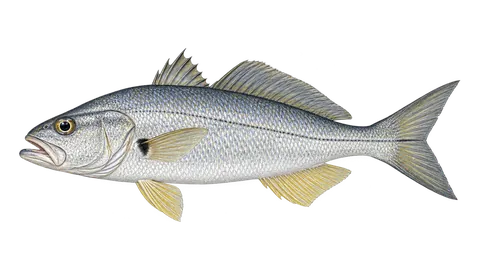
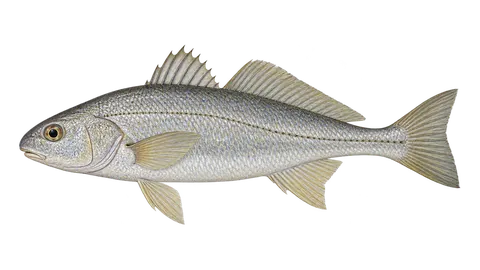
Croaker of rivers and estuaries in the Amazon and the Guianas, also recorded in the Magdalena. An important food fish, caught near the bottom and in mid-water, with its identity still debated against the pescada-do-piauí.
Freshwater and estuarine croaker of the family Sciaenidae, from the Amazon, the Guianas and, according to FishBase, the Magdalena (Colombia). It lives on the bottom and in mid-water, from 1 to 30 m (range assumed by FishBase), in the lower parts of streams and in estuaries, eats fish, matures at about 27 cm and reaches 70 cm. FishBase considers it an important food fish, of commercial use and aquaculture. Taxonomy is debated: Casatti's (2005) review recognizes five valid Plagioscion and P. surinamensis is not among them; in Colombia the pácora of the Magdalena appears as P. magdalenae, which AUNAP treats as a synonym of P. surinamensis, and FishBase includes the Magdalena in the species' distribution. IUCN uses P. surinamensis and rates it Data Deficient (DD, 2019). For the angler, the rule for Amazonian croakers applies, since they are hard to tell apart in the field.
fun facts
The epithet surinamensis means 'from Suriname'.
In the AUNAP table, the Magdalena pácora is listed as P. magdalenae and, in parentheses, P. surinamensis as the equivalent.
how to recognize it
identification
Slender, silvery body with a grayish back, two dorsal fins (the first spiny, the second longer), a large oblique mouth and a pointed tail, like the other freshwater croakers of the genus Plagioscion. No field feature reliably separates the pescada-cacunda from the pescada-do-piauí (P. squamosissimus) and other Amazonian croakers: separation depends on counts and proportions that only a specialist checks. In practice, treat them all as pescada and check the scientific name the local rule cites.
how pacora fishing looks
Loading the next 7 days…
Each card shows the day's index (0 to 100) and, below it, a strip with the index for each hour, from 0h to 23h. from poor to excellent.
Amazon basin and Amazon estuary, in Brazil; outside Brazil, the Magdalena River (Colombia) and coastal rivers of Suriname and Guyana. FishBase gives 11°N to 17°S for the species, but in Brazil it is regional: Amazonia and the north coast.
Habitat: Bottom and mid-water of rivers, estuaries and lower stretches of streams; the 1 to 30 m depth is assumed by FishBase, not measured.
native to the basins
Amazon
coast
North Coast
states
Amazonas, Pará, Amapá
calendar and clock
when to fish
best season
time of yearbest: Jul–Oct
JanFebSeaAprMayJunJulAugSepOctNovDec
Estimate: falling water and dry season concentrate fish in channels and estuaries. Check your state's closed seasons in the general rules section.
best time of day
Night and twilight. No timing studies for the species. Freshwater croakers fish best from late afternoon into the night (estimate by analogy with the pescada-do-piauí).
weather, water and behavior
what affects the pacora
sensitivity The little bars show how much each factor affects this species. Five full: it feels it a lot.
cold and cold fronts
Little effect in a tropical river; friagem (cold spells) reduce activity.
atmospheric pressure
Stable pressure favors it (estimate).
moon
Dark nights tend to produce more croakers (estimate).
rain
Little effect.
water level
Falling water concentrates fish in channels and estuaries.
noise
Moderate sensitivity.
wind
Strong wind makes it harder to control the lure on the bottom.
tide
In estuary stretches, the moving tide tends to activate the fish; in the river, no effect (estimate).
spinning reel 2500 to 3000 or baitcasting reel 100
line
braided 15 to 20 lb
leader
fluorocarbon 20 to 25 lb
hook
1/0 to 3/0
lures
jig head with silicone shad
feather jig, 1/4 oz
small spoon
natural baits
live lambari
shrimp
piece of fish
accessories
alicate
landing net
tip from an angler
There is no sport-fishing literature for the species; the gear is that of the pescada-do-piauí. Work the jig vertically near the bottom, or use live shrimp and lambari.
what the law says
rules for the pacora
Summary of the regulations we found, with the source for each. Rules change; before keeping or transporting fish, check with the state environmental agency. Conservation: Not on the Brazilian national list (Ministerial Ordinance GM/MMA No. 1.667/2026).
Colombia (Magdalena): minimum 30 cm standard length
30 cm standard lengthconfirm with the agency
In the Magdalena, Cauca and San Jorge basins, the pácora (Plagioscion magdalenae, treated as P. surinamensis) has a minimum catch size of 30 cm standard length (LE, from the tip of the snout to the base of the tail). The rule is old and should be checked with AUNAP before fishing.
AP and RO: pescada in the closed season Nov 15 to Mar 15
fishing for pescada-branca banned (the portaria cites only Plagioscion squamosissimus)15/11 to 15/03APROAmazonconfirm with the agency
The portaria bans fishing for pescada-branca (Plagioscion squamosissimus) in AP and, in the Madeira basin in RO, catching pescada, from Nov 15 to Mar 15. It does not cite P. surinamensis; since Amazonian croakers are confused in the field, enforcement may treat them as the same species. Under art. 2º, II, the recreational angler using handline or rod is exempt from the ban, unless a stricter state rule applies.
piracema closures in the basins where the species lives
Spawning closure (piracema) in Mato Grosso (all basins)
01/10 to 31/01MT
Allowed: All fishing modalities are prohibited in rivers, including catch and release (Law 9.096/2009, art. 19-A). Exceptions: subsistence fishing from shore (3 kg or 1 fish, no transport or sale) and scientific fishing. Law 13.159/2025 now allows licensed sport fishing in UHE/PCH hydropower reservoirs, natural lakes and border rivers, subject to a scientific study and a license from the environmental agency. We have not confirmed whether these licenses are already being issued.
Allowed: Recreational anglers with handline or rod, line and hook are outside the Annex II prohibitions, with a bag limit of 5 kg + 1 fish, unless a stricter state rule applies.
catch and release Releasing the fish alive, quickly and with a wet hand. During a closed season it isn't always allowed: what the regulation says applies.
A fish pulled up from depth can suffer decompression: release it quickly, with the fish in or near the water. Hold it behind the gill covers, away from the dorsal spines.
in the kitchen
FishBase calls it an important food fish. White pescada meat, good as fried fillet, grilled or in moqueca.
calculator
how much it weighs without taking it out of the water
Length-weight relationship W = a·Lb (a = 0.01047, b = 3.06; FishBase (relação peso-comprimento bayesiana, estimativa da própria espécie)). It's an average: a fat or lean fish can vary by 10% to 20%.
estimated weight
—
sources and references
The season weights (months), the time of day and the sensitivities (cold, pressure, moon, wind, rain, tide, strong light, murky water and noise) are the app's editorial estimates, based on the literature below and on the field experience of anglers and guides. They are not official data nor a measurement made for this species, and they may vary by region and year. Closed seasons and legal rules appear in the rules section, with the norm and a link.
scientificFishBase: Plagioscion surinamensis (ficha da espécie)Size, length-weight, depth, habitat, distribution, biology and IUCN status. Page checked on October 13, 2026. The maximum weight and the typical sizes and weights on the page are editorial estimates made with the length-weight relationship, because FishBase does not publish a maximum weight for the species.