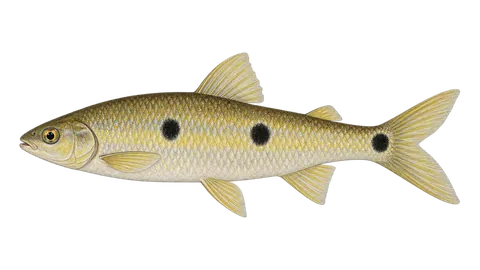
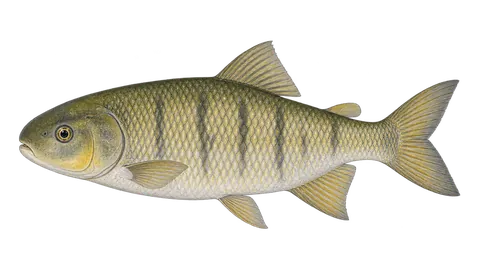
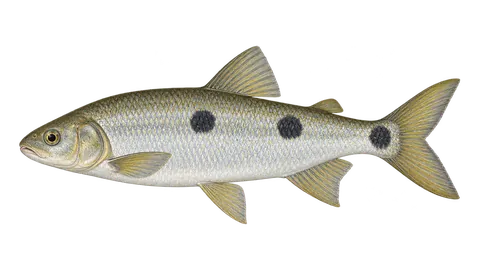
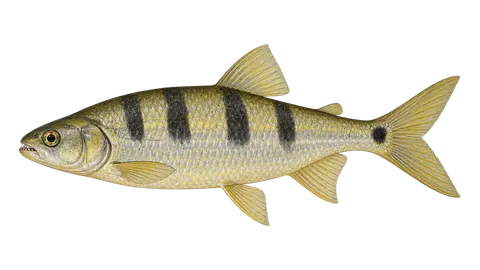
Rustic piau of the rivers and açudes (reservoirs) of the Northeast, from the São Francisco to the Parnaíba. It tolerates water with low oxygen, and the traditional 'piau season' takes place in the dry season, fished with a simple rod, corn or cornmeal dough.
Also called: piau, piau-cabeça-gorda, piau-branco, piau-coqueiro
Medium-sized anostomid, native to the Northeast, described by Fowler in 1941 from the Salgado River, in Ceará. It occurs from the São Francisco to the Parnaíba rivers and in intermittent basins draining to the Atlantic, such as Jaguaribe and Piranhas-Açu, as well as in açudes of the semi-arid region. It is considered hardy because it tolerates water with low oxygen. Omnivorous and opportunistic, it eats whatever is most abundant and feeds a lot all year, except during spawning. It migrates and spawns in the rainy season, from November to March, according to the literature. It is an important fish in artisanal, subsistence and sport fishing; in the Parnaíba, the 'piau season' takes place in the dry season, from July to September, with rod, line, hook and corn or 'grude'.
fun facts
It is called piau-cabeça-gorda, piau-branco and piau-coqueiro, depending on the region.
In a study on the Parnaíba, fish caught downstream of the Boa Esperança dam matured at a smaller size than those from the stretch upstream.
It tolerates low-oxygen water, which is why it lives even in temporary rivers of the semi-arid region.
how to recognize it
identification
Medium-sized piau with an elongated, almost spindle-shaped body and a broad head (hence piau-cabeça-gorda), a small mouth at the tip of the snout with few large, flattened teeth, as in other Leporinus, and an adipose fin. Fish caught are between 15 and 25 cm. In the rivers and açudes of the semi-arid Northeast it is one of the most important piaus for fishing; outside the Northeast, the piaus caught are other species, such as the piau-três-pintas and the piapara.
how piau fishing looks
Loading the next 7 days…
Each card shows the day's index (0 to 100) and, below it, a strip with the index for each hour, from 0h to 23h. from poor to excellent.
Rivers of the Northeast, from the São Francisco to the Parnaíba, and intermittent basins draining to the Atlantic, such as Jaguaribe and Piranhas-Açu. It was described from the Salgado River (CE) and is common in açudes of the semi-arid region, such as Taperoá II, in Paraíba.
Habitat: Perennial and temporary rivers, eddies, pools and açudes of the semi-arid region; tolerates low oxygen. Pairs spawn in places with dense vegetation, according to FishBase.
native to the basins
ParnaíbaEastern Northeast AtlanticSão Francisco
states
Piauí, Maranhão, Ceará, Rio Grande do Norte, Paraíba
calendar and clock
when to fish
best season
time of yearbest: Jun–Oct
JanFebSeaAprMayJunJulAugSepOctNovDec
The 'piau season' on the Parnaíba runs from July to September, in the driest period of the river, when fishing with corn or grude is best. Spawning falls in the rainy season (November to March), and during that phase the fish feeds much less.
best time of day
Daytime, with peaks at dawn and dusk. Feeds a lot all year, by day. Fishing is better in the morning and late afternoon, away from the midday sun.
weather, water and behavior
what affects the piau
sensitivity The little bars show how much each factor affects this species. Five full: it feels it a lot.
cold and cold fronts
Little effect over most of the Northeast; cold winter nights reduce activity.
atmospheric pressure
Little effect; stable weather is better.
moon
Small effect.
rain
Heavy rains of the rainy season scatter the fish and coincide with spawning; fishing is weaker.
water level
Low river and low açude concentrate fish in pools and eddies: this is the season.
noise
Moderate: approach shallow pools slowly.
wind
Little effect; strong wind interferes with the float.
depth
Bottom of pools and eddies, 1 to 3 m, near vegetation and rocks.
bamboo pole or telescopic rod 2.4 to 3.6 m, medium action
spinning / baitcasting reel
spinning reel 1000 to 2000, or pole fishing without a reel
line
monofilament 0.25 to 0.30 mm
leader
fluorocarbon or monofilament 0.25 mm, 40 to 60 cm
hook
No. 8 to 4, short shank, very sharp; the mouth is small
natural baits
boiled corn
grude (cornmeal and cassava starch dough, cooked in a water bath)
cornmeal dough (fubá)
minhoca
accessories
small float
corn chum
landing net
tip from an angler
Chum the spot with corn and keep the bait mid-depth, 20 to 40 cm above the bottom. The bite is quick and light: set the hook without force.
what the law says
rules for the piau
Summary of the regulations we found, with the source for each. Rules change; before keeping or transporting fish, check with the state environmental agency. Conservation: Not on the Brazilian national list (Ministerial Ordinance GM/MMA No. 1.667/2026).
Ceará: closed season Feb 1 to Apr 30, rod and line allowed
mesh gear, transport and trade banned; handline or rod are exempt01/02 to 30/04CEEastern Northeast AtlanticParnaíba
Portaria Ibama nº 4/2008 bans, from February 1 to April 30, catching with mesh gear and transporting, storing and selling inland fish of Ceará (Acaraú, Banabuiú, Coreaú, Curu, Jaguaribe, Poti and Salgado river basins, and the Metropolitan and Coastal basins). The recreational angler using handline or rod, line and hook is exempt (art. 2º). Among the piracema (spawning closure) species of art. 3º are piau comum (Schizodon fasciatus) and piau verdadeiro (Leporinus elongatus); Leporinus piau is not named, but art. 1º applies to piracema fish and to other species.
piracema closures in the basins where the species lives
Spawning closure (piracema) in Minas Gerais (state rule)
01/11 to 28/02MG
Allowed: Only exotic or hybrid species, 3 kg + 1 fish per day, with handline, rod, simple pole, or spinning or baitcasting reel. Nets prohibited. Keep the minimum distances from dams and reservoirs.
Allowed: Sport and guided fishing only in reservoirs, catch and release with barbless hooks (no keeping, transporting or eating). Subsistence: up to 5 kg per day, for household consumption only.
Spawning closure (piracema) in the São Francisco River basin (rivers and reservoirs)
01/11 to 28/02MGBAPEALSEGODF
Allowed: Recreational fishing from a boat or from shore with handline, rod, spinning or baitcasting reel, up to 5 kg + 1 fish. Prohibited within 1,000 m of dams, waterfalls and rapids, and within 500 m of confluences. Floodplain lakes have a longer closed season (see next item).
Spawning closure (piracema) in the Parnaíba River basin
15/11 to 16/03PIMACE
Allowed: Recreational fishing from a boat or from shore with handline, rod, spinning or baitcasting reel, up to 5 kg + 1 fish per day. Prohibited within 1,500 m of dams, waterfalls and rapids. Competitions prohibited.
catch and release Releasing the fish alive, quickly and with a wet hand. During a closed season it isn't always allowed: what the regulation says applies.
Small fish with a delicate mouth: use a barbless hook or one with the barb flattened, wet your hands before touching it and release it quickly, preferably in the same pool.
in the kitchen
An important source of protein in subsistence fishing in the Northeast; usually fried whole or made into caldeirada. It has bones, like piaus in general.
calculator
how much it weighs without taking it out of the water
Length-weight relationship W = a·Lb (a = 0.00933, b = 3.14; FishBase (relação peso-comprimento bayesiana, estimativa da própria espécie)). It's an average: a fat or lean fish can vary by 10% to 20%.
estimated weight
—
sources and references
The season weights (months), the time of day and the sensitivities (cold, pressure, moon, wind, rain, tide, strong light, murky water and noise) are the app's editorial estimates, based on the literature below and on the field experience of anglers and guides. They are not official data nor a measurement made for this species, and they may vary by region and year. Closed seasons and legal rules appear in the rules section, with the norm and a link.
scientificFishBase: Leporinus piau (ficha da espécie)Size, length-weight relationship, depth, habitat, distribution, biology and IUCN status. Page checked on October 13, 2026. The common size and weight and the depth range are editorial estimates for sport fish; the maximum weight was calculated from the length-weight relationship. The maximum length of 33 cm is fork length; the Parnaíba literature cites about 25 cm standard length. FishBase lists only the Salgado River (CE); the card's distribution comes from the studies cited below. The color pattern and identification features follow the genus Leporinus, because we found no published description of this species' coloration.
officialPortaria Ibama nº 4, de 28 de janeiro de 2008 (defeso das águas continentais do Ceará)Closed season Feb 1 to Apr 30, mesh gear and trade; exemption for handline and rod. The Ibama continental closed-season page (updated Nov 27, 2025) still lists the rule for Ceará. In Rio Grande do Norte and Paraíba there are separate 'piau' closed seasons (INs Ibama 209 and 210/2008), which the Ibama list links to the genus Schizodon; we do not apply them to this species.