

banded leporinus
Schizodon fasciatus
The striped piau of the Amazon várzea. A schooling herbivore, widely sold in Manaus and Santarém and a good fighter on light tackle.
- common size
- 20–32 cm
- maximum
- 40 cm
- common weight
- 0.1–0.5 kg
- record/max.
- 1.0 kg
- depth
- 0.5–5 m
- ideal water
- 26–31 °C
how to recognize it
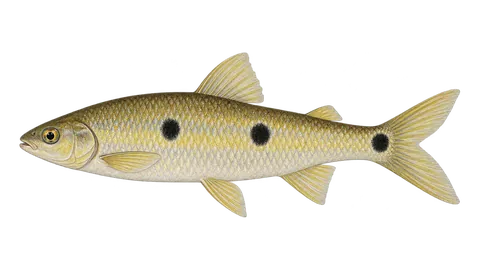
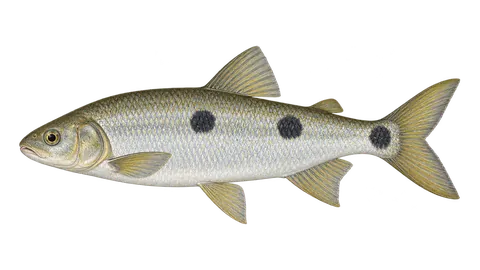
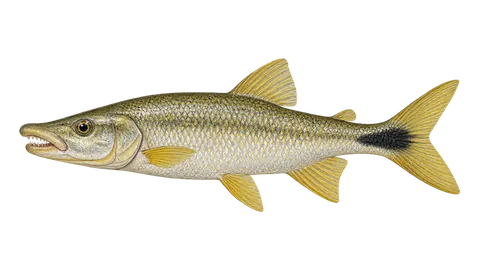
Elongated, rounded body, silver to yellowish, with three to four dark vertical bands on the flank and a dark spot at the base of the tail. Small mouth at the tip of the snout, with incisor-like teeth. Piaus of the genus Leporinus have different spots or bands; the piau-três-pintas has three round spots, not bands.
Also called: aracu-comum, aracu, araçu, aracu-pinima, aracu-pintado, piau
don't confuse with:
where found
open on the large mapWhere to look: Várzea lakes, paranás, grassy banks and aquatic vegetation; flooded forest in the flood.
Várzea lakes and whitewater rivers of the Amazon, especially the middle and lower Amazon (Manaus, Santarém). FishBase also records coastal rivers of French Guiana.
native to the basins
states
Amazonas, Pará, Amapá, Acre, Rondônia
famous destinations
when to fish
next 7 days
Loading the next 7 days…
best season
Best in falling water and the dry season (July to November), with the school concentrated. There is a closed season from Nov 15 to Mar 15 in Pará and Amapá.
best time of day
Daytime, with peaks at dawn and dusk. Active by day, with peaks early and late in the afternoon.
what affects the banded leporinus
cold and cold fronts
Cold snaps (friagem) keep the school still.
atmospheric pressure
A bad-weather front shuts down the bite for a day or two.
moon
Little effect.
rain
Light rain doesn't bother it.
water level
A falling lake concentrates the fish at the mouths and channels.
noise
Staying quiet on the bank pays off more.
wind
Little effect.
depth
Shallow, 0.5 to 3 m.
how to fish
natural baits
- flour dough
- green corn
- fruit from the bank
- minhoca
tip from an angler
Nibbles like the piaus: small hook, groundbait, and a quick strike at the first touch.
- rod
- 3 to 4 m cane pole or 5'6" to 6' rod, 6 to 12 lb
- spinning / baitcasting reel
- spinning reel 1000 to 2500
- line
- monofilament 0.20 to 0.25 mm
- leader
- optional
- hook
- #4 to 1, short shank
accessories
- groundbait of corn or bran
- feather float
catch and release
Hardy: remove the hook in the water and release it.
rules for the banded leporinus
Rules change; before keeping or transporting fish, check with the state environmental agency.
Amazonian closed season (PA, AP)
catch, transport and sale prohibited (commercial fishing)15/11 to 15/03PAAP details
In PA and AP the aracu (Schizodon spp.) is in Annex II of the ordinance, with fishing prohibited from Nov 15 to Mar 15. Under art. 2 of the ordinance, anglers fishing with a handline or pole, line and hook are exempt from this ban, unless a stricter state rule applies; during the period the angler's limit is 5 kg + 1 fish.
Marajó Island (PA): closed season from Jan 1 to Apr 30
catch prohibited (commercial fishing)01/01 to 30/04PA details
In the rivers of Marajó Island the aracu (Schizodon spp.) is on the fishing ban list from Jan 1 to Apr 30. Under art. 2 of the ordinance, anglers fishing with a handline or pole, line and hook are exempt from this ban, unless a stricter state rule applies; during the period the angler's limit is 5 kg + 1 fish.
MT (Araguaia stretch): minimum 30 cm
30 cmMT details
The MT law lists the 'piau-cabeça-gorda (Schizodon fasciatum)' with a minimum of 30 cm in the Araguaia stretch from the headwaters (GO) to Antônio Rosa (MT), including the Araguaia National Park. In MT, anglers may only kill for consumption on site (up to 2 kg or 1 fish, art. 19-C); the rule applies to that kill.
piracema and closed seasons
Each bar is the period when fishing is prohibited or restricted. The green line is today. Tap the name to see what is still allowed.
Spawning closure (piracema) in Mato Grosso (all basins)
Allowed: All fishing modalities are prohibited in rivers, including catch and release (Law 9.096/2009, art. 19-A). Exceptions: subsistence fishing from shore (3 kg or 1 fish, no transport or sale) and scientific fishing. Law 13.159/2025 now allows licensed sport fishing in UHE/PCH hydropower reservoirs, natural lakes and border rivers, subject to a scientific study and a license from the environmental agency. We have not confirmed whether these licenses are already being issued.
Closed season in the Amazon basin in Amazonas
Allowed: Under Portaria 48/2007 (art. 2, II), the recreational angler who fishes with handline or rod, line and hook is outside the Annex II prohibitions, unless a stricter state rule applies. Recreational angler bag limit: 5 kg + 1 fish. Competitions prohibited.
Source: Portaria IBAMA nº 48/2007
Closed season in the Amazon basin in Acre
Allowed: Recreational anglers with handline or rod, line and hook are outside the Annex II prohibitions, with a bag limit of 5 kg + 1 fish, unless a stricter state rule applies. On the Acre River, no fishing of any species during the period.
Source: Portaria IBAMA nº 48/2007; IN IBAMA nº 205/2008 (Acre River)
Closed season in the Acre river
Allowed: IN Ibama 205/2008 prohibits fishing in the Acre river and its tributaries during the closed season, with no exception for recreational anglers: treat it as prohibited.
Source: IN IBAMA nº 205/2008
Closed season in the Amazon basin in Pará
Allowed: Recreational anglers with handline or rod, line and hook are outside the Annex II prohibitions, with a bag limit of 5 kg + 1 fish, unless a stricter state rule applies.
Source: Portaria IBAMA nº 48/2007
Closed season in the rivers of Marajó Island (PA)
Allowed: The same recreational-angler exceptions as in Portaria 48/2007 apply (handline or rod, 5 kg + 1 fish), unless a stricter state rule applies.
Source: Portaria IBAMA nº 48/2007
Amazon basin closed season in Rondônia
Allowed: In the Madeira, Mamoré, Jamari, Abunã, Machado and Roosevelt river basins and in the main channel of the Guaporé, licensed recreational anglers may fish only for non-protected species, using a single simple gear per person (handline, rod with or without a reel, or a simple pole with a single hook). The limit is up to 5 kg or 1 fish per week; if the fish is over 5 kg, you keep only that one. You may not sell, trade or give away the catch. Catch and release is allowed only with non-protected species. Fishing is always banned within 200 m of dams, rapids, waterfalls, fish ladders and river mouths.
Closed season in the Amazon basin in Amapá
Allowed: Recreational anglers with handline or rod, line and hook are outside the Annex II prohibitions, with a bag limit of 5 kg + 1 fish, unless a stricter state rule applies.
Source: Portaria IBAMA nº 48/2007
Closed season in Roraima
Border rivers MT/RO and MT/PA
Allowed: See the exceptions in Portaria 48/2007 and the state rules for each bank.
Source: Portaria IBAMA nº 48/2007
Conservation: Not on the national list (Portaria GM/MMA 1.667/2026).
how much it weighs without taking it out of the water
estimated weight
—
how we calculate
Length-weight relationship W = a·Lb (a = 0.01259, b = 3.06; FishBase). It's an average: a fat or lean fish can vary by 10% to 20%.
more about the banded leporinus
A relative of the southern piaus, the common aracu eats plant debris, leaves and algae in várzea lakes. It lives in schools and migrates with the water cycle. During the rise and the flood it stores fat, which it uses to mature its gonads; it grows faster in falling water. Males mature from about 18 cm and females from 22 cm. It is a regular at markets in Amazonas and Pará. On the hook it takes dough, corn and fruit over groundbait, and it is a challenge on a light rod.
Family: Anostomidae · omnivore
fun facts
- The rings on the aracu's scales mark the time of year and are used to work out the fish's age.
- Fasciatus means banded, because of the dark bars along the flank.
in the kitchen
White, fatty meat in season. Fried in steaks with fine cuts or grilled over coals.
similar species
sources and references (8)
The season weights (months), the time of day and the sensitivities (cold, pressure, moon, wind, rain, tide, strong light, murky water and noise) are the app's editorial estimates, based on the literature below and on the field experience of anglers and guides. They are not official data nor a measurement made for this species, and they may vary by region and year. Closed seasons and legal rules appear in the rules section, with the norm and a link.
- scientific FishBase — Schizodon fasciatus (ficha da espécie)Names, distribution, biology, length-weight relationship and references. Page checked on October 13, 2026.
- official Portaria GM/MMA nº 1.667, de 27 de abril de 2026 — Lista Nacional Oficial de Espécies da Fauna Ameaçadas de Extinção (peixes e invertebrados aquáticos)Most recent national list. The species is not on it (search by scientific name in the text published in the DOU, checked on October 13, 2026).
- official ICMBio/SALVE — Ficha de Schizodon fasciatus (avaliação nacional do risco de extinção)ICMBio national assessment, published in 2025. DOI checked on Crossref.
- scientific IUCN Red List — Schizodon fasciatus (avaliação global: Pouco Preocupante, LC, 02/07/2020)Global assessment. Link given on the FishBase entry (Red List, version 2025-2).
- scientific Fabré, N. N.; Saint-Paul, U. (1998). Annulus formation on scales and seasonal growth of the Central Amazonian anostomid Schizodon fasciatus. Journal of Fish Biology 53(1): 1–11.Growth, fat and maturation linked to the water cycle. DOI and abstract checked in Crossref.
- scientific Garavello, J. C.; Britski, H. A. (2003). Anostomidae (headstanders). In: Reis, R. E.; Kullander, S. O.; Ferraris Jr., C. J. (orgs.). Check List of the Freshwater Fishes of South and Central America. Porto Alegre: EDIPUCRS, p. 71–84.Printed book chapter; the URL is the bibliographic record on FishBase, which cites the chapter for the species.
- scientific Ferreira, E. J. G.; Zuanon, J. A. S.; Santos, G. M. (1998). Peixes comerciais do médio Amazonas: região de Santarém, Pará. Brasília: Ibama. 211 p.Printed work; the URL is the bibliographic record on FishBase, which cites this work for the species.
- scientific Mérona, B. de; Rankin-de-Mérona, J. (2004). Food resource partitioning in a fish community of the central Amazon floodplain. Neotropical Ichthyology 2(2): 75–84.Diet of the species of the central Amazon várzea, including the common aracu. DOI checked in Crossref.