Skip to content
catalog Centropomidae · predator

mexican snook

Centropomus poeyi

SeaEstuaryFreshwater

The dark snook of the Gulf of Mexico, from Tampico to Belize. It lives in lagoons, estuaries and coastal rivers, and has a closed season from July 1 to August 15 on the Mexican Gulf coast.

Also called: robalo-prieto, Mexican snook

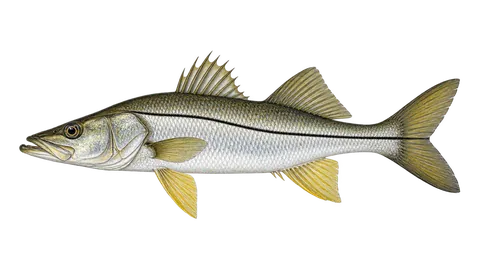
Scientific illustration of Mexican snook
common size
35–55 cm
maximum
90 cm
common weight
0.8–3.4 kg
record/max.
9.0 kg
depth
0.5–15 m
ideal water
23–30 °C
overview

who is the mexican snook

Snook of the central-western Atlantic, from Tampico (Mexico) to Belize. It lives in coastal waters, estuaries and lagoons and goes up freshwater rivers; it spawns in fresh or slightly brackish water. It eats fish and crustaceans. It reaches 90 cm and 9 kg, with a common size near 45 cm. On the Mexican Gulf coast it is fished together with the robalo flecha (robalo blanco) and the robalo peva (chucumite), in one of the most traditional artisanal fisheries in the region; since 2025 all three have a spawning closure in summer. In sport fishing it is sought at river mouths, lagoons and mangroves, with mid-water and surface lures and live bait, like other snook.

fun facts

  • According to FishBase, it spawns in fresh or slightly brackish water; the robalo flecha, for example, spawns in salt water near the bars.
  • Prieto means dark, in reference to the color of the back.
how to recognize it

identification

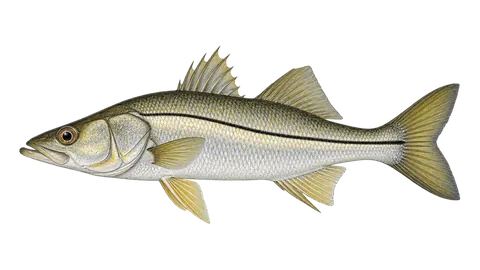
Elongated body, concave head profile, protruding lower jaw and a black lateral line reaching the tip of the tail; dark back, gray to nearly black, hence the name prieto (dark). It looks very similar to the robalo flecha and robalo peva: a reliable separation uses scale and ray counts and gill rakers (Rivas, 1986). When in doubt, follow the most restrictive rule for snook.

how mexican snook fishing looks

Loading the next 7 days…

Each card shows the day's index (0 to 100) and, below it, a strip with the index for each hour, from 0h to 23h. from poor to excellent.

distribution

where found

open on the large map

Not found in Brazil. Gulf of Mexico and western Caribbean, from Tampico (Tamaulipas, Mexico) to Belize, in lagoons, estuaries and coastal rivers of Tamaulipas, Veracruz, Tabasco, Campeche and the Yucatán peninsula.

Habitat: Coastal lagoons, estuaries, mangroves and lower stretches of rivers, near logs, roots and current breaks.

calendar and clock

when to fish

best season

time of yearbest: Apr–Oct
JanFebSeaAprMayJunJulAugSepOctNovDec

Warm months are best, but on the Mexican Gulf coast fishing is closed from July 1 to August 15. Cold northerly winds in winter reduce activity.

best time of day

0h6h12h18h sunrise ~6amsunset ~6pm

Night and twilight. Hunts more at dawn, dusk and night, during tide changes and at spots with current.

weather, water and behavior

what affects the mexican snook
sensitivity The little bars show how much each factor affects this species. Five full: it feels it a lot.

cold and cold fronts

Winter cold fronts (the nortes) shut down activity for days.

atmospheric pressure

Stable pressure favors; the arrival of a norte ends the fishery.

moon

Full-moon and new-moon tides move water at lagoon mouths.

rain

Rising river with muddy water scatters the fish; clearing water afterward is good.

water level

Falling river concentrates snook at mouths and channels.

noise

Very sensitive to noise and shade on the water; approach by paddle or electric motor.

wind

Strong wind hinders precise casting into the mangrove roots.

tide

Falling tide at lagoon and river mouths is best.

depth

From 0.5 to 5 m near logs, roots and current breaks.

technique, gear and bait

how to fish

rod
6'6" to 7', fast action, 12 to 25 lb
spinning / baitcasting reel
spinning reel 3000 to 4000 or low-profile baitcasting reel
line
braid 20 to 30 lb
leader
fluorocarbon 30 to 50 lb (the gill cover cuts)
hook
reinforced treble hooks 1 to 2/0; circle 2/0 to 4/0 on live bait

lures

  • mid-water jerkbait
  • silicone shad on a jig head
  • stickbait and propeller lure at dawn
  • streamer for fly fishing

natural baits

  • live shrimp
  • small live fish (in the sea and the estuary; in Mexico's inland waters, live fish is prohibited)

accessories

  • alicate
  • boga-grip
  • polarized glasses

tip from an angler

Cast tight to the roots on the falling tide and retrieve with pauses: the snook strikes the lure that comes out of the shade carried by the current.

what the law says

rules for the mexican snook

Summary of the regulations we found, with the source for each. Rules change; before keeping or transporting fish, check with the state environmental agency.

Gulf of Mexico (MX): snook closed season, July 1 to August 15

fishing prohibited from July 1 to August 1501/07 to 15/08

In federal waters off the coast of Tamaulipas, Veracruz, Tabasco and Campeche, catching prieto snook, fleche snook (robalo blanco) and peva snook (chucumite) is prohibited from July 1 to August 15 each year, during spawning. The sport fishing rule prohibits fishing in closed areas and seasons, so the rule also applies to recreational anglers.
Source: Agreement amending the Notice on closed seasons and zones of Mar 16, 1994, section XX (DOF Dec 2, 2025, Sader/Conapesca); Amendment to NOM-017-PESC-1994, item 4.10 a

Mexico: up to 5 per species and 10 saltwater fish per day

5 specimens of the species per angler per day, within the limit of 10 saltwater fish

In recreational sport fishing in Mexican federal waters, each angler may keep up to 10 saltwater fish per day, no more than 5 of the same species. The dark snook (robalo prieto) is not among the species reserved for sport fishing under art. 68 of the General Law of Sustainable Fishing and Aquaculture, and has no quota of its own. Fish over the limit must be returned alive to the water, and sport-caught fish may not be sold. Anglers fishing from a boat need a Conapesca permit.

Source: Amendment to NOM-017-PESC-1994 (recreational sport fishing in federal waters of Mexico), published in the DOF on Nov 25, 2013, items 4.9.1 and 4.9.5 (Sagarpa/Conapesca)

catch and release
catch and release Releasing the fish alive, quickly and with a wet hand. During a closed season it isn't always allowed: what the regulation says applies.

Hold it by the mouth with a fish grip, support its belly and watch the sharp edge of the gill cover. Release it facing the current, only when it swims off on its own.

in the kitchen

Firm white flesh, highly valued in the Gulf of Mexico; fried, roasted or ceviche.

calculator

how much it weighs without taking it out of the water

Length-weight relationship W = a·Lb (a = 0.01122, b = 3.15; FishBase). It's an average: a fat or lean fish can vary by 10% to 20%.

estimated weight

—

sources and references

The season weights (months), the time of day and the sensitivities (cold, pressure, moon, wind, rain, tide, strong light, murky water and noise) are the app's editorial estimates, based on the literature below and on the field experience of anglers and guides. They are not official data nor a measurement made for this species, and they may vary by region and year. Closed seasons and legal rules appear in the rules section, with the norm and a link.

  1. scientific FishBase — Centropomus poeyi (ficha da espécie)Names, distribution, biology, length-weight relationship, list of countries and references. Page checked 13/10/2026. The FishBase country list also includes Trinidad and Tobago as native range and Nicaragua as a doubtful record; the entry's own distribution text runs from Tampico to Belize, which is what the app's entry follows.
  2. scientific IUCN Red List — Centropomus poeyi (avaliação global: Pouco Preocupante, LC, 01/11/2018)Global assessment. Link given on the FishBase entry (Red List, version 2025-2).
  3. scientific Rivas, L. R. (1986). Systematic review of the perciform fishes of the genus Centropomus. Copeia 1986(3): 579-611.
  4. official DOF — Acordo que modifica o Aviso de épocas e zonas de veda de 16/03/1994 para estabelecer a veda de robalo blanco, robalo prieto e chucumite no golfo do México (02/12/2025)Annual closed season from July 1 to August 15 in the federal waters of Tamaulipas, Veracruz, Tabasco and Campeche. Text checked in the DOF.
  5. official DOF — Modificação da NOM-017-PESC-1994, para regular a pesca deportivo-recreativa em águas de jurisdição federal do México (publicada em 25/11/2013)Daily limits at sea (item 4.9.1) and in fresh water (4.9.2), one rod in inland waters (4.6 b), ban on live fish as bait in inland waters (4.7 c) and on fishing in closed areas and seasons (4.10).
don't confuse

similar species