Federal minimum size (50 cm) in the Southeast and South
50 cm (TL)ESRJSPPRSCRSSoutheast CoastSouth Coast
Prohibited to fish for, keep on board or land snook under 50 cm total length on the coast of ES, RJ, SP, PR, SC and RS.
Centropomus undecimalis
Brazil's largest snook and the prize of coastal fishing. Hunts with the tide running at inlets, mangroves and rocky shores.
Also called: robalo-flecha, robalo-flexa, camurim (Nordeste)

The fleche snook (robalo-flecha) is the largest centropomid in the Atlantic and the trophy fish of Brazilian coastal fishing. It lives on the border between sea and river: inlets, mangrove channels, surf beaches, rocky shores and bridge pilings. It tolerates fresh water and swims up rivers for kilometres. It hunts by ambush, almost always with the tide running, eating shrimp, small mullet, anchovy and crab. Large ones, over 10 kg, appear in summer at the inlets and rocky shores, when they gather to spawn. It is hermaphroditic: it starts life as a male and the largest turn into females, which is why releasing big fish protects reproduction. It fights with head shakes, jumps and runs for structure, and cuts thin line on barnacles and rock.
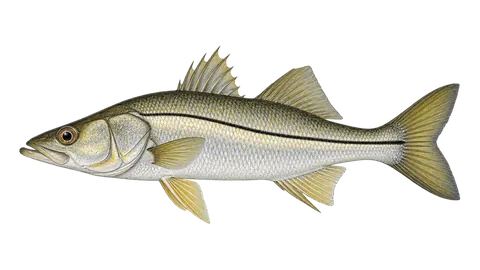
Long, slender body, long pointed snout, projecting lower jaw. Thick black lateral line from the gill cover to the end of the tail, a mark of all snook. Greenish-grey back, silver flanks, yellowish pelvic fins. Difference from the peva snook: the fleche is more elongated, with a longer head, and easily passes 70 cm; the peva has a deeper body, smaller scales, a proportionally larger eye and rarely exceeds 60 cm.
Loading the next 7 days…
Each card shows the day's index (0 to 100) and, below it, a strip with the index for each hour, from 0h to 23h. from poor to excellent.
The whole coast from Amapá to Santa Catarina, most common from the Northeast to Paraná. It enters estuaries, coastal lagoons and rivers, such as the Ribeira de Iguape (SP), the Paraíba do Sul (RJ), the Doce (ES) and the lower São Francisco. Rare in Rio Grande do Sul.
Habitat: River mouths, mangrove channels and creeks, surf beaches and rocky shores, jetties and bridge pilings.
native to the basins
coast
states
Amapá, Pará, Maranhão, Piauí, Ceará, Rio Grande do Norte, Paraíba, Pernambuco, Alagoas, Sergipe, Bahia, Espírito Santo, Rio de Janeiro, São Paulo, Paraná, Santa Catarina
In the South and Southeast the strong season runs from October to March; large ones come into inlets and rocky shores in summer. In winter, cold fronts shut down the bite. In the Northeast it bites all year, with peaks during the rains, when the river pushes shrimp to the inlet. Respect the state closed seasons (PR, ES, BA).
Dawn and dusk. Peaks at dawn and dusk, when the light fades and the tide is running. At night it bites at lit spots. By day, only in murky water, overcast skies or strong tide.
A tropical fish. Water below 18 °C shuts down the bite; a strong cold front in the South can kill snook in shallow lagoons.
Pre-frontal, with falling pressure and a northeast wind, often gives a peak. Post-frontal, with blue sky and cold, is poor.
Full and new moons give larger tidal ranges and more bait on the move. At night, the new moon favors fishing under artificial light.
Light drizzle and overcast skies help. Thunderstorm with lightning: get out of the water.
A high river pushes muddy water toward the inlet: fish the line where clear and dirty water meet. Too strong a flood scares them off.
Very wary in shallow, clear water. Turn off the engine well away from the spot, use paddle or electric motor and don't light up the water.
Surf on the beach helps the snook hunt in the breakers. A south wind with a cold front shuts it down.
It depends on moving water. The rising tide brings clear water and schools inside: fish the mangrove creek mouths and the mangrove edge. The falling tide pulls shrimp out of the mangroves: time for the channel mouths and the inlet, and the first hours are usually the best. At slack water it stops; use that time to change spots.
Shallow (0.5 to 3 m) at high tide in mangroves and beaches; channel holes, pilings and rocks (4 to 10 m) at low tide and in cold weather.
lures
natural baits
accessories
Live shrimp drifting on a float with the falling tide along the mangrove bank is the surest bait. Let the bait drift naturally; after the hookset, hold firm for the first few metres to get the fish out of the pilings.
Walk-in fishing on rocky shores, with natural bait on the bottom and artificial lures in the foam, always in calm sea.
ready-made kitBoat or kayak fishing in mangroves, channels, brackish rivers and under bridges, with artificial lures and live shrimp, following the tide.
guideWhat the numbers and letters engraved on the rod mean, and how to match rod, line, lure and reel for each kind of fishing.
guideOverhead, sidearm, pitching, flipping and skipping: when to use each, how to aim at structure, and why the first cast to a spot is the one that gets the most bites.
guideHow to choose gear by its number, rig the backing, line, leader and tippet, make a basic cast, and which flies to use for peacock bass, golden dorado and snook.
Summary of the regulations we found, with the source for each. Rules change; before keeping or transporting fish, check with the state environmental agency.
Conservation: Not on the national list of threatened species (Portaria GM/MMA nº 1.667/2026).
Prohibited to fish for, keep on board or land snook under 50 cm total length on the coast of ES, RJ, SP, PR, SC and RS.
On the coast and in the inland waters of Paraná, it is prohibited to kill and keep fleche snook (robalo-flecha) and peva snook (robalo-peva) in November and December. Outside the closed season, fleche snook may only be kept between 60 and 70 cm (recreational), and the recreational quota is 7 fish per species. Professional: minimum 60 cm.
Source: Resolução CEMA nº 91/2013 (State Environment Council of Paraná)
Snook fishing is prohibited on the coast and in the inland waters of Espírito Santo from May 1 to June 30. Dates taken from a summary of the text; confirm with Ibama-ES before fishing.
The Bahia government announces a snook closed season running to July 31. It was not possible to confirm the start date or the rule number: confirm with the competent agency (SEMA/INEMA-BA).
Source: Government of Bahia (official notice; rule not confirmed)
In federal waters off the coast of Tamaulipas, Veracruz, Tabasco and Campeche, catching prieto snook, fleche snook (robalo blanco) and peva snook (chucumite) is prohibited from July 1 to August 15 each year, during spawning. The sport fishing rule prohibits fishing in closed areas and seasons, so the rule also applies to recreational anglers.
Catching, transporting and selling snook (robalo) in Bahia are prohibited.
Source: Portaria IBAMA nº 49-N/1992; 2026 closed-season calendar of Sema-BA
Snook (robalo) closed season in ES for any gear. Tournaments targeting snook are prohibited from May 1 to Aug 31. In April, July and August, only the gear listed in the IN may be used.
Source: IN IBAMA nº 10/2009
Source: IN MMA nº 53/2005 (coast from ES to RS; total length)
Don't hold it by the gill cover: the edge of the preopercle is serrated and cuts. Use a lip grip on the lower lip and support the body horizontally; a large fish should not hang from its mouth alone. Revive it facing the current until it swims off on its own.
One of the noblest fish on the coast: white, firm meat with no intramuscular bones. Grilled, baked whole in coarse salt, or in moqueca.
Length-weight relationship W = a·Lb (a = 0.00724, b = 3.03; FishBase (estimativa bayesiana, comprimento total)). It's an average: a fat or lean fish can vary by 10% to 20%.
estimated weight
—
The season weights (months), the time of day and the sensitivities (cold, pressure, moon, wind, rain, tide, strong light, murky water and noise) are the app's editorial estimates, based on the literature below and on the field experience of anglers and guides. They are not official data nor a measurement made for this species, and they may vary by region and year. Closed seasons and legal rules appear in the rules section, with the norm and a link.
Your location is saved only on this device and feeds the forecast, the map and the "today" on the home page.