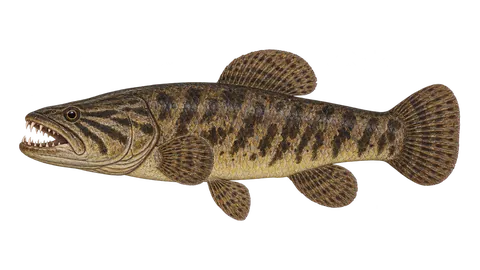
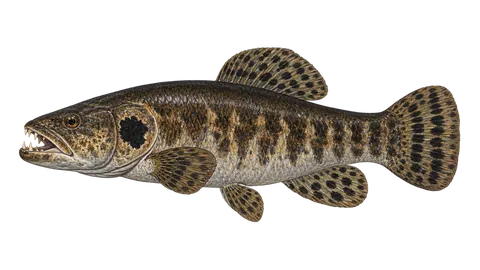
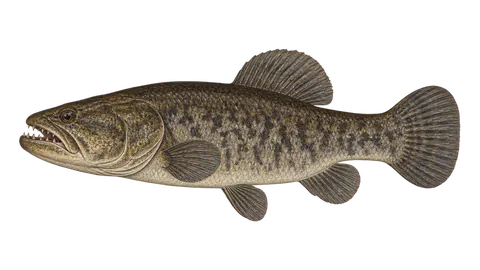
The native trairão of the São Francisco, the upper Paraná and the Doce River. An ambush predator that explodes on surface lures near submerged timber, water hyacinth and rock.
One of the five trairões of the Hoplias lacerdae group, revalidated in the 2009 revision that separated Brazilian trairões by basin. It lives in the São Francisco, upper Paraná and Doce basins, especially in Minas Gerais. It is larger and more robust than the common trahira: FishBase records 60 cm standard length and 3.8 kg in fish from the Sapucaí-Mirim River, in the Grande River basin. It stays still at the shore, among submerged timber, water hyacinth and rocks, and attacks fish and other animals that pass close. It bites better in the warm months. Part of the trairão in fee-fishing ponds and reservoirs in the Southeast comes from fish farming and is not always identified as the species; in Goiás, the fishing rule treats the São Francisco basin trairão as non-native, from fish farming.
fun facts
Until 2009, almost all trairões in Brazil were called Hoplias lacerdae; the revision split off five species, and the trairão of the São Francisco, upper Paraná and Doce went back to being H. intermedius.
The largest size on FishBase comes from a study at small hydroelectric dams on the Sapucaí-Mirim River, in the Grande River basin.
how to recognize it
identification
Cylindrical, robust body, large head and wide mouth full of conical teeth. Like all trairões, it has no teeth on the tongue and the inner edges of the jaw run parallel; in the trahira (H. malabaricus) they converge toward the tip. It has 42 to 46 scales in the lateral line and 4 to 6 pores under the jaw (6 to 8 in the trairão-do-sul). Grayish-brown color, pale belly, without the strong blotched pattern of the trahira.
how trairão-do-sudeste fishing looks
Loading the next 7 days…
Each card shows the day's index (0 to 100) and, below it, a strip with the index for each hour, from 0h to 23h. from poor to excellent.
São Francisco, upper Paraná (such as the Grande River and its tributaries) and Doce River basins, mainly in Minas Gerais. Also in reservoirs and fee-fishing ponds, sometimes with fish from farms of uncertain origin.
Habitat: River backwaters, oxbow lakes, veredas and reservoirs; banks with submerged timber, water hyacinth, flooded grass and rocks.
native to the basins
São FranciscoParanáSoutheast Atlantic
states
Minas Gerais, Bahia, São Paulo, Goiás, Espírito Santo
calendar and clock
when to fish
best season
time of yearbest: Oct–Mar
JanFebSeaAprMayJunJulAugSepOctNovDec
Warm months, September to March. In winter it eats little and stays deeper. The piracema (spawning closure) shuts fishing for native species in the Paraná basin and in Minas Gerais from November to February.
best time of day
Daytime, with peaks at dawn and dusk. Attacks by day, with peaks early in the morning and late in the afternoon; on warm nights it also hunts.
weather, water and behavior
what affects the trairão-do-sudeste
sensitivity The little bars show how much each factor affects this species. Five full: it feels it a lot.
cold and cold fronts
Cold water drops activity; during cold fronts it almost stops.
atmospheric pressure
Warm, stable days are the best.
moon
Little effect.
rain
Light rain doesn't bother it; a flash flood of the streams muddies the water and scatters the fish.
water level
Stable, clean river concentrates the fish along the bank.
noise
Sensitive to hull knocks and engine noise near the bank; approach by paddle or electric trolling motor.
wind
A light chop helps topwater lures; strong wind makes precise casting hard.
depth
Shallow, 0.3 to 2 m, close to the structure; drops a little in the cold.
low-profile baitcasting reel 100 to 200 or spinning reel 3000
line
braid 30 to 50 lb
leader
fluorocarbon or monofilament 40 to 60 lb, 40 to 60 cm
hook
reinforced treble hooks 1/0 to 2/0; offset hook 4/0 to 5/0 for soft plastic lures
lures
rubber frog
zara/stickbait 9 to 12 cm
prop bait
spinnerbait
natural baits
live lambari
live bait native to the same basin
accessories
long-nose pliers
boga-grip
tip from an angler
Work the lure slowly along the submerged timber and wait to feel the weight before setting the hook: it often misses the first strike.
what the law says
rules for the trairão-do-sudeste
Summary of the regulations we found, with the source for each. Rules change; before keeping or transporting fish, check with the state environmental agency. Conservation: Not on the national list of threatened species (Portaria GM/MMA nº 1.667/2026).
GO: São Francisco trairão treated as non-native
catch and transport without size or quantity limitGOSão Francisco
Annex II of the Goiás rule lists the trairão (Hoplias cf. lacerdae) as a non-native species from fish farming in the São Francisco basin, with free catch and transport. The 'cf.' marks doubt about the species; in GO's other basins the trairão is not on that list.
piracema closures in the basins where the species lives
Spawning closure (piracema) in the Paraná River basin
01/11 to 28/02SPPRMGGOMSDF
Allowed: Recreational fishing only for non-native species and hybrids (peacock bass, tilapia, black bass, carp, croaker, etc.; piauçu remains prohibited), with handline, simple pole, or rod with spinning or baitcasting reel, up to 10 kg + 1 fish. In rivers, from shore only; in reservoirs, from a boat or from shore. Prohibited: floodplain lakes, aquatic-animal bait, within 1,500 m of dams and waterfalls, and within 500 m of confluences. Tournaments only in reservoirs and only with non-native species.
Spawning closure (piracema) in Minas Gerais (state rule)
01/11 to 28/02MG
Allowed: Only exotic or hybrid species, 3 kg + 1 fish per day, with handline, rod, simple pole, or spinning or baitcasting reel. Nets prohibited. Keep the minimum distances from dams and reservoirs.
Allowed: Sport and guided fishing only in reservoirs, catch and release with barbless hooks (no keeping, transporting or eating). Subsistence: up to 5 kg per day, for household consumption only.
Spawning closure (piracema) in the São Francisco River basin (rivers and reservoirs)
01/11 to 28/02MGBAPEALSEGODF
Allowed: Recreational fishing from a boat or from shore with handline, rod, spinning or baitcasting reel, up to 5 kg + 1 fish. Prohibited within 1,000 m of dams, waterfalls and rapids, and within 500 m of confluences. Floodplain lakes have a longer closed season (see next item).
Spawning closure (piracema) in the Southeast basins
01/11 to 28/02ESMGRJSPPR
Allowed: In rivers, shore fishing only; in reservoirs, from a boat or from shore. Only non-native species, hybrids, and giant river prawn (camarão-gigante-da-malásia), up to 10 kg + 1 fish. Prohibited in floodplain lakes and within 1,000 m of dams.
catch and release Releasing the fish alive, quickly and with a wet hand. During a closed season it isn't always allowed: what the regulation says applies.
Use long-nose pliers and a lip grip (boga): the teeth cut. Support the body, take a quick photo and release it at the bank where you caught it.
in the kitchen
White, tasty flesh, with Y-shaped bones along the back; fried in steaks or as well-boned fillets.
calculator
how much it weighs without taking it out of the water
Length-weight relationship W = a·Lb (a = 0.00794, b = 3.18; FishBase). It's an average: a fat or lean fish can vary by 10% to 20%.
estimated weight
—
sources and references
The season weights (months), the time of day and the sensitivities (cold, pressure, moon, wind, rain, tide, strong light, murky water and noise) are the app's editorial estimates, based on the literature below and on the field experience of anglers and guides. They are not official data nor a measurement made for this species, and they may vary by region and year. Closed seasons and legal rules appear in the rules section, with the norm and a link.
scientificFishBase — Hoplias intermedius (ficha da espécie)Diagnosis, distribution, maximum length and weight, length-weight relationship and country list. The entry has no common names. Page checked on Oct 13, 2026.