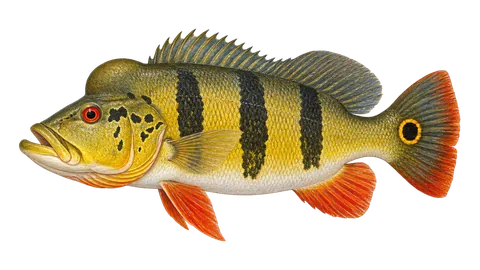
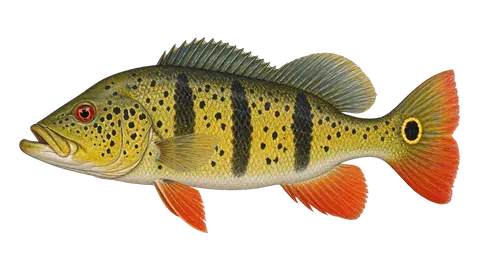
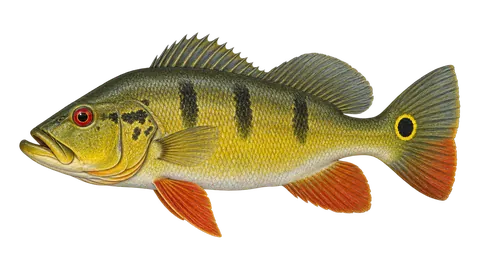
The peacock bass of the Uatumã and lower Trombetas, a sport fishing target on Balbina reservoir. In Amazonas, recreational anglers may only catch and release it.
Described in 2006, Vazzoler's peacock bass belongs to the açu and pinima group, with rows of pale spots in juveniles and large females, and dark bars on adults. It lives in the Uatumã River, where Balbina reservoir is, and in the lower Trombetas. At Balbina it is targeted by commercial and recreational fishing; decades of fishing pressure have reduced stocks and fish size, which are larger and more numerous inside the Uatumã Biological Reserve. Females mature from about 27 cm standard length, and the species spawns several times a year, peaking from October to January.
fun facts
The name honors ichthyologist Anna Emília Vazzoler.
At Balbina, peacock bass are bigger and more numerous inside the Uatumã Biological Reserve than outside it.
how to recognize it
identification
Peacock bass body, with a black ocellus edged in pale at the base of the tail. In juveniles and large females, four horizontal rows of pale spots on the flank; in adults, black vertical bars with pale edges. Small scales and a lateral line that is almost always broken. Very similar to the açu and pinima peacock bass; the fishing area (Uatumã and Trombetas) helps tell them apart.
how vazzoleri pavon fishing looks
Loading the next 7 days…
Each card shows the day's index (0 to 100) and, below it, a strip with the index for each hour, from 0h to 23h. from poor to excellent.
The dry season (August to December) concentrates fish along the banks and in snags. Spawning runs from October to January, with pairs guarding their nests.
best time of day
Daytime, with peaks at dawn and dusk. Active by day, peaking in the first hours after sunrise and in late afternoon.
weather, water and behavior
what affects the vazzoleri pavon
sensitivity The little bars show how much each factor affects this species. Five full: it feels it a lot.
cold and cold fronts
Cold snaps shut down activity for one to three days.
atmospheric pressure
Stable pressure helps; a quick drop before a storm gives a short peak.
moon
Small effect.
rain
A light drizzle doesn't matter; with a thunderstorm, get out of the water.
water level
A falling reservoir concentrates fish on points and in snags.
noise
Very sensitive to engine noise and hull knocks near cover.
wind
Light chop helps surface lures; strong wind makes casting harder.
depth
Shallow, 0.5 to 3 m; drops deeper when the sun heats up.
low-profile baitcasting reel or spinning reel 2500 to 3000
line
braid 30 to 50 lb
leader
fluorocarbon or monofilament 40 to 60 lb
hook
reinforced treble hooks 1/0 to 3/0, preferably barbless
lures
zara/stickbait 9 to 12 cm
prop bait
feather jig 1/4 to 1/2 oz
mid-water jerkbait
accessories
long-nose pliers
boga-grip
polarized glasses
tip from an angler
Surface lure on the tips of snags early in the morning; in Amazonas do not use live bait for peacock bass.
what the law says
rules for the vazzoleri pavon
Summary of the regulations we found, with the source for each. Rules change; before keeping or transporting fish, check with the state environmental agency. Conservation: Not on the national list (Portaria GM/MMA 1.667/2026).
AM: catch and release only; commercial fishing banned
killing prohibited for recreational and sport anglersAMAmazon
In Amazonas it is prohibited for recreational and sport anglers to kill Vazzoler's peacock bass: the fish must be returned alive. Commercial fishing of the species is also banned. The same law bans live bait in peacock bass fishing (art. 17).
piracema closures in the basins where the species lives
Spawning closure (piracema) in Mato Grosso (all basins)
01/10 to 31/01MT
Allowed: All fishing modalities are prohibited in rivers, including catch and release (Law 9.096/2009, art. 19-A). Exceptions: subsistence fishing from shore (3 kg or 1 fish, no transport or sale) and scientific fishing. Law 13.159/2025 now allows licensed sport fishing in UHE/PCH hydropower reservoirs, natural lakes and border rivers, subject to a scientific study and a license from the environmental agency. We have not confirmed whether these licenses are already being issued.
Allowed: Recreational anglers with handline or rod, line and hook are outside the Annex II prohibitions, with a bag limit of 5 kg + 1 fish, unless a stricter state rule applies.
catch and release Releasing the fish alive, quickly and with a wet hand. During a closed season it isn't always allowed: what the regulation says applies.
Mandatory in Amazonas. Hold it by the mouth with a lip grip, support its belly, take a quick photo and release it next to the structure.
in the kitchen
White, firm flesh, but in Amazonas anglers may not kill it.
calculator
how much it weighs without taking it out of the water
Length-weight relationship W = a·Lb (a = 0.01122, b = 3.08; FishBase). It's an average: a fat or lean fish can vary by 10% to 20%.
estimated weight
—
sources and references
The season weights (months), the time of day and the sensitivities (cold, pressure, moon, wind, rain, tide, strong light, murky water and noise) are the app's editorial estimates, based on the literature below and on the field experience of anglers and guides. They are not official data nor a measurement made for this species, and they may vary by region and year. Closed seasons and legal rules appear in the rules section, with the norm and a link.