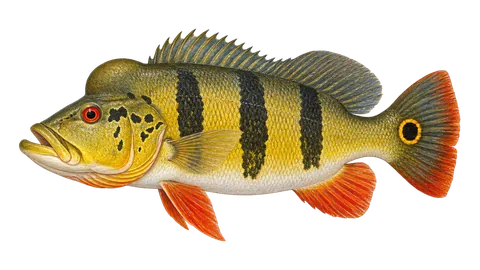
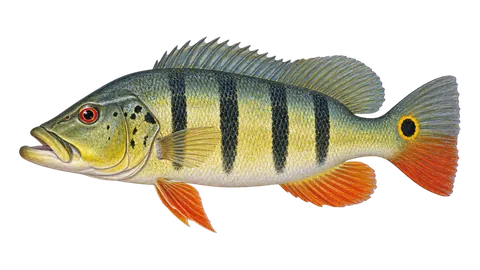
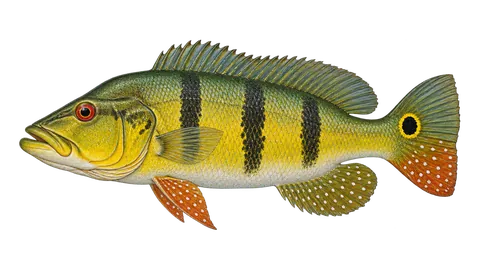
It is the large peacock bass of the clearwater rivers that drain into the lower Amazon, in Pará and Amapá. It lives in bank lakes, eddies, beaches and rocky bottoms of rivers such as the lower Tapajós, Curuá-Una and Jari. Its habits resemble the açu's: it hunts near structure, defends its territory and strikes surface lures hard. In the dry season fish gather in lakes and beach edges, and fishing becomes productive. The name pinima comes from Tupi and means painted. In angling, many people also call the painted phase of the açu 'pinima', which causes confusion in reports and records.
fun facts
The species was only formally described in 2006, in the revision of the genus Cichla.
Genetic studies indicate ancient hybridization with the açu in part of its range.
how to recognize it
identification
Three dark vertical bars and, between them, irregular black spots and specks scattered over the flank and head. Black ocellus with a golden ring on the tail. Yellow-green body. The açu in paca phase has light spots, not black ones. The yellow has white spots only on the lower fins. The blue has five bars. When in doubt, the capture area helps define it.
how pinima pavon fishing looks
Loading the next 7 days…
Each card shows the day's index (0 to 100) and, below it, a strip with the index for each hour, from 0h to 23h. from poor to excellent.
low-profile baitcasting reel 100 to 200 or spinning reel 3000 to 4000
line
braid 30 to 50 lb
leader
fluorocarbon 40 to 50 lb
hook
reinforced treble hooks 2/0 to 4/0
lures
zara 11 to 13 cm
double prop bait
feather jig 3/8 to 1/2 oz
mid-water jerkbait
natural baits
In Amazonas, live bait is banned for peacock bass fishing (Law AM 6.647/2023).
accessories
alicate
boga-grip
polarized glasses
tip from an angler
In clear water, long casts and fluorocarbon leader make a difference.
what the law says
rules for the pinima pavon
Summary of the regulations we found, with the source for each. Rules change; before keeping or transporting fish, check with the state environmental agency. Conservation: Not on the national list (Portaria GM/MMA 1.667/2026).
Mato Grosso: Zero Transport for 12 species
MTParaguay (Pantanal)AmazonTocantins-Araguaia
Transport, storage and sale are fully prohibited for 5 years from Jan 1, 2024 for: cachara, caparari, dorado, jaú, matrinchã (Brycon spp.), pintado/surubim (Pseudoplatystoma spp.), piraíba, piraputanga, pirarara, arapaima (pirarucu), trairão and peacock bass (tucunaré, Cichla spp.). For recreational anglers: catch and release only. These 12 species may not even be eaten on site, since the 2 kg or 1 fish limit excludes the art. 19-B list. The law cites jaú as Zungaro zungaro; we also include the Pantanal jaú (Z. jahu) out of caution. The list may still change: § 2 (exotic and predatory species), § 3 (review through study) and the 3-year assessment planned for 2027. A TJMT news report of Jun 2, 2026 confirms the 12 prohibited species. The STF denied a preliminary injunction in the ADIs against the law in 2024; we found no merits ruling.
Amazonas: tucunaré-açu, pinima and vazzoleri catch and release only
AMAmazon
In Amazonas it is prohibited for recreational and sport anglers to kill tucunaré-açu (Cichla temensis), tucunaré-vazzoleri (Cichla vazzoleri) and tucunaré-pinima (Cichla pinima): the fish must be released alive. Commercial fishing for these three species is also prohibited. The original law (6.647/2023) banned killing all peacock bass; Law 7.208/2024 narrowed the rule to these three. The same law prohibits live bait when fishing for peacock bass (art. 17) and provides for a peacock bass closed season, still to be regulated, without preventing catch and release.
Roraima: peacock bass in rivers of the lower Rio Branco
RRAmazon
Commercial and recreational peacock bass fishing is prohibited in the Água Boa do Univini, Itapará, Xeruini, Jufari and Jauaperi rivers and their tributaries. Only sport fishing, by companies licensed by Femarh with a maximum of 2 barbless hooks per bait, and subsistence fishing by riverside residents, are allowed.
piracema closures in the basins where the species lives
Spawning closure (piracema) in Mato Grosso (all basins)
01/10 to 31/01MT
Allowed: All fishing modalities are prohibited in rivers, including catch and release (Law 9.096/2009, art. 19-A). Exceptions: subsistence fishing from shore (3 kg or 1 fish, no transport or sale) and scientific fishing. Law 13.159/2025 now allows licensed sport fishing in UHE/PCH hydropower reservoirs, natural lakes and border rivers, subject to a scientific study and a license from the environmental agency. We have not confirmed whether these licenses are already being issued.
Allowed: Recreational anglers with handline or rod, line and hook are outside the Annex II prohibitions, with a bag limit of 5 kg + 1 fish, unless a stricter state rule applies.
catch and release Releasing the fish alive, quickly and with a wet hand. During a closed season it isn't always allowed: what the regulation says applies.
Lip grip (boga) in the mouth and support under the belly. Release it facing the current.
in the kitchen
In Amazonas, the pinima peacock bass is catch and release only, by state law. Elsewhere: white, firm flesh. Grilled, fried or in fish stew.
calculator
how much it weighs without taking it out of the water
Length-weight relationship W = a·Lb (a = 0.01122, b = 3.08; FishBase (bayesiano, estimado pelo gênero/forma do corpo)). It's an average: a fat or lean fish can vary by 10% to 20%.
estimated weight
—
sources and references
The season weights (months), the time of day and the sensitivities (cold, pressure, moon, wind, rain, tide, strong light, murky water and noise) are the app's editorial estimates, based on the literature below and on the field experience of anglers and guides. They are not official data nor a measurement made for this species, and they may vary by region and year. Closed seasons and legal rules appear in the rules section, with the norm and a link.