

- common size
- 28–38 cm
- maximum
- 41 cm
- common weight
- 0.5–1.2 kg
- record/max.
- 1.5 kg
- depth
- 0.5–6 m
- ideal water
- 27–31 °C

the right time
to be on the water
Choose the place and the species. The index, from 0 to 100, combines weather, sun, moon and tide with each fish's habits. Up to 28 days, with each day's confidence.
Loading the forecast…
—
Looking for alerts within 30 km…
Looking for what anglers have logged near here…
what you need to fish herelicense, certification and boat documents
fish likely at this spot
Tap a fish to see its forecast.
hour by hour
slide your finger or mouse over the chart to see each hoursee hour-by-hour table
why this index at —?
choose the day
the fishing month at a glance
what's the best window for the crew?
Choose how many fishing days. We compare each stretch by its average index, discount days with a warning or closed season, and show the 3 best.
trend for the coming weeks
Line: the middle value of 31 simulations of the American GEFS model. Band: where 8 out of 10 fall. Narrow, firm trend; wide, high uncertainty.
everything about the vazzoleri pavon
how to recognize it
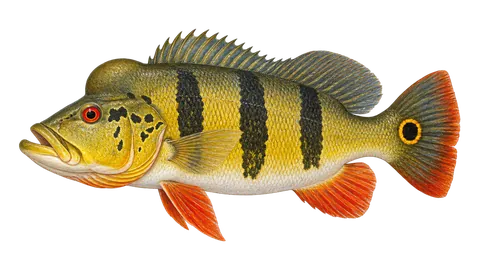
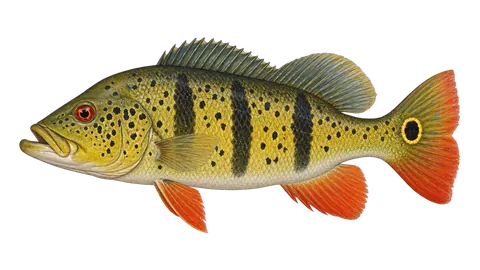
Peacock bass body, with a black ocellus edged in pale at the base of the tail. In juveniles and large females, four horizontal rows of pale spots on the flank; in adults, black vertical bars with pale edges. Small scales and a lateral line that is almost always broken. Very similar to the açu and pinima peacock bass; the fishing area (Uatumã and Trombetas) helps tell them apart.
Also called: tucunaré-vazzoleri, tucunaré
don't confuse with:
where found
open on the large mapWhere to look: Submerged timber, snags, islands and shorelines of the reservoir; structured banks and beaches on the rivers.
Uatumã River, including Balbina reservoir (AM), and lower Trombetas River (PA).
native to the basins
states
Amazonas, Pará
famous destinations
when to fish
best season
The dry season (August to December) concentrates fish along the banks and in snags. Spawning runs from October to January, with pairs guarding their nests.
best time of day
Daytime, with peaks at dawn and dusk. Active by day, peaking in the first hours after sunrise and in late afternoon.
what affects the vazzoleri pavon
cold and cold fronts
Cold snaps shut down activity for one to three days.
atmospheric pressure
Stable pressure helps; a quick drop before a storm gives a short peak.
moon
Small effect.
rain
A light drizzle doesn't matter; with a thunderstorm, get out of the water.
water level
A falling reservoir concentrates fish on points and in snags.
noise
Very sensitive to engine noise and hull knocks near cover.
wind
Light chop helps surface lures; strong wind makes casting harder.
depth
Shallow, 0.5 to 3 m; drops deeper when the sun heats up.
how to fish
lures
- zara/stickbait 9 to 12 cm
- prop bait
- feather jig 1/4 to 1/2 oz
- mid-water jerkbait
tip from an angler
Surface lure on the tips of snags early in the morning; in Amazonas do not use live bait for peacock bass.
- rod
- 5'6" to 6', fast action, 14 to 25 lb
- spinning / baitcasting reel
- low-profile baitcasting reel or spinning reel 2500 to 3000
- line
- braid 30 to 50 lb
- leader
- fluorocarbon or monofilament 40 to 60 lb
- hook
- reinforced treble hooks 1/0 to 3/0, preferably barbless
accessories
- long-nose pliers
- boga-grip
- polarized glasses
catch and release
Mandatory in Amazonas. Hold it by the mouth with a lip grip, support its belly, take a quick photo and release it next to the structure.
rules for the vazzoleri pavon
Rules change; before keeping or transporting fish, check with the state environmental agency.
AM: catch and release only; commercial fishing banned
killing prohibited for recreational and sport anglersAM details
In Amazonas it is prohibited for recreational and sport anglers to kill Vazzoler's peacock bass: the fish must be returned alive. Commercial fishing of the species is also banned. The same law bans live bait in peacock bass fishing (art. 17).
Source: Lei estadual AM nº 6.647/2023, arts. 7º, 8º and 17, as amended by Lei nº 7.208/2024
piracema and closed seasons
Each bar is the period when fishing is prohibited or restricted. The green line is today. Tap the name to see what is still allowed.
Spawning closure (piracema) in Mato Grosso (all basins)
Allowed: All fishing modalities are prohibited in rivers, including catch and release (Law 9.096/2009, art. 19-A). Exceptions: subsistence fishing from shore (3 kg or 1 fish, no transport or sale) and scientific fishing. Law 13.159/2025 now allows licensed sport fishing in UHE/PCH hydropower reservoirs, natural lakes and border rivers, subject to a scientific study and a license from the environmental agency. We have not confirmed whether these licenses are already being issued.
Closed season in the Amazon basin in Amazonas
Allowed: Under Portaria 48/2007 (art. 2, II), the recreational angler who fishes with handline or rod, line and hook is outside the Annex II prohibitions, unless a stricter state rule applies. Recreational angler bag limit: 5 kg + 1 fish. Competitions prohibited.
Source: Portaria IBAMA nº 48/2007
Closed season in the Amazon basin in Acre
Allowed: Recreational anglers with handline or rod, line and hook are outside the Annex II prohibitions, with a bag limit of 5 kg + 1 fish, unless a stricter state rule applies. On the Acre River, no fishing of any species during the period.
Source: Portaria IBAMA nº 48/2007; IN IBAMA nº 205/2008 (Acre River)
Closed season in the Acre river
Allowed: IN Ibama 205/2008 prohibits fishing in the Acre river and its tributaries during the closed season, with no exception for recreational anglers: treat it as prohibited.
Source: IN IBAMA nº 205/2008
Closed season in the Amazon basin in Pará
Allowed: Recreational anglers with handline or rod, line and hook are outside the Annex II prohibitions, with a bag limit of 5 kg + 1 fish, unless a stricter state rule applies.
Source: Portaria IBAMA nº 48/2007
Closed season in the rivers of Marajó Island (PA)
Allowed: The same recreational-angler exceptions as in Portaria 48/2007 apply (handline or rod, 5 kg + 1 fish), unless a stricter state rule applies.
Source: Portaria IBAMA nº 48/2007
Amazon basin closed season in Rondônia
Allowed: In the Madeira, Mamoré, Jamari, Abunã, Machado and Roosevelt river basins and in the main channel of the Guaporé, licensed recreational anglers may fish only for non-protected species, using a single simple gear per person (handline, rod with or without a reel, or a simple pole with a single hook). The limit is up to 5 kg or 1 fish per week; if the fish is over 5 kg, you keep only that one. You may not sell, trade or give away the catch. Catch and release is allowed only with non-protected species. Fishing is always banned within 200 m of dams, rapids, waterfalls, fish ladders and river mouths.
Closed season in the Amazon basin in Amapá
Allowed: Recreational anglers with handline or rod, line and hook are outside the Annex II prohibitions, with a bag limit of 5 kg + 1 fish, unless a stricter state rule applies.
Source: Portaria IBAMA nº 48/2007
Closed season in Roraima
Border rivers MT/RO and MT/PA
Allowed: See the exceptions in Portaria 48/2007 and the state rules for each bank.
Source: Portaria IBAMA nº 48/2007
Conservation: Not on the national list (Portaria GM/MMA 1.667/2026).
how much it weighs without taking it out of the water
estimated weight
—
how we calculate
Length-weight relationship W = a·Lb (a = 0.01122, b = 3.08; FishBase). It's an average: a fat or lean fish can vary by 10% to 20%.
more about the vazzoleri pavon
Described in 2006, Vazzoler's peacock bass belongs to the açu and pinima group, with rows of pale spots in juveniles and large females, and dark bars on adults. It lives in the Uatumã River, where Balbina reservoir is, and in the lower Trombetas. At Balbina it is targeted by commercial and recreational fishing; decades of fishing pressure have reduced stocks and fish size, which are larger and more numerous inside the Uatumã Biological Reserve. Females mature from about 27 cm standard length, and the species spawns several times a year, peaking from October to January.
Family: Cichlidae · predator
fun facts
- The name honors ichthyologist Anna Emília Vazzoler.
- At Balbina, peacock bass are bigger and more numerous inside the Uatumã Biological Reserve than outside it.
in the kitchen
White, firm flesh, but in Amazonas anglers may not kill it.
similar species
sources and references (6)
The season weights (months), the time of day and the sensitivities (cold, pressure, moon, wind, rain, tide, strong light, murky water and noise) are the app's editorial estimates, based on the literature below and on the field experience of anglers and guides. They are not official data nor a measurement made for this species, and they may vary by region and year. Closed seasons and legal rules appear in the rules section, with the norm and a link.
- scientific FishBase — Cichla vazzoleri (ficha da espécie)Names, distribution, biology, length-weight relationship and references. Page checked on October 13, 2026.
- official Portaria GM/MMA nº 1.667, de 27 de abril de 2026 — Lista Nacional Oficial de Espécies da Fauna Ameaçadas de Extinção (peixes e invertebrados aquáticos)Most recent national list. The species is not on it (search by scientific name in the text published in the DOU, checked on October 13, 2026).
- official ICMBio/SALVE — Ficha de Cichla vazzoleri (avaliação nacional do risco de extinção)ICMBio national assessment, published in 2025. DOI checked on Crossref.
- scientific IUCN Red List — Cichla vazzoleri (avaliação global: Pouco Preocupante, LC, 07/11/2018)Global assessment. Link given on the FishBase entry (Red List, version 2025-2).
- scientific Kullander, S. O.; Ferreira, E. J. G. (2006). A review of the South American cichlid genus Cichla, with descriptions of nine new species (Teleostei: Cichlidae). Ichthyological Exploration of Freshwaters 17(4): 289–398.Original species description. Printed journal; the URL is the bibliographic record on FishBase.
- scientific Horie, C. A. C.; Deus, C. P.; Röpke, C. P.; Amadio, S. A. (2024). Estrutura da população e biologia reprodutiva de Cichla vazzoleri (Perciformes: Cichlidae): subsídios para o ordenamento da pesca no entorno da REBIO Uatumã, Amazonas, Brasil. Biodiversidade Brasileira 14(2).Scientific journal of ICMBio. Size at first maturity, spawning season and reserve effect; abstract checked on the journal's page.
how we calculatewhere each number comes from
The weather comes from three independent global models, cross-checked hour by hour: when they agree, confidence goes up; when they diverge, the band between them shows on the chart. Beyond 16 days, we use the GEFS ensemble of 31 simulations: if 20 of the 31 predict rain, the chance of rain is 65%. Sun and moon are calculated astronomically, with no uncertainty.
The index adds up, weighted for each species: time of day (species curve anchored to real sunrise and sunset), moon (transits, rise and set, phase), pressure (3 h trend and 24 h swing), water temperature (in rivers, estimated from air temperature; at sea, estimated by an ocean model), wind, rain, clouds, tide and the month in the species' cycle.
sources for this lookup
how accurate the forecast is
Accuracy measured in the reference project (4 regions, 93 days, forecast vs. observed): maximum temperature is off by 0.6 °C on average the next day and 1.7 °C at 7 days; rain of 5 mm or more is detected 76% of the time the next day and 57% at 7 days. Detection isn't everything: the false alarm rate isn't published here yet, and 93 days in 4 regions is still a small sample. We now also measure every day, at the app's destinations: