Skip to content
fishing forecast

gag

Mycteroperca microlepis · Epinephelidae · predator

EstuarySeaIUCN global: VU · vulnerable

Greyish-brown badejo from rocky shelf bottoms, the most common grouper on the ledges of the eastern Gulf of Mexico. Vulnerable worldwide; in Mexico it is in the NOM for groupers and has a February-to-March closed season.

Also called: badejo-da-areia, serigado-badejo, gag

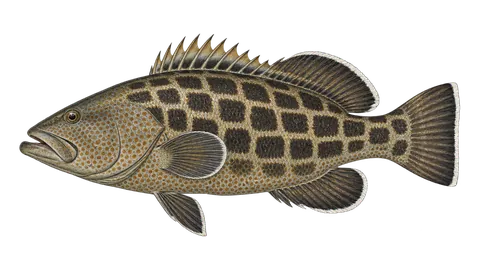
Scientific illustration of Gag
common size
50–80 cm
maximum
145 cm
common weight
1.4–5.8 kg
record/max.
36.5 kg
depth
30–160 m
ideal water
16–26 °C
location

Sample location: choose yours to see the forecast for where you fish.

period

Reading the weather across 3 global models and 31 simulations…

the species

everything about the gag

overview

who is the gag

The badejo-da-areia (gag) lives in the western Atlantic, from North Carolina (juveniles reach Massachusetts) to the Yucatán Peninsula, Mexico. It is rare in Bermuda, has one record from Cuba, and there is a report from eastern Brazil. Juveniles stay in estuaries and seagrass beds; adults live on rock bottoms offshore (rarely beyond 152 m) and sometimes closer in, over rock or grass. It is the most common grouper on the rock ledges of the eastern Gulf of Mexico. It lives alone or in groups of 5 to 50, and eats mostly fish, plus crabs, shrimp and cephalopods. It reaches 145 cm and 36.5 kg and lives up to 31 years. Heavily exploited, it is Vulnerable on the IUCN list (2016). In Mexico, the mero abadejo is one of the commercially valuable groupers of the Campeche Bank.

fun facts

  • It is the most common grouper on the rock ledges of the eastern Gulf of Mexico.
  • It lives alone or in groups of 5 to 50 fish.
  • Juveniles (under 20 cm) mostly eat crustaceans that live in shallow seagrass beds.
how to recognize it

identification

Adult females and juveniles are greyish-brown, with dark marks like veins. In the camouflage phase 5 dark brown saddles appear, separated by short white bars below the dorsal fin. Large males may show the 'black-belly' phase: light grey body with faint reticulation, belly and lower body above the anal fin black, and black margins on the soft dorsal, in the middle of the caudal fin and behind the pectoral and pelvic fins. The preopercle has a rounded lobe with larger serrations, the posterior nostrils of adults are much larger than the anterior ones, and the body scales are smooth.

distribution

where found

open on the large map

FishBase mentions only one report from 'eastern Brazil', with no location or detail, and we found no Brazilian survey confirming the species; treat the report with caution, because Brazilian badejos look similar. Outside Brazil, it ranges from North Carolina to the Yucatán Peninsula, with a record from Cuba.

Habitat: Juveniles in estuaries and seagrass beds; adults on rock bottoms from 30 to 160 m, alone or in groups of 5 to 50 fish.

coast

Northeast CoastSoutheast Coastcoastalshelf
calendar and clock

when to fish

best season

time of year
JanFebSeaAprMayJunJulAugSepOctNovDec

No set season on bottoms of 30 m or more. In Mexico the grouper closed season applies, from Feb 1 to Mar 31. In Brazil, where the presence is not confirmed, there is no specific rule.

best time of day

0h6h12h18h sunrise ~6amsunset ~6pm

Any time. On rock bottoms of 30 m or more, the time of day matters little; current and sea state matter more.

weather, water and behavior

what affects the gag
sensitivity The little bars show how much each factor affects this species. Five full: it feels it a lot.

cold and cold fronts

A subtropical species; a strong cold front may push it into deeper water.

atmospheric pressure

A cold front brings choppy seas and makes it hard to hold station over the spot.

moon

Small effect.

rain

No effect at depth.

water level

Not applicable at sea.

noise

Not very sensitive to noise at that depth.

wind

Strong wind and fast drift keep the bait from staying on the bottom.

tide

Moderate current activates feeding on the rock ledges.

depth

Adults from 30 to 160 m; juveniles in shallow water.

technique, gear and bait

how to fish

rod
6' to 7', 30 to 60 lb
spinning / baitcasting reel
baitcasting reel 300 to 400 or spinning reel 6000 to 8000, with strong drag
line
braided line 50 to 80 lb
leader
fluorocarbon 60 to 100 lb, 1.5 m
hook
circle 5/0 to 8/0

lures

  • 80 to 250 g jig

natural baits

  • small live fish
  • lula

accessories

  • descender (fish descender)
  • long-nose pliers
  • luvas

tip from an angler

The fish stays close to the rock: stop the lure's fall near the bottom and lift the fish in the first few metres, before it dives into a hole.

what the law says

rules for the gag

Summary of the regulations we found, with the source for each. Rules change; before keeping or transporting fish, check with the state environmental agency.
Conservation: Vulnerable in the 2016 global assessment. Not on the Brazilian national list (Portaria GM/MMA nº 1.667/2026).

Mexico: grouper closed season from Feb 1 to Mar 31

catch prohibited from Feb 1 to Mar 3101/02 to 31/03

In Mexico, catching all grouper species, a group in which NOM-065 includes the badejo-da-areia (mero abadejo or cuna aguají), is banned from Feb 1 to Mar 31 in federal waters of the Gulf of Mexico off Tabasco, Campeche, Yucatán and Quintana Roo, up to the border with Belize. Bottom longlines are also banned in that period. The agreement does not mention sport fishing: confirm with Conapesca whether it applies to your type of fishing.

Source: Grouper closed-season agreement (DOF Feb 14, 2007), amended Mar 3, 2017 (Sagarpa/Conapesca); NOM-065-SAG/PESC-2014, item 4.1

Mexico: up to 3 kg of grouper per angler per day (household consumption)

3 kg per angler per day

In federal waters of the Gulf of Mexico and the Caribbean, NOM-065 allows, for household-consumption fishing, at most 3 kg per angler per day of any grouper species or associated species, such as the badejo-da-areia. The fish is for the angler's and family's own consumption only, may not be sold, and only equipment that one person can operate alone is allowed. Sport fishing has its own rule (NOM-017-PESC-1994), which we did not check.

Source: NOM-065-SAG/PESC-2014 (DOF Jul 3, 2015), items 4.1 and 4.13 (Sagarpa/Conapesca)

catch and release
catch and release Releasing the fish alive, quickly and with a wet hand. During a closed season it isn't always allowed: what the regulation says applies.

If it comes from more than 15 to 20 m, use a descender. Support the belly and release quickly. Because it is Vulnerable worldwide, it is worth releasing the large ones.

in the kitchen

White, firm flesh, highly prized where the species is caught on a commercial scale (FishBase marks it as intensively commercially fished). In Mexico, household consumption of groupers is limited to 3 kg per angler per day.

calculator

how much it weighs without taking it out of the water

Length-weight relationship W = a·Lb (a = 0.00955, b = 3.04; FishBase (relação peso-comprimento bayesiana, estimativa da própria espécie)). It's an average: a fat or lean fish can vary by 10% to 20%.

estimated weight

—

sources and references

The season weights (months), the time of day and the sensitivities (cold, pressure, moon, wind, rain, tide, strong light, murky water and noise) are the app's editorial estimates, based on the literature below and on field experience from anglers and guides. They are not official data or measurements made for this species and may vary by region and year. Closed seasons and legal rules appear in the rules section, with the rule and link. The common size and weight ranges, water temperature and typical depth are also editorial estimates, anchored in FishBase data.

  1. scientific FishBase: Mycteroperca microlepis (ficha da espécie)Size, length-weight, depth, habitat, distribution, biology and IUCN status. Page checked Oct 13, 2026. Common size and weight ranges, water temperature and typical depth: editorial estimates anchored in FishBase data. Name of this profile: 'badejo-da-areia' is one of the Brazilian Portuguese names that FishBase lists. The occurrence in Brazil comes from a report of 'eastern Brazil' with no details.
  2. scientific FishBase: nomes populares de Mycteroperca microlepisNames by country and language.
  3. official Portaria GM/MMA nº 1.667, de 27 de abril de 2026: Lista Nacional Oficial de Espécies da Fauna Ameaçadas de Extinção (peixes e invertebrados aquáticos)The species is not on the list. Checked in the DOU of April 28, 2026.
  4. official México: NOM-065-SAG/PESC-2014, para regular o aproveitamento das espécies de mero e espécies associadas no Golfo do México e no Mar do Caribe (DOF de 03/07/2015)Text published in the Diario Oficial de la Federación, in a copy from the Secretaría de Economía, read Oct 13, 2026: item 4.1 (list of grouper species), 4.8 (minimum size of the mero rojo) and 4.13 (household-consumption fishing: up to 3 kg per angler per day). Sport fishing has its own rule (NOM-017-PESC-1994, amended in 2013), whose limits were not checked.
  5. official México: acordo que modifica a veda de todas as espécies de mero no Golfo do México e no Caribe (DOF de 03/03/2017; acordo original de 14/02/2007)Sets the closed season from Feb 1 to Mar 31, starting in 2018, in federal waters off Tabasco, Campeche, Yucatán and Quintana Roo, and bans bottom longlines in that period. The text does not mention sport fishing. We found no later amendment; confirm each season with Conapesca.
  6. scientific Heemstra, P. C.; Randall, J. E. (1993). FAO species catalogue. Vol. 16. Groupers of the world (family Serranidae, subfamily Epinephelinae). FAO Fisheries Synopsis 125(16). Roma: FAO.General reference for identifying groupers worldwide.
don't confuse

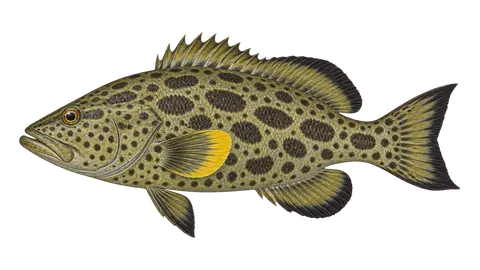
similar species