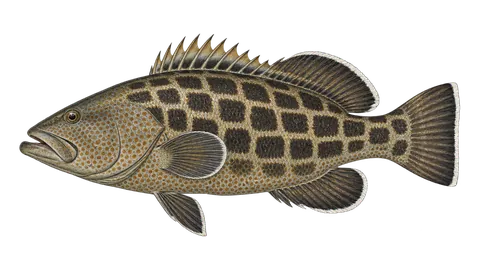
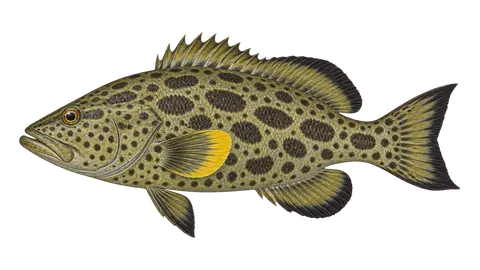
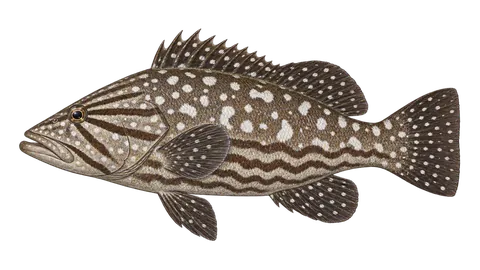
Badejo-amarelo: light brown, with a yellow mouth inside, from reefs and islands of the Caribbean and Brazil. Vulnerable: in Brazil, recreational anglers may only fish catch and release, and there is a closed season from Aug 1 to Sep 30.
Also called: badejo-amarelo, serigado (uso local; nas normas, sirigado é o badejo-quadrado), yellowmouth grouper
The badejo-amarelo (yellowmouth grouper) lives in the western Atlantic, from the Gulf of Mexico, Bermuda and the Caribbean to Brazil, where the literature records it from Maranhão to Santa Catarina, including the oceanic islands. It is a fish of rock and coral bottoms, from the shoreline down to at least 55 m, and juveniles and mid-sized fish also occur in mangrove lagoons. It favors islands over the mainland coast. It reaches 84 cm and 10.2 kg and can live 41 years. It eats fish, and juveniles mimic the wrasse Halichoeres maculipinna to get close to prey. It is born female and changes sex. It is on the national list as Vulnerable, has a recovery plan and its own fishing rules.
fun facts
The juvenile mimics the colors and swimming style of a wrasse (Halichoeres maculipinna) to get close to prey without spooking it.
It is more common around islands than along the mainland coast.
FishBase records sex reversal: it is born female and becomes male.
how to recognize it
identification
Adults light brown to brown, paler below, with many small, close brown spots on the head and body (sometimes uniform). The inside of the mouth and the edge of the spiny dorsal fin are yellow, which gives the name. The corner of the preopercle is angular, with a serrated lobe and a notch above, and the posterior nostrils are much larger than the anterior ones. Juveniles are brown on the back, with a white stripe on the head and at the base of the dorsal fin. The badejo-ferro has oval dark spots and a yellow pectoral tip, and the badejo-quadrado has rectangular spots.
how yellowmouth grouper fishing looks
Loading the next 7 days…
Each card shows the day's index (0 to 100) and, below it, a strip with the index for each hour, from 0h to 23h. from poor to excellent.
In Brazil, the literature records the species from Maranhão to Santa Catarina, including Fernando de Noronha and Trindade; a UFMA paper reports it as a new record for the Amazonian coast, based on the Raposa market (MA). It is more common around islands than along the mainland coast.
Habitat: Rock and coral bottoms from the shoreline down to at least 55 m, more common around islands; juveniles and mid-sized fish also in mangrove lagoons.
coast
North CoastNortheast CoastSoutheast CoastSouth Coastcoastalshelf
calendar and clock
when to fish
best season
time of year
JanFebSeaAprMayJunJulAugSepOctNovDec
Tropical reef fish, with no marked season for fishing. Spawning occurs all year, peaking in April and May according to the literature. In Brazil the closed season runs from Aug 1 to Sep 30; in Mexico, the grouper closure runs from Feb 1 to Mar 31.
best time of day
Daytime, with peaks at dawn and dusk. Hunts by day, with peaks at dawn and in the late afternoon.
weather, water and behavior
what affects the yellowmouth grouper
sensitivity The little bars show how much each factor affects this species. Five full: it feels it a lot.
cold and cold fronts
A tropical reef fish; cold fronts reduce its activity.
atmospheric pressure
A churned sea after a cold front shuts down bottom fishing.
moon
Effect poorly known; spring tides move more bait on the reef.
rain
Little effect at depth.
water level
Not applicable at sea.
noise
Anchor and hull knocking on the reef scare fish.
wind
Strong wind makes it hard to hold position over the spot.
tide
Moderate current activates feeding at the reef edge.
baitcasting reel 300 to 400 or spinning reel 6000 to 8000, with strong drag
line
braided line 50 to 65 lb
leader
fluorocarbon 60 to 100 lb, 1.5 m
hook
circle hook 5/0 to 8/0, preferably barbless (makes release easier)
lures
jig 80 to 200 g
mid-water plug over the reef
natural baits
small live fish
lula
accessories
descender (fish descender)
long-nose pliers
luvas
tip from an angler
In Brazil recreational anglers may only release: use a barbless hook, lift the fish the first few metres so it does not dive into a hole, and keep the pliers handy.
what the law says
rules for the yellowmouth grouper
Summary of the regulations we found, with the source for each. Rules change; before keeping or transporting fish, check with the state environmental agency. Conservation: Already on the previous list and still Vulnerable. Recovery plan: Portaria MMA 292/2018; rules of use in PI SG-PR/MMA 59-C/2018, under review by Portaria 1.666/2026 (art. 11). Global assessment: VU (IUCN, 2016).
Amateur fishing for catch and release only
mandatory catch and releaseNorth CoastNortheast CoastSoutheast CoastSouth Coast
Recreational and sport fishing for badejo-amarelo is allowed only as catch and release, in all Brazilian waters. Targeted fishing, transport, landing and trade outside the ordinance's rules are banned; a specimen caught by chance outside those rules must be released alive or discarded immediately, with a record.
fishing prohibited August 1 to September 3001/08 to 30/09North CoastNortheast CoastSoutheast CoastSouth Coast
Fishing for badejo-amarelo is banned from Aug 1 to Sep 30, together with caranha, sirigado and garoupa-são-tomé. Keeping on board and landing are tolerated until Aug 3; storing, transporting and selling during the period is allowed only with stock declared to Ibama by Aug 10.
45 cm (TL)North CoastNortheast CoastSoutheast CoastSouth Coast
Authorized commercial fishing may only keep, transport, process and sell badejo-amarelo of 45 cm or more in total length. It does not apply to recreational anglers, who must release all fish.
Vulnerable (VU)North CoastNortheast CoastSoutheast CoastSouth Coastconfirm with the agency
The badejo-amarelo is on the national list as Vulnerable and was already on the previous list. Under Portaria GM/MMA 1.666/2026, threatened species have full protection, except for use provided in an approved recovery plan. The badejo-amarelo plan (Portaria MMA 292/2018) and the rules of PI 59-C/2018 remain in force during the review ordered by the portaria (art. 11). In practice, recreational anglers may only release. Check whether anything has changed before fishing.
Mexico: grouper closed season from Feb 1 to Mar 31
catch prohibited from Feb 1 to Mar 3101/02 to 31/03
In Mexico, catching all grouper species, a group in which NOM-065 includes the badejo-amarelo (cuna amarilla or mero gallineta), is banned from Feb 1 to Mar 31 in federal waters of the Gulf of Mexico off Tabasco, Campeche, Yucatán and Quintana Roo, up to the border with Belize. Bottom longlines are also banned in that period. The agreement does not mention sport fishing: confirm with Conapesca whether it applies to your type of fishing.
Mexico: up to 3 kg of grouper per angler per day (household consumption)
3 kg per angler per day
In federal waters of the Gulf of Mexico and the Caribbean, NOM-065 allows, for household-consumption fishing, at most 3 kg per angler per day of any grouper species or associated species, such as the badejo-amarelo. The fish is for the angler's and family's own consumption only, may not be sold, and only equipment that one person can operate alone is allowed. Sport fishing has its own rule (NOM-017-PESC-1994), which we did not check.
Puerto Rico (federal waters): up to 5 per person per day
5 per person per day; 15 per boat with 3 or more people
In federal waters around Puerto Rico, beyond 9 miles from the coast, the recreational angler may keep a maximum of 5 fish per day from groupers, snappers and parrotfish combined (up to 15 per boat when there are 3 or more people aboard). The limit does not apply to anyone with a commercial license from Puerto Rico or the U.S. Virgin Islands.
catch and release Releasing the fish alive, quickly and with a wet hand. During a closed season it isn't always allowed: what the regulation says applies.
In Brazil recreational anglers may only fish catch and release: use a barbless circle hook and long pliers, support the belly and do not hold large fish by the mouth alone. If it comes from more than 15 to 20 m, use a descender. Release quickly, with minimal handling.
in the kitchen
Prized meat, sold fresh and of good quality according to FishBase. In Brazil recreational anglers may not take the fish home; commercial fishing has a 45 cm minimum size and a closed season in August and September.
calculator
how much it weighs without taking it out of the water
Length-weight relationship W = a·Lb (a = 0.00631, b = 3.06; FishBase (relação peso-comprimento bayesiana, estimativa da própria espécie)). It's an average: a fat or lean fish can vary by 10% to 20%.
estimated weight
—
sources and references
The season weights (months), the time of day and the sensitivities (cold, pressure, moon, wind, rain, tide, strong light, murky water and noise) are the app's editorial estimates, based on the literature below and on field experience from anglers and guides. They are not official data or measurements made for this species and may vary by region and year. Closed seasons and legal rules appear in the rules section, with the rule and link. The common size and weight ranges, water temperature and typical depth are also editorial estimates, anchored in FishBase data.
scientificFishBase: Mycteroperca interstitialis (ficha da espécie)Size, length-weight, depth, habitat, distribution, biology and IUCN status. Page checked Oct 13, 2026. Common size and weight ranges, water temperature and typical depth: editorial estimates anchored in FishBase data. Name of this profile: 'badejo-amarelo' is the name the PI 59-C/2018 uses for the species. FishBase lists 'serigado', which in the rules designates the badejo-quadrado.
technicalWikipedia: Mycteroperca interstitialisSecondary source, used for the distribution in Brazil (Maranhão to Santa Catarina, with Noronha and Trindade), the spawning peak in April and May, and the mouth color. Data not checked against a primary source.