

scamp
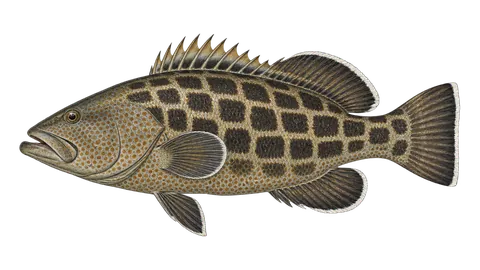
Mycteroperca phenax
Badejo from rock bottoms of 30 to 100 m, from the Gulf of Mexico and the US coast to the southern Caribbean. In Mexico it is in the NOM for groupers and under the February-to-March closed season.
- common size
- 35–55 cm
- maximum
- 107 cm
- common weight
- 0.5–1.9 kg
- record/max.
- 14.2 kg
- depth
- 30–100 m
- ideal water
- 14–24 °C
how to recognize it
It has four color patterns, which makes identification harder. Brown phase: light brown head and body with reddish-brown specks reaching the fins. 'Cat's paw' phase: light brown background with groups of dark spots on the back, like cat's paw prints. Large adults: silvery-grey head with dark reticulation and the rear two-thirds of the body dark. Bicolor phase: light brown in front and chocolate brown behind. In all of them, the corner of the preopercle has a clear bony lobe, and the posterior nostrils of adults are 2 to 4 times larger than the anterior ones.
Also called: badejo-garopa, scamp
don't confuse with:
where found
open on the large mapWhere to look: Ledges and high rock bottoms from 30 to 100 m; juveniles in jetties and mangroves.
The species is not recorded in Brazil. It occurs in the central western Atlantic: the Gulf of Mexico, the US east coast (from North Carolina to the Keys) and the southern Caribbean coast, from Belize to Venezuela and Trinidad and Tobago.
when to fish
next 7 days
Loading the next 7 days…
best season
No set season on bottoms of 30 to 100 m. FishBase reports that the species seems to have moved closer to shore when the bottom water cooled below 8.6 °C. In Mexico the grouper closed season applies, from Feb 1 to Mar 31.
best time of day
Any time. On bottoms of 30 to 100 m, the time of day matters little; current and sea state matter more.
what affects the scamp
cold and cold fronts
According to FishBase, the species moved closer to shore when the bottom cooled below 8.6 °C.
atmospheric pressure
A cold front brings choppy seas and makes it hard to hold station over the spot.
moon
Small effect.
rain
No effect at depth.
water level
Not applicable at sea.
noise
Not very sensitive to noise at that depth.
wind
Strong wind and fast drift keep the bait from staying on the bottom.
tide
Moderate current activates feeding on the ledges.
depth
Adults from 30 to 100 m.
how to fish
lures
- jig 80 to 200 g
natural baits
- small live fish
- lula
tip from an angler
Fish close to the rock ledges and lift the fish in the first few metres, before it dives into a hole.
- rod
- 6' to 7', 30 to 60 lb
- spinning / baitcasting reel
- baitcasting reel 300 to 400 or spinning reel 6000 to 8000, with strong drag
- line
- braided line 50 to 65 lb
- leader
- fluorocarbon 60 to 100 lb, 1.5 m
- hook
- circle 5/0 to 8/0
accessories
- descender (fish descender)
- long-nose pliers
- luvas
catch and release
If it comes from more than 15 to 20 m, use a descender. Support the belly and release quickly. In Mexico, respect the grouper closed season (February and March).
rules for the scamp
Rules change; before keeping or transporting fish, check with the state environmental agency.
Mexico: grouper closed season from Feb 1 to Mar 31
catch prohibited from Feb 1 to Mar 3101/02 to 31/03 details
In Mexico, catching all grouper species, a group in which NOM-065 includes the badejo-garopa (cuna garopa or mero gallina), is banned from Feb 1 to Mar 31 in federal waters of the Gulf of Mexico off Tabasco, Campeche, Yucatán and Quintana Roo, up to the border with Belize. Bottom longlines are also banned in that period. The agreement does not mention sport fishing: confirm with Conapesca whether it applies to your type of fishing.
Mexico: up to 3 kg of grouper per angler per day (household consumption)
3 kg per angler per day details
In federal waters of the Gulf of Mexico and the Caribbean, NOM-065 allows, for household-consumption fishing, at most 3 kg per angler per day of any grouper species or associated species, such as the badejo-garopa. The fish is for the angler's and family's own consumption only, may not be sold, and only equipment that one person can operate alone is allowed. Sport fishing has its own rule (NOM-017-PESC-1994), which we did not check.
Source: NOM-065-SAG/PESC-2014 (DOF Jul 3, 2015), items 4.1 and 4.13 (Sagarpa/Conapesca)
Conservation: Data Deficient in the 2016 global assessment. It does not occur in Brazil, so it is not on the national list.
how much it weighs without taking it out of the water
estimated weight
—
how we calculate
Length-weight relationship W = a·Lb (a = 0.00912, b = 3.05; FishBase (relação peso-comprimento bayesiana, estimativa pelo gênero e formato do corpo)). It's an average: a fat or lean fish can vary by 10% to 20%.
more about the scamp
The badejo-garopa (scamp) lives in the central western Atlantic: the Gulf of Mexico, the US east coast from North Carolina to the Florida Keys, and the southern Caribbean coast; juveniles sometimes appear as far north as Massachusetts. Adults live on ledges and high rock bottoms, from 30 to 100 m, and the species was the most abundant grouper on Oculina coral formations at 70 to 100 m off Florida. Juveniles occupy jetties and mangroves. It reaches 107 cm and 14.2 kg and lives up to 21 years; FishBase gives 30 cm as the common length. It is intensively caught commercially and as a sport fish. In Mexico, the mero gallina is among the commercially valuable groupers of the medium-height fleet on the Campeche Bank. It does not occur in Brazil.
Family: Epinephelidae · predator
fun facts
- It changes color through four phases, including one with spots that look like cat's paw prints.
- It was the most abundant grouper on the Oculina coral reefs at 70 to 100 m off Florida.
- Juveniles sometimes appear in jetties and mangroves, and some reach Massachusetts.
in the kitchen
Sold fresh and of great commercial importance, according to FishBase. In Mexico, household consumption of groupers is limited to 3 kg per angler per day.
similar species



sources and references (5)
The season weights (months), the time of day and the sensitivities (cold, pressure, moon, wind, rain, tide, strong light, murky water and noise) are the app's editorial estimates, based on the literature below and on field experience from anglers and guides. They are not official data or measurements made for this species and may vary by region and year. Closed seasons and legal rules appear in the rules section, with the rule and link. The common size and weight ranges, water temperature and typical depth are also editorial estimates, anchored in FishBase data.
- scientific FishBase: Mycteroperca phenax (ficha da espécie)Size, length-weight, depth, habitat, distribution, biology and IUCN status. Page checked Oct 13, 2026. Common size and weight ranges, water temperature and typical depth: editorial estimates anchored in FishBase data. Name of this profile: FishBase lists no Portuguese name; 'badejo-garopa' follows the pattern used for species that do not occur in Brazil (the Portuguese group name plus the Spanish name, cuna garopa, used in NOM-065).
- scientific FishBase: nomes populares de Mycteroperca phenaxNames by country and language.
- official México: NOM-065-SAG/PESC-2014, para regular o aproveitamento das espécies de mero e espécies associadas no Golfo do México e no Mar do Caribe (DOF de 03/07/2015)Text published in the Diario Oficial de la Federación, in a copy from the Secretaría de Economía, read Oct 13, 2026: item 4.1 (list of grouper species), 4.8 (minimum size of the mero rojo) and 4.13 (household-consumption fishing: up to 3 kg per angler per day). Sport fishing has its own rule (NOM-017-PESC-1994, amended in 2013), whose limits were not checked.
- official México: acordo que modifica a veda de todas as espécies de mero no Golfo do México e no Caribe (DOF de 03/03/2017; acordo original de 14/02/2007)Sets the closed season from Feb 1 to Mar 31, starting in 2018, in federal waters off Tabasco, Campeche, Yucatán and Quintana Roo, and bans bottom longlines in that period. The text does not mention sport fishing. We found no later amendment; confirm each season with Conapesca.
- scientific Heemstra, P. C.; Randall, J. E. (1993). FAO species catalogue. Vol. 16. Groupers of the world (family Serranidae, subfamily Epinephelinae). FAO Fisheries Synopsis 125(16). Roma: FAO.General reference for identifying groupers worldwide.