

peruvian rock seabass
Paralabrax humeralis · Serranidae · predator
A sea bass of the rocky shores of the South American Pacific, heavily fished from rocks and boats in Peru and Chile. Takes natural bait and jigs near the rocky bottom.
Also called: cabrilha-do-pacífico, cabrilla, Peruvian rock seabass

- common size
- 25–40 cm
- maximum
- 54 cm
- common weight
- 0.3–1.2 kg
- record/max.
- 2.5 kg
- depth
- 2–60 m
- ideal water
- 14–20 °C

the right time
to be on the water
Choose the place and the species. The index, from 0 to 100, combines weather, sun, moon and tide with each fish's habits. Up to 28 days, with each day's confidence.
Reading the weather across 3 global models and 31 simulations…
—
hour by hour
tap or drag on the chart to read each hour · on a keyboard, arrow keyssee hour-by-hour table
why this index at —?
choose the day
Each card shows the day's index (0 to 100) and, below it, a strip with the index for each hour, from 0h to 23h. from poor to excellent.
the fishing month at a glance
what's the best window for the crew?
Choose how many fishing days. We compare each stretch by its average index, discount days with a warning or closed season, and show the 3 best.
trend for the coming weeks
Line: the middle value of 31 simulations of the American GEFS model. Band: where 8 out of 10 fall. Narrow, firm trend; wide, high uncertainty.
everything about the peruvian rock seabass
who is the peruvian rock seabass
A sea bass of the grouper family (Serranidae), from the eastern Pacific, from Costa Rica and Colombia to southern Chile. It is most common in the cold waters of the Humboldt Current, in Peru and Chile, where it lives in schools over rocky bottoms, from shallow rocky shores to tens of metres deep. It eats small fish and crustaceans. It is much sought after in rock fishing (peña) and boat fishing in Peru and Chile, and its meat is highly prized. For the angler it is a medium-tackle fish that takes natural bait, with firm bites and a short fight near the rocks. There are studies on its reproduction in captivity.
fun facts
- The name cabrilla is used for several Pacific sea basses; in Peru and Chile it refers to this species.
- It is a close relative of the cabrillas and of the California calico bass, in the same genus.
identification
Elongated, compressed body, grey-brown to olive, with irregular dark blotches and marbling and a paler belly. Continuous dorsal fin with spines and soft rays, large mouth and straight to slightly concave tail. Atlantic groupers are taller and do not occur in the southern Pacific.
where found
Does not occur in Brazil. Eastern Pacific, from Costa Rica and Colombia to the far southern tip of Chile; most common in Peru and Chile.
Habitat: Rocky shores and bottoms, reefs and rock edges with algae, from a few metres to tens of metres deep.
when to fish
best season
Fished all year in Peru and Chile; summer, with calmer seas and clearer water over the rocks, is usually the most productive.
best time of day
Daytime, with peaks at dawn and dusk. Feeds by day, with peaks early in the morning and late in the afternoon, near the rocky bottom.
what affects the peruvian rock seabass
sensitivity The little bars show how much each factor affects this species. Five full: it feels it a lot.
cold and cold fronts
Adapted to cold water; strong sea warming shifts its distribution.
atmospheric pressure
A front with rough seas stops rock fishing.
moon
Small effect.
rain
Little effect.
water level
Does not apply at sea. The equivalent is clear water and little surge over the rocks.
noise
Moderately sensitive near shallow rocks.
wind
A moderately churned sea helps on the rocks; heavy surge makes fishing dangerous.
tide
A rising tide with clear water favors reef-side fishing.
depth
Rocky shores from 2 to 15 m, and deeper rocks reached from a boat.
how to fish
- rod
- rocky shore: 3 to 4 m, 30 to 80 g; boat: 6' to 7', 12 to 25 lb
- spinning / baitcasting reel
- 3000 to 5000 spinning reel
- line
- monofilament 0.30 to 0.35 mm or braided 20 to 30 lb
- leader
- fluorocarbon 25 to 40 lb
- hook
- 1/0 to 3/0
lures
- jig head with silicone shad
- metal jig 20 to 60 g
natural baits
- shrimp
- caranguejo
- anchovy or sardine fillet
- lula
accessories
- sinker 30 to 100 g
- alicate
- non-slip footwear for rocks
tip from an angler
Fish close to the rocks, with the bait a few centimetres off the bottom. On feeling the bite, set the hook and lift at once so the fish cannot get into a crevice.
rules for the peruvian rock seabass
Summary of the regulations we found, with the source for each. Rules change; before keeping or transporting fish, check with the state environmental agency.
Conservation: A species heavily exploited by artisanal fishing in Peru.
We found no species-specific rule beyond the region's general rules.
catch and release
catch and release Releasing the fish alive, quickly and with a wet hand. During a closed season it isn't always allowed: what the regulation says applies.
A shallow-bottom fish tolerates release well; unhook quickly. If it comes up from deeper water, use a descender.
in the kitchen
White meat highly valued in Peru; fried, stewed and in ceviche.
how much it weighs without taking it out of the water
Length-weight relationship W = a·Lb (a = 0.01047, b = 3.05; FishBase). It's an average: a fat or lean fish can vary by 10% to 20%.
estimated weight
—
sources and references
The season weights (months), the time of day and the sensitivities (cold, pressure, moon, wind, rain, tide, strong light, murky water and noise) are the app's editorial estimates, based on the literature below and on the field experience of anglers and guides. They are not official data nor a measurement made for this species, and they may vary by region and year. Closed seasons and legal rules appear in the rules section, with the norm and a link.
- scientific FishBase — Paralabrax humeralis (ficha da espécie)Names, distribution, biology, length-weight relationship, country list and references. Page checked on Oct 13, 2026.
- scientific IUCN Red List — Paralabrax humeralis (avaliação global: Dados Insuficientes, DD, 01/05/2008)Global assessment. Link given on the FishBase entry (Red List, version 2025-2).
- technical CABI Compendium — Paralabrax humeralis. (2017).Species data sheet. DOI checked in Crossref.
- scientific Iannacone, J.; Alvariño, L. (2009). Dinámica poblacional de la diversidad parasitaria de la cabrilla Paralabrax humeralis (Teleostei: Serranidae) en Chorrillos, Lima, Perú. Neotropical Helminthology 3(2): 73-88.A study of cabrillas from the Lima coastal fishery. DOI checked on Crossref.
similar species
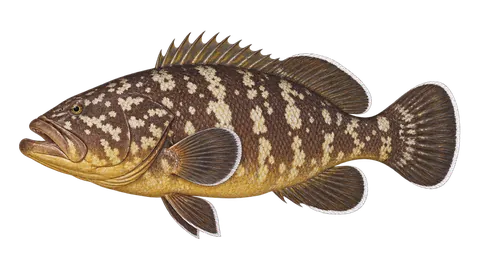
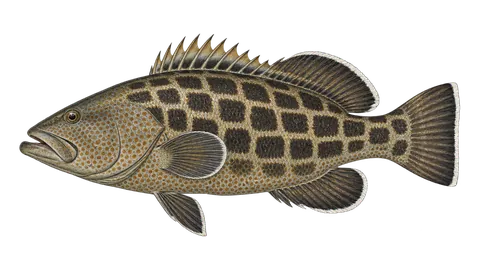
where each number comes from
The weather comes from three independent global models, cross-checked hour by hour: when they agree, confidence goes up; when they diverge, the band between them shows on the chart. Beyond 16 days, we use the GEFS ensemble of 31 simulations: if 20 of the 31 predict rain, the chance of rain is 65%. Sun and moon are calculated astronomically, with no uncertainty.
The index adds up, weighted for each species: time of day (species curve anchored to real sunrise and sunset), moon (transits, rise and set, phase), pressure (3 h trend and 24 h swing), water temperature (in rivers, estimated from air temperature; at sea, estimated by an ocean model), wind, rain, clouds, tide and the month in the species' cycle.
sources for this lookup
how accurate the forecast is
Accuracy measured in the reference project (4 regions, 93 days, forecast vs. observed): maximum temperature is off by 0.6 °C on average the next day and 1.7 °C at 7 days; rain of 5 mm or more is detected 76% of the time the next day and 57% at 7 days. Detection isn't everything: the false alarm rate isn't published here yet, and 93 days in 4 regions is still a small sample. We now also measure every day, at the app's destinations: