MS: minimum 80 cm
80 cmMS
Minimum size for cachara in MS. Counts as the only native fish in the recreational bag limit.
Source: Decreto estadual MS nº 15.375/2020 (amends Decreto nº 15.166/2019), art. 9º - Semadesc/Imasul
Pseudoplatystoma reticulatum · Pimelodidae · predator
The striped sorubim of the Pantanal. Smaller than the pintado, more common along the shore and much sought in night drifting with tuvira.
Also called: cachara, surubim-cachara, surubim-tigre


Choose the place and the species. The index, from 0 to 100, combines weather, sun, moon and tide with each fish's habits. Up to 28 days, with each day's confidence.
Reading the weather across 3 global models and 31 simulations…
Each card shows the day's index (0 to 100) and, below it, a strip with the index for each hour, from 0h to 23h. from poor to excellent.
Choose how many fishing days. We compare each stretch by its average index, discount days with a warning or closed season, and show the 3 best.
Line: the middle value of 31 simulations of the American GEFS model. Band: where 8 out of 10 fall. Narrow, firm trend; wide, high uncertainty.
A leather catfish of the Pantanal and the Paraná, a close relative of the pintado. It is more abundant than it in many Pantanal rivers and comes closer to the shore, into the camalote mats and corixo mouths. At night it hunts tuviras, muçuns and small fish, using its barbels. During falling water it concentrates at bay outlets, the classic spots. It fights with strong pulls and tries to tangle in water hyacinth and submerged timber. It has strict rules: transport banned in MT, keeping banned in PR and a size window in MS.
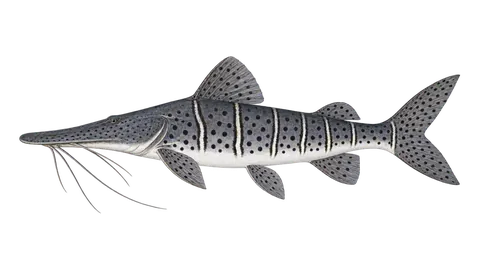
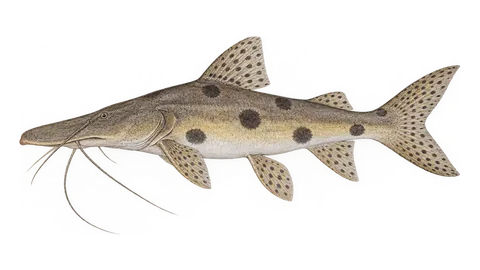
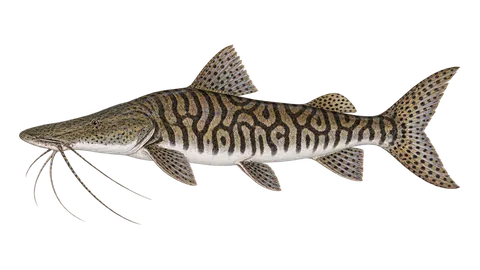
Long, flat head like the pintado's, but a little shorter. The flank has broad, wavy dark bands that join into a net, with pale areas between them and few spots. The pintado has many round spots and fine pale bands. The jurupoca has a duck-bill-shaped snout, a longer lower jaw and few large spots.
Rivers and bays of the Pantanal (Paraguay, Cuiabá, São Lourenço, Piquiri, Taquari, Negro, Miranda, Aquidauana) and the Paraná main channel.
Habitat: Bay and corixo mouths, shorelines with camalote mats, banks, backwaters and beaches at night; pools by day.
native to the basins
states
Mato Grosso do Sul, Mato Grosso, Paraná
Falling water (April to June) is already good, with water flowing out of the bays. The dry season (August to October) concentrates fish in the channels.
Night and twilight. Active from dusk until dawn. At first light it still bites along the shore; by day, only on the bottom.
A cold snap (friagem) cuts activity; in the following days, fish deeper and slower.
Best with muggy, stable weather.
Dark nights favor the shoreline.
Light rain doesn't bother it.
Water draining from the bays into the river is the trigger: position the boat at the mouth.
Anchor quietly and avoid knocking the hull.
Little effect.
Shoreline 1 to 3 m at night; pool 4 to 10 m by day.
lures
natural baits
accessories
Live tuvira hooked through the mouth, light sinker and boat drifting along the shore. Let it run before setting the hook.
Fishing for surubim catfish, cachara and jau catfish in the Pantanal and rivers of the Paraguay basin, with natural bait, drifting downriver by boat or staying still at the bank and in the pool.
guideWhere fish are in each type of water, from rapids and swirls to bay mouths and corixo channels, and how river level changes everything.
guideHow to rig your gear, choose bait, feel the bottom, decide between anchoring and trolling, the best times, and respect for fishing guides and riverside communities.
guideHow to choose the season and destination, get licenses, choose between a live-aboard boat and a lodge, bring your rods, pack, and use the app's 14 to 28-day forecast to pick your dates.
Summary of the regulations we found, with the source for each. Rules change; before keeping or transporting fish, check with the state environmental agency.
Minimum size for cachara in MS. Counts as the only native fish in the recreational bag limit.
Source: Decreto estadual MS nº 15.375/2020 (amends Decreto nº 15.166/2019), art. 9º - Semadesc/Imasul
Above 120 cm catching is banned in MS.
Source: Decreto estadual MS nº 15.375/2020 (amends Decreto nº 15.166/2019), art. 9º - Semadesc/Imasul
Art. 19-B bans for 5 years (since Jan 1, 2024) transporting, storing and trading cachara caught in rivers of MT. Recreational anglers may only keep up to 2 kg or 1 fish for consumption on site (within 500 m of the river), and art. 19-C excludes the species from art. 19-B: in practice, for this species, catch and release only. The law provides for an evaluation after 3 years (2027) that may revise the list. List checked in the consolidated text published by Sema-MT on May 29, 2026; Law 13.159/2025 did not change the list.
Source: Lei estadual MT nº 9.096/2009, arts. 19-B and 19-C (added by Lei nº 12.434/2024) - Sema-MT
In PR the cachara is among the species with possession, keeping and transport banned in inland waters.
Federal minimum size for cachara sorubim in the Paraná basin. The stricter state rule prevails.
Source: Instrução Normativa Ibama nº 26/2009 (fishing rules for the Paraná River basin), Annex
Transport, storage and sale are fully prohibited for 5 years from Jan 1, 2024 for: cachara, caparari, dorado, jaú, matrinchã (Brycon spp.), pintado/surubim (Pseudoplatystoma spp.), piraíba, piraputanga, pirarara, arapaima (pirarucu), trairão and peacock bass (tucunaré, Cichla spp.). For recreational anglers: catch and release only. These 12 species may not even be eaten on site, since the 2 kg or 1 fish limit excludes the art. 19-B list. The law cites jaú as Zungaro zungaro; we also include the Pantanal jaú (Z. jahu) out of caution. The list may still change: § 2 (exotic and predatory species), § 3 (review through study) and the 3-year assessment planned for 2027. A TJMT news report of Jun 2, 2026 confirms the 12 prohibited species. The STF denied a preliminary injunction in the ADIs against the law in 2024; we found no merits ruling.
Possession, killing and transport of these species are prohibited in Paraná's inland waters (Paraná and Atlantic Southeast basins, except the Iguaçu River and the coast). Catch and release only, with immediate release at the same spot.
Source: Decreto estadual MS nº 15.166/2019, art. 9º (as amended by Decreto nº 15.375/2020)
Source: IN IBAMA nº 26/2009, Annex (Paraná River basin; stricter state rules prevail)
Source: IN Semad-GO nº 17/2026, Annex I, Araguaia-Tocantins basin (on-site consumption only; zero transport)
Allowed: Recreational fishing only for non-native species and hybrids (peacock bass, tilapia, black bass, carp, croaker, etc.; piauçu remains prohibited), with handline, simple pole, or rod with spinning or baitcasting reel, up to 10 kg + 1 fish. In rivers, from shore only; in reservoirs, from a boat or from shore. Prohibited: floodplain lakes, aquatic-animal bait, within 1,500 m of dams and waterfalls, and within 500 m of confluences. Tournaments only in reservoirs and only with non-native species.
Source: IN IBAMA nº 25/2009
Allowed: Only exotic or hybrid species, 3 kg + 1 fish per day, with handline, rod, simple pole, or spinning or baitcasting reel. Nets prohibited. Keep the minimum distances from dams and reservoirs.
Source: Portarias IEF nº 154/2011 (São Francisco), 155/2011 (East) and 156/2011 (Grande/Paranaíba)
Allowed: Sport and guided fishing only in reservoirs, catch and release with barbless hooks (no keeping, transporting or eating). Subsistence: up to 5 kg per day, for household consumption only.
Allowed: Subsistence fishing by riverside residents and authorized scientific fishing. Decree 15.166/2019 (art. 11, §5) allows catch and release only in February and only in the channels of the Paraguay and Paraná rivers. For the rest of the period, not even catch and release is allowed. Check the Imasul portaria for each season.
Source: Decreto estadual MS nº 15.166/2019, art. 11; IN IBAMA nº 201/2008
Allowed: All fishing modalities are prohibited in rivers, including catch and release (Law 9.096/2009, art. 19-A). Exceptions: subsistence fishing from shore (3 kg or 1 fish, no transport or sale) and scientific fishing. Law 13.159/2025 now allows licensed sport fishing in UHE/PCH hydropower reservoirs, natural lakes and border rivers, subject to a scientific study and a license from the environmental agency. We have not confirmed whether these licenses are already being issued.
Support the body with both hands and avoid the pectoral spines. Release it into the current without tossing the fish.
White, boneless flesh, like the pintado's. Grilled steaks or moqueca.
Length-weight relationship W = a·Lb (a = 0.00589, b = 3.1; FishBase (estimativa bayesiana pela forma da subfamília)). It's an average: a fat or lean fish can vary by 10% to 20%.
estimated weight
—
The season weights (months), the time of day and the sensitivities (cold, pressure, moon, wind, rain, tide, strong light, murky water and noise) are the app's editorial estimates, based on the literature below and on the field experience of anglers and guides. They are not official data nor a measurement made for this species, and they may vary by region and year. Closed seasons and legal rules appear in the rules section, with the norm and a link.
The weather comes from three independent global models, cross-checked hour by hour: when they agree, confidence goes up; when they diverge, the band between them shows on the chart. Beyond 16 days, we use the GEFS ensemble of 31 simulations: if 20 of the 31 predict rain, the chance of rain is 65%. Sun and moon are calculated astronomically, with no uncertainty.
The index adds up, weighted for each species: time of day (species curve anchored to real sunrise and sunset), moon (transits, rise and set, phase), pressure (3 h trend and 24 h swing), water temperature (in rivers, estimated from air temperature; at sea, estimated by an ocean model), wind, rain, clouds, tide and the month in the species' cycle.
Accuracy measured in the reference project (4 regions, 93 days, forecast vs. observed): maximum temperature is off by 0.6 °C on average the next day and 1.7 °C at 7 days; rain of 5 mm or more is detected 76% of the time the next day and 57% at 7 days. Detection isn't everything: the false alarm rate isn't published here yet, and 93 days in 4 regions is still a small sample. We now also measure every day, at the app's destinations:
Your location is saved only on this device and feeds the forecast, the map and the "today" on the home page.