

- common size
- 35–55 cm
- maximum
- 110 cm
- common weight
- 0.3–0.9 kg
- record/max.
- 2.5 kg
- depth
- 3–20 m
- ideal water
- 24–29 °C

the right time
to be on the water
Choose the place and the species. The index, from 0 to 100, combines weather, sun, moon and tide with each fish's habits. Up to 28 days, with each day's confidence.
Loading the forecast…
—
Looking for alerts within 30 km…
Looking for what anglers have logged near here…
what you need to fish herelicense, certification and boat documents
fish likely at this spot
Tap a fish to see its forecast.
hour by hour
slide your finger or mouse over the chart to see each hoursee hour-by-hour table
why this index at —?
choose the day
the fishing month at a glance
what's the best window for the crew?
Choose how many fishing days. We compare each stretch by its average index, discount days with a warning or closed season, and show the 3 best.
trend for the coming weeks
Line: the middle value of 31 simulations of the American GEFS model. Band: where 8 out of 10 fall. Narrow, firm trend; wide, high uncertainty.
everything about the scrawled filefish
how to recognize it
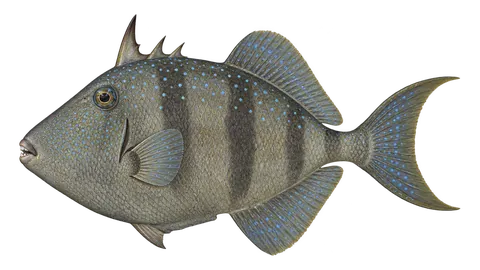
Elongated body, very flattened on the sides, olive to gray, with irregular blue lines and spots and small black dots on the head and body; juveniles are brownish with dark blotches. Concave snout, small mouth turned upward, two spines on the first dorsal and a long, rounded caudal fin. The pelvic fin is rudimentary or absent. The common filefish (Aluterus monoceros) is sandy gray with brown spots and a dark tail, and has a convex snout in adults.
Also called: cangulo-pavão, cangulo-velho, peixe-porco, porquinho, scrawled filefish, tobaccofish
where found
open on the large mapWhere to look: Lagoons, outer reefs and reef edges, usually from 3 to 20 m and up to 120 m. Adults stay on deep coastal slopes; juveniles drift with algae in open sea. They wedge into reef crevices at night.
Circumtropical (FishBase). In Brazil it occurs along the whole coast, on reefs and coastal hard bottoms, from 3 to 20 m and deeper, and juveniles may appear associated with floating algae.
coast
when to fish
best season
Caught all year in tropical water; it is incidental catch and follows no fishing season.
best time of day
Daytime. Grazes by day on the reef and wedges into a crevice at night; bites happen in the sunlight hours, with small bait on the reef bottom.
what affects the scrawled filefish
cold and cold fronts
Warm-water species: a sharp drop in temperature makes the fish retreat.
atmospheric pressure
Small effect; the problem with the front is the rough sea and dirty water.
moon
Little influence on a species that feeds by day.
rain
Heavy rain and muddy water reduce visibility.
water level
Does not apply at sea. The equivalent is clear reef water.
noise
Slow and curious; only loud noise scares it off.
wind
Swell does not bother it, but strong wind stirs up sand on the shallow reef.
tide
Moderate current helps carry the bait's scent to the fish.
depth
Usually between 3 and 20 m, near the reef; also on slopes down to 120 m.
how to fish
lures
- rarely used: the fish eats algae and invertebrates
natural baits
- shrimp
- squid pieces
- pieces of algae and sea urchin
tip from an angler
The mouth is small: use a small hook and bait cut into small pieces, and be careful with the spines when releasing.
- rod
- 6' to 7', medium action, 12 to 20 lb
- spinning / baitcasting reel
- spinning reel 3000 to 4000
- line
- braided 15 to 20 lb
- leader
- fluorocarbon 20 to 30 lb, 1 m
- hook
- small hook, No. 4 to 1/0 (the mouth is small)
accessories
- long-nose pliers
- luvas
catch and release
In shallow fishing, release it quickly with long-nose pliers, without squeezing the flattened body and watching the spines on the head and belly.
rules for the scrawled filefish
Rules change; before keeping or transporting fish, check with the state environmental agency.
Mexico: up to 5 per species and 10 saltwater fish per day
5 specimens of the species per angler per day, within the limit of 10 saltwater fish details
In recreational sport fishing in Mexican federal waters, each angler may keep up to 10 marine fish per day, with a maximum of 5 of the same species. The scrawled filefish (lija trompa) is not among the species reserved for sport fishing (marlins, sailfish, swordfish, dorado, pez gallo and tarpon) and has no limit of its own. Anything over the limit goes back alive into the water, and sport-caught fish are for personal consumption, not for sale. Anglers fishing from a boat need a Conapesca permit.
Colombia: AUNAP license and catch and release as the main practice
personal AUNAP license; keep only fish that meets the minimum size, for personal useconfirm with the agency details
Colombian sport fishing requires the personal, non-transferable AUNAP license (natural persons, nationals or foreigners). The resolution sets catch and release as the main practice and only allows keeping specimens that meet the minimum sizes, for personal use. We found no specific minimum size or marine quota for this species; confirm with AUNAP before taking any fish home.
Source: Resolución AUNAP nº 0549, of Mar 18, 2022 (sport fishing), arts. 6º and 8º
Conservation: Not on the Brazilian national list (Portaria GM/MMA nº 1.667/2026). The IUCN rates it Least Concern (2014 assessment). Note the name: the 20 cm fork-length minimum size of IN MMA No. 53/2005 applies to the Balistes triggerfish (B. capriscus and B. vetula), not to the Aluterus filefish.
how much it weighs without taking it out of the water
estimated weight
—
how we calculate
Length-weight relationship W = a·Lb (a = 0.00933, b = 2.87; FishBase (relação peso-comprimento bayesiana, estimativa da própria espécie)). It's an average: a fat or lean fish can vary by 10% to 20%.
more about the scrawled filefish
The scrawled filefish is a circumtropical monacanthid that lives in lagoons and outer reefs, usually between 3 and 20 m, but reaches 120 m. Adults usually stay on deep coastal slopes or reef edges, near 20 m, and juveniles drift with algae mats in open sea, where they can reach a good size. It eats algae, seagrass, hydroids, sea fans, colonial anemones and tunicates. It reaches 110 cm and 2.5 kg, with a common length of 55 cm. When threatened, it wedges into a reef crevice with its head spine; it is slow and easy to approach. It has small commercial use, is collected for aquariums, and there are reports of ciguatera.
Family: Monacanthidae · omnivore
fun facts
- It wedges into a reef crevice with its large head spine, held in place by a smaller spine behind it, and extends another spine on the belly to brace itself, according to the Florida Museum.
- Juveniles stay with floating algae mats in open sea for a long time and reach a good size.
- In Brazil, "cangulo" and "peixe-porco" apply to several monacanthids and balistids: confirm the species before applying size rules.
in the kitchen
There are reports of ciguatera, and the Florida Museum advises caution when eating it. Like other filefish, its skin is thick and is usually removed. If you cook it, choose small fish from a known source, and avoid large specimens from reefs with a history of ciguatera.
similar species



sources and references (8)
The season weights (months), the time of day and the sensitivities (cold, pressure, moon, wind, rain, tide, strong light, murky water and noise) are the app's editorial estimates, based on the literature below and on the field experience of anglers and guides. They are not official data nor a measurement made for this species, and they may vary by region and year. Closed seasons and legal rules appear in the rules section, with the norm and a link.
- scientific FishBase: Aluterus scriptus (ficha da espécie)Size, length-weight, depth, habitat, distribution, biology, and IUCN status. Page checked on Oct 13, 2026.
- scientific FishBase: nomes populares de Aluterus scriptusNames by country and language.
- official Portaria GM/MMA nº 1.667, de 27 de abril de 2026: Lista Nacional Oficial de Espécies da Fauna Ameaçadas de Extinção (peixes e invertebrados aquáticos)The species is not on the list. Checked in the DOU of April 28, 2026.
- official Portaria MPA nº 532, de 23 de setembro de 2025: nomes científicos e nomes comuns das principais espécies de peixes de interesse comercialAnnex: "Aluterus spp.", names "Cangulo", "Peixe-Porco", "Peroá" and "Porquinho" (checked in the Annex text). The names "cangulo-pavão" and "cangulo-velho" come from FishBase.
- scientific Florida Museum: Scrawled Filefish (Aluterus scriptus)Appearance, habitat, behavior of wedging into crevices, diet, uses and caution regarding ciguatera. Page checked Oct 13, 2026.
- official NOM-017-PESC-1994 e sua modificação: pesca deportivo-recreativa em águas de jurisdição federal do MéxicoItem 4.9.1: up to 10 marine fish per angler per day, no more than 5 per species. The original text (DOF May 9, 1995) was also read at https://platiica.economia.gob.mx/normalizacion/wp-content/uploads/sites/2/PDF_Normas_Publicas/017-pesc.pdf.
- official Resolução AUNAP nº 0549, de 18 de março de 2022: lineamentos para a pesca esportiva e recreativa na ColômbiaSummary of articles 6 (license) and 8 (catch and release, minimum sizes). We did not check the per-species quota and size values, which depend on the full text.
- official Instrução Normativa MMA nº 53, de 22 de novembro de 2005: tamanhos mínimos de captura no litoral do ES ao RSThe species is not in Annexes I and II (checked in the consolidated reproduction of the rule), so there is no federal minimum size under that rule. We found no other federal minimum-size rule or specific quota for the species.
how we calculatewhere each number comes from
The weather comes from three independent global models, cross-checked hour by hour: when they agree, confidence goes up; when they diverge, the band between them shows on the chart. Beyond 16 days, we use the GEFS ensemble of 31 simulations: if 20 of the 31 predict rain, the chance of rain is 65%. Sun and moon are calculated astronomically, with no uncertainty.
The index adds up, weighted for each species: time of day (species curve anchored to real sunrise and sunset), moon (transits, rise and set, phase), pressure (3 h trend and 24 h swing), water temperature (in rivers, estimated from air temperature; at sea, estimated by an ocean model), wind, rain, clouds, tide and the month in the species' cycle.
sources for this lookup
how accurate the forecast is
Accuracy measured in the reference project (4 regions, 93 days, forecast vs. observed): maximum temperature is off by 0.6 °C on average the next day and 1.7 °C at 7 days; rain of 5 mm or more is detected 76% of the time the next day and 57% at 7 days. Detection isn't everything: the false alarm rate isn't published here yet, and 93 days in 4 regions is still a small sample. We now also measure every day, at the app's destinations: