

- common size
- 30–45 cm
- maximum
- 65 cm
- common weight
- 0.5–1.6 kg
- record/max.
- 6.1 kg
- depth
- 5–30 m
- ideal water
- 24–28 °C

the right time
to be on the water
Choose the place and the species. The index, from 0 to 100, combines weather, sun, moon and tide with each fish's habits. Up to 28 days, with each day's confidence.
Loading the forecast…
—
Looking for alerts within 30 km…
Looking for what anglers have logged near here…
what you need to fish herelicense, certification and boat documents
fish likely at this spot
Tap a fish to see its forecast.
hour by hour
slide your finger or mouse over the chart to see each hoursee hour-by-hour table
why this index at —?
choose the day
the fishing month at a glance
what's the best window for the crew?
Choose how many fishing days. We compare each stretch by its average index, discount days with a warning or closed season, and show the 3 best.
trend for the coming weeks
Line: the middle value of 31 simulations of the American GEFS model. Band: where 8 out of 10 fall. Narrow, firm trend; wide, high uncertainty.
everything about the ocean triggerfish
how to recognize it
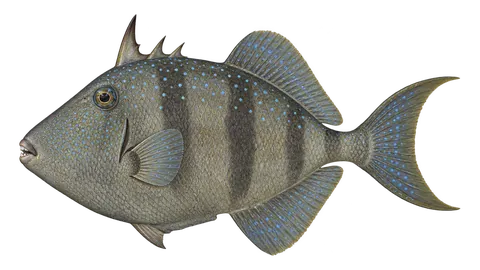
Tall-bodied filefish, grayish brown, with a large dark brown blotch at the base of the pectoral fins. The soft dorsal and anal fins have long leading edges, with rays almost as long as the head, and the tail has two concavities (double-emarginate). Three spines in the first dorsal; 25 to 28 rays in the second dorsal and 23 to 25 in the anal. The peixe-porco (Balistes capriscus) is lighter, with spots, and lacks the blotch on the pectoral fin. Other dark filefish, such as Melichthys niger, are also called cangulo-preto.
Also called: cangulo-preto, cangulo-guiné, cangulo-garoupa, peixe-porco, ocean triggerfish
don't confuse with:
where found
open on the large mapWhere to look: Edge of ocean reefs facing deep sea and open water, near the surface; often under sargassum patches and drifting objects.
In Brazil, the latitude range given by FishBase (up to 17°S) covers the North and Northeast, and the species is known to fishers in Ceará and Pernambuco. FishBase also cites the St. Peter and St. Paul Archipelago. In Latin America, FishBase's country list includes the Bahamas, Belize, Cuba, the Dominican Republic, Haiti, Jamaica, Puerto Rico and Trinidad and Tobago.
coast
when to fish
best season
Fished all year in tropical water; it does best with calm seas and warm water, from late spring to summer.
best time of day
Daytime. Active by day, especially with calm seas and blue water; at night it retreats and disappears from the baits.
what affects the ocean triggerfish
cold and cold fronts
Warm-water fish: it moves deeper and becomes scarce when the water cools.
atmospheric pressure
Small effect.
moon
Small effect.
rain
Little effect in open sea; muddy river water pushes the fish away from shore.
water level
Does not apply at sea. The equivalent is clear blue water at the edge of the reef.
noise
Small effect.
wind
Rough seas make it hard to stay over the reef edge and follow the drifting sargassum.
tide
The current that runs along the reef edge brings plankton and gathers fish.
depth
From 5 to 30 m for most catches, nearer the surface under sargassum.
how to fish
lures
- jig of 20 to 60 g
- silicone bait imitating shrimp or small squid
natural baits
- squid strips
- shrimp
- fish pieces
tip from an angler
Near sargassum and drifting objects, lower the small bait to midwater and retrieve slowly with pauses. Once hooked, it locks its dorsal spine and slips into crevices if there is reef nearby.
- rod
- 6'6" to 7', medium to fast action, 12 to 30 lb
- spinning / baitcasting reel
- 3000 to 5000 spinning reel
- line
- braid 20 to 30 lb
- leader
- fluorocarbon 30 to 50 lb, 80 cm to 1 m (teeth cut thin line)
- hook
- single 1/0 to 3/0, short and with a strong shank; small treble hook on the jig
accessories
- alicate
- luvas
- boga-grip
catch and release
Hold it from the side, away from the mouth (the teeth are strong). The first dorsal spine locks upright and only lowers when the second one, the trigger, is pressed. Release it quickly, with its head in the water.
rules for the ocean triggerfish
Rules change; before keeping or transporting fish, check with the state environmental agency.
Puerto Rico (federal waters): up to 5 per person per day
5 per person per day; 15 per boat with 3 or more people details
In federal waters around Puerto Rico (outside territorial waters, from 9 miles offshore), recreational anglers may keep a maximum of 5 fish per day in total from angelfish, grunts, jacks and other carangids, surgeonfish, filefish and wrasses (up to 15 per boat when 3 or more people are aboard; no more than 1 surgeonfish per person). The ocean triggerfish (cangulo-preto) is part of the filefish complex in the federal management plan. The limit does not apply to anyone holding a commercial license from Puerto Rico or the US Virgin Islands.
Source: 50 CFR 622.444(a)(2) (NOAA Fisheries, US), wording from 90 FR 26940, of Jun 25, 2025
Conservation: Not on the Brazilian national list (Portaria GM/MMA nº 1.667/2026). In 2025, a US federal rule reduced the annual catch limits for the filefish complex (cangulo-rei, peixe-porco and cangulo-preto) around Puerto Rico.
how much it weighs without taking it out of the water
estimated weight
—
how we calculate
Length-weight relationship W = a·Lb (a = 0.0263, b = 2.89; FishBase (relação peso-comprimento bayesiana, estimativa da própria espécie)). It's an average: a fat or lean fish can vary by 10% to 20%.
more about the ocean triggerfish
The ocean triggerfish (cangulo-preto) is an open-water filefish, common near reef edges that drop to deep sea. In the western Atlantic it ranges from Massachusetts and Bermuda to northern South America; it also occurs at Atlantic islands in the central and eastern Atlantic, such as St. Peter and St. Paul, Ascension, St. Helena, Cape Verde and São Tomé. It lives from 5 to 60 m, almost always 5 to 30 m, alone or in small groups in open water, often near sargassum. It eats mostly large zooplankton. It reaches 65 cm and 6.1 kg and is caught for sport and commercially. Artisanal fishers in Ceará and Pernambuco call it by several cangulo names, including cangulo-preto.
Family: Balistidae · predator
fun facts
- Usually seen near sargassum, in drifting patches.
- FishBase records the ocean triggerfish as a sport fish and as an aquarium fish, sold commercially.
- Unlike the king filefish, it spends much of its life in open water and eats large zooplankton instead of sea urchins.
in the kitchen
White, firm flesh, good eating, but without the fame of the king filefish. Remove the thick skin before preparing. On Caribbean reefs, reef fish can cause ciguatera; ask local fishers.
similar species


sources and references (6)
The season weights (months), the time of day and the sensitivities (cold, pressure, moon, wind, rain, tide, strong light, murky water and noise) are the app's editorial estimates, based on the literature below and on the field experience of anglers and guides. They are not official data nor a measurement made for this species, and they may vary by region and year. Closed seasons and legal rules appear in the rules section, with the norm and a link.
- scientific FishBase: Canthidermis sufflamen (ficha da espécie)Size, length-weight, depth, habitat, distribution, biology and IUCN status. Page checked Oct 13, 2026. FishBase does not report the common length; the common size range is an editorial estimate.
- scientific FishBase: nomes populares de Canthidermis sufflamenNames by country and language.
- official Portaria GM/MMA nº 1.667, de 27 de abril de 2026: Lista Nacional Oficial de Espécies da Fauna Ameaçadas de Extinção (peixes e invertebrados aquáticos)The species is not on the list. Checked in the DOU of April 28, 2026.
- scientific Pinto, M. F.; Mourão, J. S.; Alves, R. R. N. (2015). Use of ichthyofauna by artisanal fishermen at two protected areas along the coast of Northeast Brazil. Journal of Ethnobiology and Ethnomedicine.Common names recorded from artisanal fishers in Tamandaré (PE) and the Batoque Extractive Reserve (CE).
- official 50 CFR Part 622, Subpart S: FMP for the EEZ around Puerto Rico (NOAA Fisheries, EUA), § 622.444(a)(2), redação de 90 FR 26940 (25/06/2025)Recreational catch limit in federal waters around Puerto Rico and species list from the management plan. Text checked Oct 13, 2026.
- official NOAA Fisheries: Final rule to modify annual catch limits for the triggerfish complex in federal waters around Puerto RicoThe complex includes the queen triggerfish, the gray triggerfish (peixe-porco) and the ocean triggerfish (cangulo-preto); in force since July 25, 2025. Checked Oct 13, 2026.
how we calculatewhere each number comes from
The weather comes from three independent global models, cross-checked hour by hour: when they agree, confidence goes up; when they diverge, the band between them shows on the chart. Beyond 16 days, we use the GEFS ensemble of 31 simulations: if 20 of the 31 predict rain, the chance of rain is 65%. Sun and moon are calculated astronomically, with no uncertainty.
The index adds up, weighted for each species: time of day (species curve anchored to real sunrise and sunset), moon (transits, rise and set, phase), pressure (3 h trend and 24 h swing), water temperature (in rivers, estimated from air temperature; at sea, estimated by an ocean model), wind, rain, clouds, tide and the month in the species' cycle.
sources for this lookup
how accurate the forecast is
Accuracy measured in the reference project (4 regions, 93 days, forecast vs. observed): maximum temperature is off by 0.6 °C on average the next day and 1.7 °C at 7 days; rain of 5 mm or more is detected 76% of the time the next day and 57% at 7 days. Detection isn't everything: the false alarm rate isn't published here yet, and 93 days in 4 regions is still a small sample. We now also measure every day, at the app's destinations: